On October 30, 2026, Binance suffered a breach estimated at US$6.3 billion—the largest crypto heist in history. For a finance lead paying global team members in crypto, this isn’t just another exchange headline. It’s a direct hit to crypto payroll provider risk: wages aren’t instant on-chain transfers; they spend hours or days sitting in a custodian’s wallet before reaching an employee. The Binance hack forces a reckoning that most payroll guides skip—your stablecoin payroll exposure is a custodial recovery problem, not merely a technology one.
Table of Contents
- What just happened: the $6.3 billion Binance hack
- Why the Binance hack changes crypto payroll provider risk
- Background: how crypto payroll actually moves money
- Four questions to ask your crypto payroll provider after the hack
- Concrete implications and recommended actions
- What a safer crypto payroll setup looks like
- What to watch next and open questions
- Frequently Asked Questions
- Key Takeaways
- Sources
What just happened: the $6.3 billion Binance hack
The reported scale and attribution risk
According to The Business Times on November 8, 2026, Binance itself estimates the breach at US$6.3 billion, making it crypto’s biggest heist. While details of the attack vector remain sparse, the publication notes that if North Korean hackers are responsible—as early reports suggest—recovery will depend heavily on token issuers’ willingness to roll back or reissue assets, and on international police cooperation. That’s a frightening proposition for any organization with payroll funds caught in the middle.
Why Binance's 'we'll cover losses' promise isn't a guarantee
Binance has publicly committed to covering all user losses. But as the Business Times letter to the editor points out, a promise is not a guarantee. Smaller platforms, and even large ones facing liquidity crunches, may be unable to pay. For payroll providers that rely on an underlying exchange (Binance itself, or another), the question isn’t whether they intend to make clients whole—it’s whether they legally must, and from what pool of assets.
The legal venue that decides recovery: Abu Dhabi Global Market law
Recovery claims against Binance would be pursued abroad. Its terms are governed by Abu Dhabi Global Market (ADGM) law, with disputes arbitrated there. This means your company’s payroll funds—potentially subject to US, EU, or Singaporean employment laws—would be caught in a foreign legal framework, with all the cost and time that implies. The Business Times piece cites Singapore’s Quoine v B2C2 (2020) case to underscore a critical principle: whether an exchange holds customer crypto on trust determines if those assets are protected from the exchange’s creditors. If not held on trust, they’re just part of the exchange’s general pool—and payroll funds become unsecured claims in an insolvency.
Why the Binance hack changes crypto payroll provider risk
Your payroll funds don’t live in an employee’s wallet during the process. Between the fiat on-ramp and the final destination, money parks in a provider’s or exchange’s omnibus wallet—often for hours, sometimes overnight. That’s the precise window the Binance hack exploited. If your provider or its custodian gets hacked, you’re responsible for recovery, not your employees. The counterparty risk lives in the custody agreement, not the compliance checklist. Automation moves money; custody decides who owns it during those transit windows. A provider that merely integrates with an exchange to automate USDC swaps still exposes you to that exchange’s balance sheet. Crypto payroll compliance with KYC/AML, while essential, doesn’t equal safety in a breach.
Background: how crypto payroll actually moves money
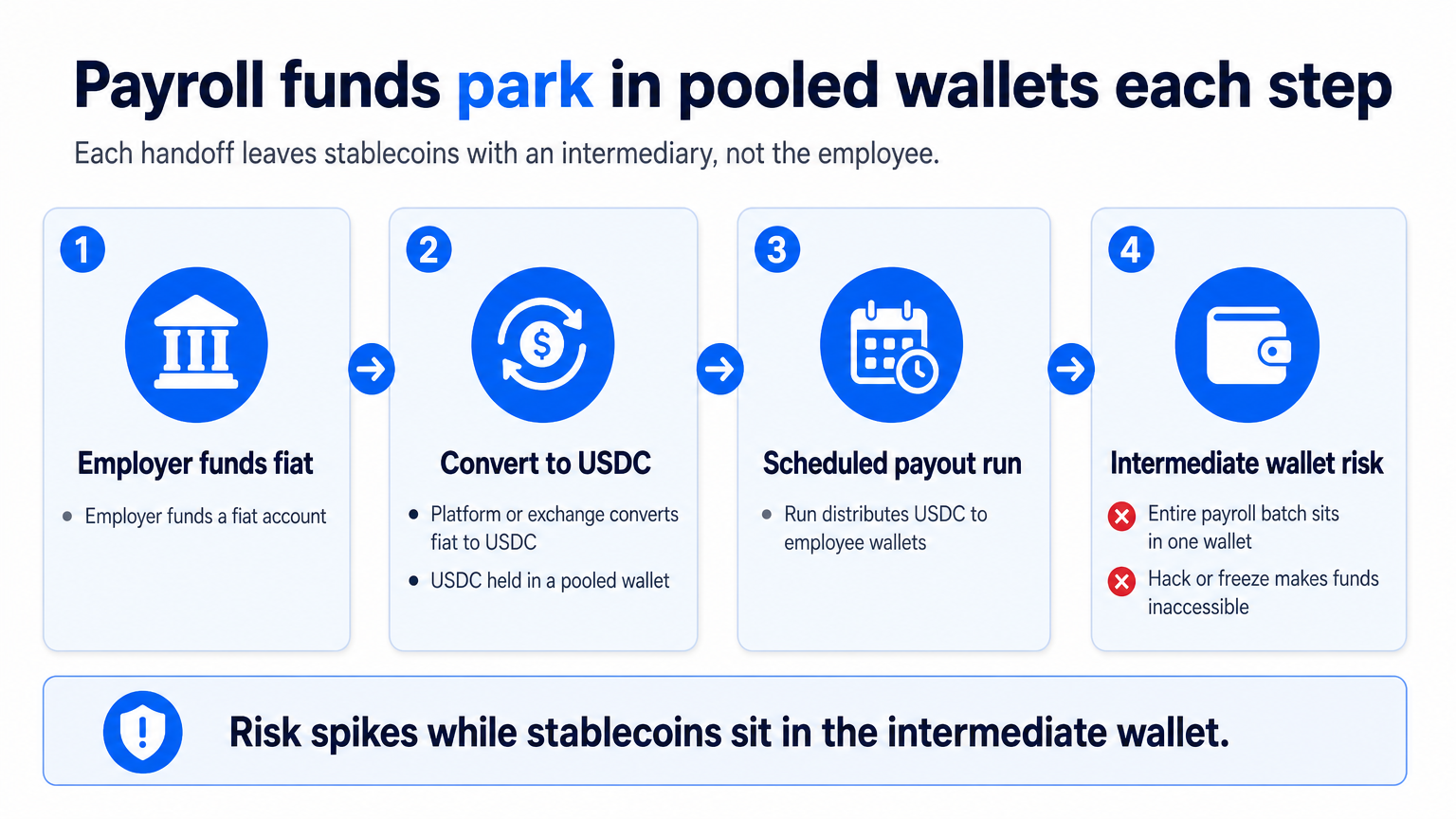
Typical flow: employer funds a fiat account. The platform or an exchange converts that to USDC and holds it in a pooled wallet. Scheduled payout runs then distribute USDC to employee wallets. At each step, funds sit somewhere. The risk spike comes while stablecoins sit in the intermediate wallet. If the custodian is hacked or frozen, the entire payroll batch becomes inaccessible. As crypto payroll volumes grow, this liquidity pool becomes an increasingly tempting target.
Four questions to ask your crypto payroll provider after the hack
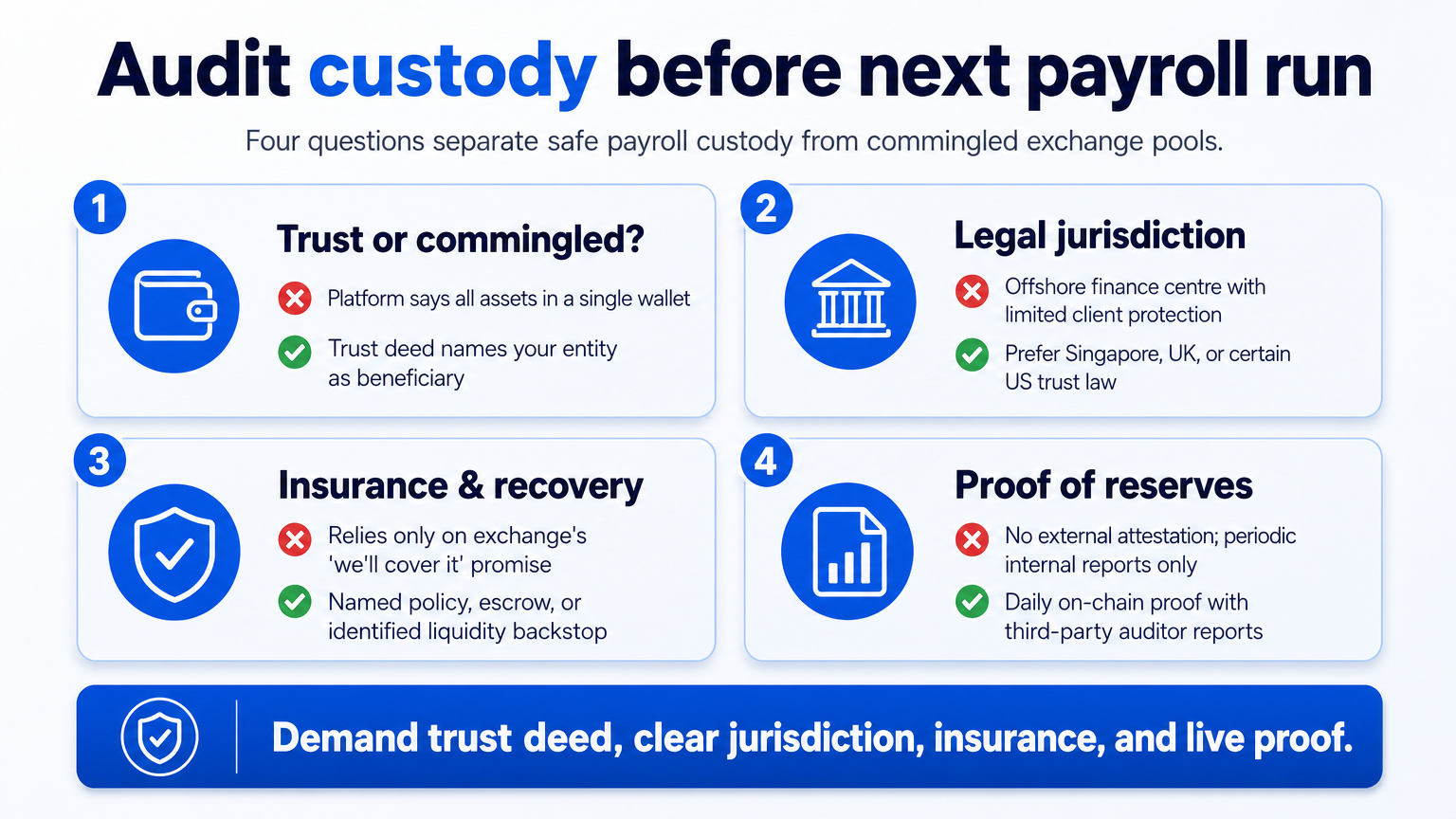
Use this checklist before your next payroll run.
Are payroll crypto assets held on trust or commingled?
Ask to see the trust deed or legal opinion. Without a trust, your payroll is just an unsecured claim. As the Quoine case reminds us, the difference is everything if the platform becomes insolvent.
Which legal jurisdiction and arbitration clause govern your funds?
Even if your provider is incorporated in a friendly jurisdiction, the underlying custodian may operate under ADGM law, as Binance does. That mismatch can leave you enforcing a payroll claim in a forum far from your employment contracts.
What insurance or recovery process covers an exchange or custodian failure?
Don’t accept “we have insurance” without seeing the policy’s scope. Does it cover theft by state-backed actors? What are the sub-limits? If North Korean hackers are indeed responsible for the Binance hack, typical cyber policies may exclude nation-state attacks.
Can you see real-time proof of reserves or segregated accounts?
A vendor that cannot produce an on-chain attestation for your payroll deposit is effectively asking you to trust their internal ledger. Post-hack, that’s no longer acceptable.
Concrete implications and recommended actions
Map exactly where your USDC sits from the moment fiat leaves your bank until it hits employee wallets. For most platforms, that’s a single exchange integration—the same single point of failure the Binance hack exploited. Route through institutional-grade custody that uses multi-party computation (MPC) and segregated crypto accounts. Platforms that offer free USDC transactions and Fireblocks-backed custody keep the payroll batch away from hot wallets. Work with legal counsel to document your recovery path now. If the answer is “arbitration in ADGM,” factor that into your risk tolerance.
What a safer crypto payroll setup looks like
Segregated multi-currency accounts that hold fiat and USDC side by side, with instant conversion, remove the need to park large sums on an exchange for days. When a provider uses Fireblocks-backed custody—digital assets secured in MPC-based wallets with policy controls—the payroll batch never touches a hot wallet that can be drained in a single exploit. Mandatory MFA, digital KYC onboarding, and real-time transaction visibility are now table stakes. OneSafe, for example, combines all of these: segregated global accounts, Fireblocks-based custody for DAO and business assets, free USDC flow, and a payroll-friendly infrastructure that treats crypto payroll custody as a legal and security question, not just a speed feature.
What to watch next and open questions
If token issuers freeze or reissue assets after the Binance hack, legitimate payroll distributions could be disrupted. Post-hack, the most credible providers will publish legal opinions on trust status, proof-of-reserves dashboards, and insurance details. FinCEN’s MEXC ban already forced platforms to get serious about counterparty risk; the Binance hack will accelerate demand for transparency on custody. Until regulators impose trust accounting rules on crypto payroll taxes and wage handling, the onus remains on employers to negotiate that protection. Services like Joyrise—which Joyrise plans, writes and publishes illustrated SEO articles to your Webflow blog every day—can help teams stay informed as this landscape evolves.
Frequently Asked Questions
What is crypto payroll?
Crypto payroll means paying employees, contractors, or freelancers in digital assets—typically stablecoins like USDC—automating conversion and distribution to individual wallets.
Is crypto payroll safe after the Binance hack?
Yes, but only if you audit the custody arrangement. Safety hinges on whether payroll funds sit in segregated, trust-based accounts or in a commingled exchange pool.
What happens to payroll crypto if a provider or custodian is hacked?
If assets were held on trust and segregated, they may be recoverable outside the custodian’s bankruptcy estate (as Quoine v B2C2 illustrates). If commingled, payroll funds become a general unsecured claim, often leading to lengthy, uncertain proceedings abroad.
How do stablecoins reduce risk in USDC payroll?
Stablecoins like USDC eliminate Bitcoin’s volatility, so an employee’s wage doesn’t swing in value between transfer and off-ramp. They don’t reduce custody risk, but they speed settlement and can enable free deposit/withdrawal on platforms that support them natively.
Is it legal to pay employees in crypto?
In many jurisdictions, yes—subject to wage-and-hour laws, minimum wage in fiat terms, and proper crypto payroll tax withholding. You must value the crypto at fair market value on the pay date, withhold applicable taxes, and meet local labor regulations.
How is crypto payroll taxed?
Employers treat crypto wages as ordinary income, withholding based on the USD value at payment time. Employees owe income tax and payroll taxes; the employer reports on W-2s or 1099s accordingly. Later sales may trigger capital gains.
What should finance leads check before choosing a crypto payroll provider?
After the Binance hack, the top checks are legal ownership structure (trust vs. commingled), custodial architecture (segregated accounts), jurisdiction and arbitration clause, insurance and recovery process, and real-time proof of reserves. Traditional speed and fee comparisons are secondary.
Key Takeaways
- The $6.3B Binance hack shows that crypto payroll risks are custodial, not technological—wages sit with an intermediary, and a hack can vaporize that entire batch.
- A provider’s promise to cover losses is only as strong as its legal structure; if assets aren’t held on trust, your payroll may become an unsecured claim in a distant arbitration forum.
- Demand proof of segregation, trust-based legal ownership, and real-time reserves from any payroll provider—compliance alone is not protection.
- Stablecoin payroll reduces volatility but doesn’t eliminate counterparty risk; choose a setup that uses institutional-grade custody with segregated accounts.
- Document your legal recovery path now, before a loss—know which jurisdiction governs your funds and whether you can enforce a claim quickly.
Start paying your global team with the security of segregated, Fireblocks-backed custody and free USDC flows—open a OneSafe business account today.
Sources
- Crypto Payroll & Global Stablecoin Payouts
- Best Crypto Payroll Platforms 2026: Compared | Support - Eco
- Crypto Payroll: Borderless On-Chain Payroll for Global Teams
Get started with Crypto in minutes!
Get started with Crypto effortlessly. OneSafe brings together your crypto and banking needs in one simple, powerful platform.