Reasons undisclosed for 1 in 10 delisted crypto assets
Other exchanges disclosed reasons for the same assets
Self-regulation cited as a problem... Calls grow for legal oversight
Delisting criteria vary among domestic cryptocurrency exchanges. Even for the same cryptocurrency, some exchanges disclose the reason for delisting while others do not, and a cryptocurrency delisted on one exchange may continue to trade openly on another. There are growing calls to regulate procedures such as reviews of trading support and its termination through legislation rather than self-regulation, in order to prevent this fragmented system.
[Image source: Yonhap News]
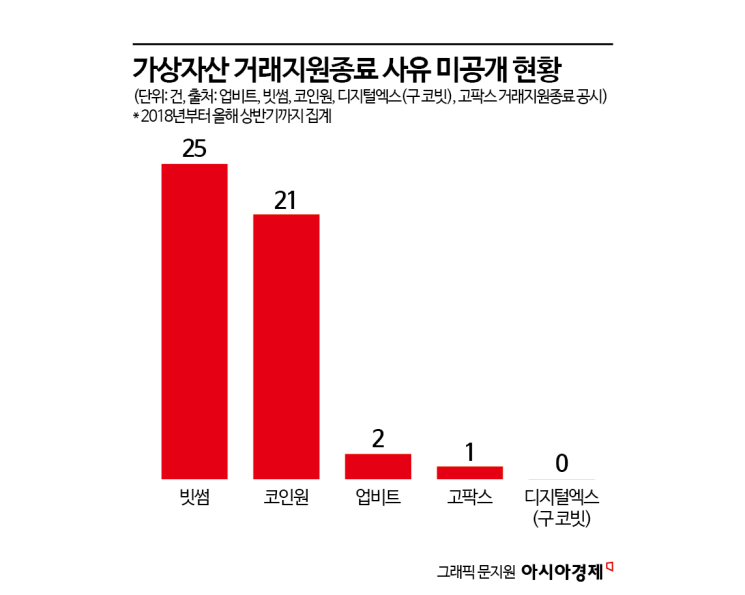
According to “An International Comparison of Cryptocurrency Trading Support Termination Systems and Recommendations for Domestic Improvements,” published in the Financial Supervisory Research journal by the Financial Supervisory Service on November 10, of the 448 notices of trading support termination (delisting) for cryptocurrencies traded on Korea’s five major exchanges, including Upbit and Bithumb, from 2018 through the first half of 2026, 49 (10.9%) did not disclose the reason for termination.
The number of cases in which the reason for termination was not disclosed was 25 on Bithumb, 21 on Coinone, 2 on Upbit, 1 on GOPAX and 0 on Digital X (formerly Korbit). Notably, 10 of Bithumb’s 25 cases involved cryptocurrencies for which other exchanges had provided specific reasons for termination. In other words, exchanges differed in whether they disclosed the reason, even for the same cryptocurrency.
According to figures compiled by the Financial Services Commission, there were 11,175,000 user accounts eligible to trade in Korea as of the first half of 2026. This means that more than one in five people in the country had an account. In Korea, where the corporate market is closed off and a retail-investor-centered market has formed, terminating trading support for a particular cryptocurrency deprives users of the opportunity to sell that asset on the exchange. In other words, individual investors bear the losses resulting from trading support termination.
Exchanges also differed in how much time they gave users to respond to such potential losses. The warning period is the time from when a cryptocurrency is designated as requiring caution until trading support is actually terminated. The median warning period was 41 days. Investors had to decide during those 41 days whether to sell the cryptocurrency. The warning period was only 17 days on Upbit, compared with 90 days on GOPAX, a substantial difference.
The timing of trading support termination also varied for the same cryptocurrency. Among the 334 types of cryptocurrencies listed in termination notices, there were 354 cryptocurrency groups whose trading support was terminated within 30 days. Only 54 cryptocurrencies (15.3%) were delisted jointly across exchanges. Two cryptocurrencies were delisted jointly on all five exchanges, 7 on four exchanges, 18 on three exchanges and 27 on two exchanges. Terminations on a single exchange accounted for 300 cases (84.7%).
Procedures such as trading support termination differ from one exchange to another because, in Korea, they have not been governed by law and have remained subject to self-regulation. At present, no legislation regulates review criteria, notification periods or procedures for approving or terminating trading support for individual cryptocurrencies. The main laws relating to cryptocurrencies, including the Act on Reporting and Using Specified Financial Transaction Information and the Act on the Protection of Virtual Asset Users, focus on regulations such as business entry requirements, anti-money laundering and the protection of user assets.
Unlike Korea, other jurisdictions regulate procedures such as trading support termination by law. Under the European Union’s (EU) Markets in Crypto-Assets Regulation (MiCA), exchanges are required to establish operating rules covering the approval and provision of cryptocurrency trading support, the conditions for maintaining it and the conditions for suspending trading. The regulation also grants supervisory authorities oversight and investigative powers. In Hong Kong, the Securities and Futures Commission (SFC) supervises exchanges under the Securities and Futures Ordinance and the Anti-Money Laundering and Counter-Terrorist Financing Ordinance, and sets criteria for providing and terminating trading support through operating guidelines for operators.
Hot Picks Today
- The Era of Getting 200 Million Won After 30 Years Is Over... A Japanese Bank's "Perpetual Department Head" Who Just Clocked In Cries Out
- Spain Hit by Its Worst Tragedy... Lee Kangin, Moreno and Real Madrid Join Soccer World in Mourning
- They Said, “Make It Your Home for Life” - Then Suddenly Kicked 200 Passengers Off... What Happened to the Around-the-World Cruise?
- "130 Rice Bowls Sold Out in a Day"... 'Unfiltered Face' Adds 8 Million Won to Night Market Sales: China's Bungeunwoo
Cho Gwanghyeon, an adjunct professor in the Department of Fintech and Blockchain at Dongguk University’s Graduate School, said, “Trading support termination is an important aspect of investor protection because it can limit users’ opportunities to sell their assets and lead to losses.” He added, “The legal basis for regulation should be established by incorporating provisions on review criteria and procedures for approving, maintaining and terminating trading support into the Act on the Protection of Virtual Asset Users in the short term and into the Digital Asset Basic Act, which governs the cryptocurrency trading business, in the long term, and by linking these provisions to supervisory enforcement.”
© The Asia Business Daily. All rights reserved. Unauthorized AI training and use prohibited.