Blockchain, designed to break free of the existing monetary order,
is paradoxically embedding the dollar deeper in finance
Analysts say the expansion of blockchain-based transactions could reinforce the dollar-centered international financial order. Although the way funds move between countries is changing, the currencies used in transactions remain concentrated in dollars. This trend is taking shape as new payment services using tokenized dollar deposits emerge and dollar-pegged stablecoins lead the market.
According to financial industry sources on November 20, global investment bank JPMorgan and Singapore’s DBS Bank recently launched a service that connects their blockchain-based payment networks to transfer tokenized dollar deposits across borders in real time. The service allows companies in the United States and Singapore to send and receive dollars regardless of bank operating hours. The first company to use the service is Ant International, a payments company affiliated with China’s Ant Group.
This is drawing attention because dollars, the main currency in the existing international financial market, are also being used on new payment networks that leverage blockchain. Connecting payment networks operated by different banks improves the efficiency of cross-border fund transfers while keeping the transaction currency in dollars. This case shows that the growth of on-chain finance does not necessarily weaken the dollar-centered financial order.
Alongside tokenized deposits, stablecoins pegged to the value of the dollar are also widely used on-chain. According to an analysis published on November 6 by global credit rating agency Moody’s Ratings, 99.5% of the global stablecoin market capitalization consists of assets pegged to the dollar. Stablecoins pegged to other currencies, such as the euro, are also being issued, but dollar-pegged assets appear to have the advantage in liquidity and use cases. Moody’s also noted, “The infrastructure supporting stablecoins is concentrated among a small number of operators,” adding that “Ethereum and Tron are major payment networks, with more than 80% of all stablecoins in circulation on the two networks.”
A financial industry official said, “Because the dollar is so widely used across the market, a dollar-centered ecosystem is naturally taking root on-chain as well. In places where confidence in the local currency is low, people want to convert money they have into dollar stablecoins and hold them.” The official added, “As more people use dollar stablecoins, network effects emerge: transactions become easier and the number of places where they can be used increases.”
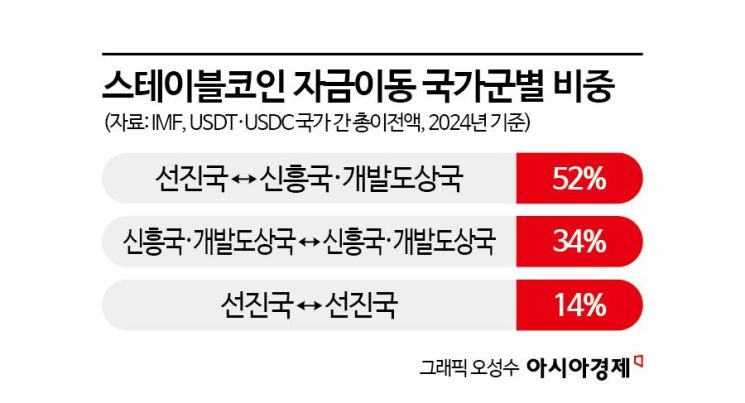
According to a study published last month by the International Monetary Fund (IMF), in 2024, transfers between advanced economies and emerging market and developing economies accounted for 52% of the total cross-border transfer value of USDT and USDC, while transfers among emerging market and developing economies accounted for 34%. The IMF analyzed that the wider use of stablecoins pegged to foreign currencies such as the dollar could deepen so-called “digital dollarization,” in which the use of local currencies declines. It said foreign-currency stablecoins can be held and transferred easily across borders, potentially spreading currency substitution faster and more widely than traditional cash or foreign-currency deposits.
Hot Picks Today
- The Era of Getting 200 Million Won After 30 Years Is Over... A Japanese Bank's "Perpetual Department Head" Who Just Clocked In Cries Out
- Spain Hit by Its Worst Tragedy... Lee Kangin, Moreno and Real Madrid Join Soccer World in Mourning
- They Said, “Make It Your Home for Life” - Then Suddenly Kicked 200 Passengers Off... What Happened to the Around-the-World Cruise?
- "130 Rice Bowls Sold Out in a Day"... 'Unfiltered Face' Adds 8 Million Won to Night Market Sales: China's Bungeunwoo
Park Seongje, a researcher at Shinhan Securities, said, “Blockchain was created to break away from the existing monetary order, but dependence on the dollar has instead increased. The network has become decentralized, but the monetary benchmark has once again become centralized.” He added, “The fact that decentralized technology has become a tool for expanding the influence of existing currencies rather than disrupting the monetary order is connected to why the United States views stablecoins as strategic financial infrastructure.”
© The Asia Business Daily. All rights reserved. Unauthorized AI training and use prohibited.