On November 20, 2026, EY published a report signaling that blockchain payments have moved decisively from exploration to active implementation across enterprises. For CFOs and finance leads, that single data point rewrites the timetable for crypto treasury management—no longer a future proof-of-concept, but an operational capability that must be built now. The teams that get it right will run payments faster and cheaper; those that wait will find themselves managing a fragmented treasury stack while competitors already run live stablecoin rails. This article interprets the EY finding and delivers a concrete playbook for taking a treasury from zero to operational, anchored in the real capabilities of a platform that already bridges fiat and crypto natively.
Table of Contents
- The Trigger: Blockchain Payments Cross the Implementation Line
- The Backbone: What Crypto Treasury Management Actually Demands
- The Playbook: Taking a Treasury from Zero to Operational
- The Cost Equation: Where Teams Save and Leak
- What to Watch Over the Next 12 Months
- Start With Infrastructure That Doesn’t Force a Fork
- Key Risks and Practical Questions
- Key Takeaways
The Trigger: Blockchain Payments Cross the Implementation Line
EY’s report identifies that enterprises are leaving behind years of pilots and publicly committing to production blockchain payment flows. The report highlights scaled use of stablecoins for cross-border supplier settlements, intracompany transfers, and payroll, noting that the technology stack, regulatory clarity, and institutional-grade custody are now sufficient for live operations. For treasury teams, the question has shifted from whether to how quickly.
The signal lands at a moment when regulatory guardrails have firmed up. The OCC’s interpretive letter on stablecoin payments made it clear that national banks can use public blockchains for payment activities (see our analysis on Stablecoin Payments: What the OCC’s Approval Means), and global frameworks are crystallizing. The cost of inaction is rising: companies that operationalize crypto treasury management today capture speed and cost advantages, while late adopters face a steep learning curve when counterparties demand stablecoin rails. A unified treasury infrastructure is now a boardroom priority.
The Backbone: What Crypto Treasury Management Actually Demands
A live blockchain treasury ties together three functions that in traditional finance are separate: instant liquidity (fiat and stablecoin), safeguarding assets through institutional-grade custody, and a real-time compliance trail for KYB/AML. Sending a stablecoin payment to a supplier triggers fiat-to-USDC conversion, an on-chain transfer, and a simultaneous ledger entry—all while creating a regulator-ready record. A patchwork of bank portal, exchange login, and hardware wallet cannot deliver this as a seamless workflow. The Stripe guide on crypto treasury management frames these activities as interdependent, requiring integrated technology.
This differs fundamentally from traditional treasury. Legacy batch processing and T+2 settlement give way to near-instant settlement and 24/7 operations. A treasury running stablecoin payouts on Solana must monitor balances continuously, manage cryptographic keys, and understand smart-contract risk. The Deloitte report on treasury’s trajectory amid digital assets emphasizes that this demands new technical skill, processes, and regulatory awareness. End-of-day sweeps simply break under real-time flows.
The Playbook: Taking a Treasury from Zero to Operational
Choosing infrastructure
Most finance teams’ first instinct is to bolt a crypto exchange onto their existing bank and add a custodian—creating three separate interfaces, manual data re-entry, and a reconciliation headache. A unified fiat and crypto platform collapses those layers: multi-currency accounts, built-in crypto on/off-ramps, and secure digital asset custody all in one interface. OneSafe’s architecture, for instance, provides these capabilities natively—banking services via partners, Fireblocks custody, and instant fiat-to-crypto conversion—so the team logs in once, sees a single ledger, and executes from one dashboard. That design matches the real-time demands of a blockchain treasury implementation because there is no hand-off delay.
Onboarding and segregation in under a week
With fully digital KYB, a business can open a unified account within a week—OneSafe’s typical onboarding requires only formation papers and government ID (plus EIN for U.S. companies). Once onboarded:
- Create separate sub-accounts—for payroll, supplier payments, and long-term holdings—in both fiat and stablecoins.
- Assign roles and permissions. For DAOs, a 3-of-5 multisig approval for payments above a threshold can be enforced within the platform.
- Test a stablecoin send and receive, verifying on-chain addresses and that deposits and withdrawals appear without fee surprises.
Monthly close without chaos
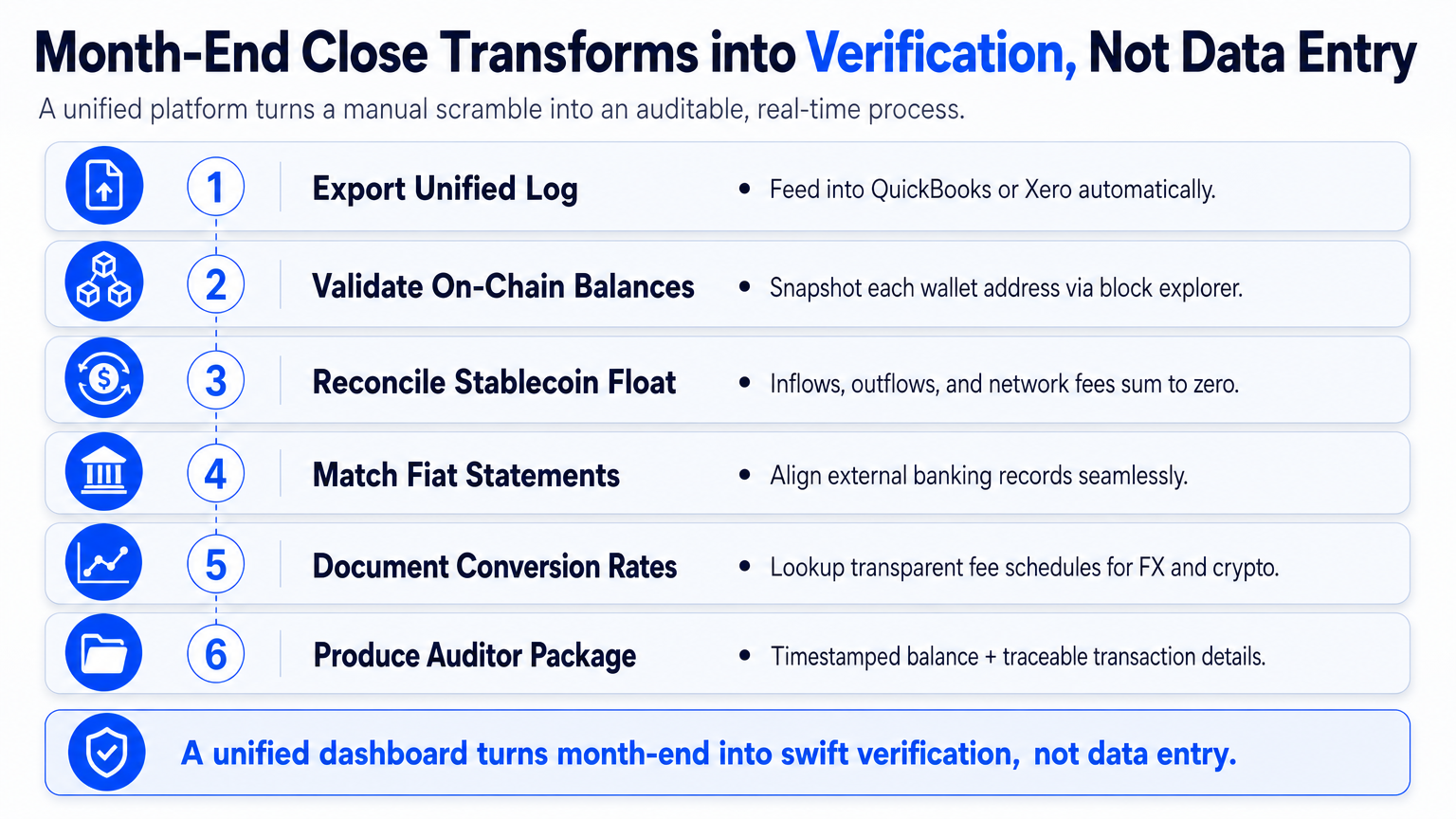
A month-end reconciliation on-chain need not mean manual spreadsheet waterfalls:
- Export the unified transaction log. OneSafe’s accounting integration feeds into QuickBooks or Xero.
- Independently validate on-chain balances via a block explorer snapshot for each wallet address. Compare with platform-reported balances.
- Reconcile stablecoin float: sum USDC inflows, outflows, and network fees. Since USDC deposits and withdrawals are free on OneSafe, the net change must exactly match.
- Match any external fiat statements.
- Document each FX and crypto conversion rate. With transparent fee schedules, this is a lookup.
- Produce an auditor package: a timestamped balance confirmation and transaction detail traceable to on-chain addresses.
Stablecoin payables that work
Pay suppliers in USDC directly when the counterparty is crypto-native, or use off-ramp cards for fiat-only suppliers. OneSafe’s virtual corporate cards, top-upable with 8+ tokens, automatically convert crypto to fiat at point of sale. Payroll can be scheduled as batch USDC payments, with the platform handling compliance checks. Commercial integrations like web3 payments via Polygon—see our piece on Polygon’s OMS integration with Nuvera—show these rails powering live B2B settlement.
The Cost Equation: Where Teams Save and Leak

Fee transparency across fiat and crypto
Fragmented setups leak money through countless small spreads. Below is a typical comparison:
A unified platform can cut cross-border payment costs by more than half compared to a traditional bank-and-exchange stack, with savings multiplying as volume grows.
Hidden operational drag
The deeper leak is operational drag. Logging into three systems to initiate one USDC payment and manually reconciling entries burns 10–15 hours per month for a $2M monthly volume. Error rates climb and month-end becomes a scramble. A unified dashboard with real-time balances turns reconciliation into verification, not data entry.
What to Watch Over the Next 12 Months
Regulatory signals
Stablecoin legislation in the U.S. will mandate specific custody and reserve requirements. The SEC defends its stablecoin oversight—read our analysis of recent enforcement signals. Platforms using qualified custodians and segregated client accounts are ahead. The collapse of a Paraguay bank servicing crypto firms—covered here—shows that a single fragile banking partner can freeze treasury operations overnight.
Beyond stablecoins
The EY report suggests tokenized money market funds and on-chain corporate bonds are the next phase of working-capital optimization. For now, most treasuries stay within stablecoin rails, but the infrastructure should be flexible enough for tokenized securities. Starting with a platform that treats fiat and digital assets natively avoids a future fork.
Start With Infrastructure That Doesn’t Force a Fork
A neo-banking platform that fuses multi-currency accounts, corporate cards, FX, and crypto on/off-ramps into one interface is the architectural answer to the EY implementation shift. OneSafe’s model—banking partners, Fireblocks custody, real-time conversion—means a single login controls the treasury, with no conceptual separation between fiat and crypto workflows. DAOs already pioneer this model: OneSafe has processed over $800 million from 1,000+ businesses across 30+ countries, many Web3 startups using the platform as a single source of truth for both fiat and crypto, integrating on-chain activity directly into accounting systems.
Key Risks and Practical Questions
What are the biggest risks? Operational security (compromised private keys), smart-contract risk, volatility (if holding non-stablecoins), and regulatory ambiguity. The most common failure point is a fragile stack of free tools that breaks under live payment volume.
Can idle stablecoin balances earn yield? Some providers promote staking or lending. The Privy guide on crypto treasury management warns that yield strategies often introduce rehypothecation, smart-contract vulnerability, and oracle failures—exposures that violate capital preservation. For operating capital, segregated custody that does not rehypothecate is safest. If yield is pursued, use only regulated, transparent, non-rehypothecating vehicles, and never with funds needed for upcoming obligations.
What does the EY shift mean for smaller finance teams? The infrastructure is mature enough for mainstream adoption. A lean team can skip the pilot phase and adopt a unified platform backed by institutional custody and compliance. A startup with two finance staff can onboard and be live with stablecoin payments in under a week—as demonstrated by the 1,000+ businesses on OneSafe.
Key Takeaways
- EY confirmed blockchain payments have shifted to enterprise implementation, making operational crypto treasury management a competitive necessity.
- Unifying fiat and crypto on a single platform eliminates fragmentation that causes cost leaks and reconciliation delays.
- A month-end close linking on-chain proof-of-control to an audit-ready ledger is achievable today with platforms that provide timestamped reports and accounting integration.
- Stablecoin payables—supplier and payroll—can be live in under a week, with corporate cards bridging crypto and fiat counterparties.
- For most treasury teams, principal preservation outweighs yield; idle stablecoin balances are safest in segregated custody.
As you build your operational treasury stack, automating routine content like this analysis can be handled by Joyrise: grow organic traffic while you sleep, which writes and publishes SEO articles to Webflow, WordPress, or Shopify daily, with your first article ready before you pay. Ready to bring your crypto treasury operations onto a single, secure platform? Open your OneSafe account today and onboard in under a week.
Get started with Crypto in minutes!
Get started with Crypto effortlessly. OneSafe brings together your crypto and banking needs in one simple, powerful platform.


