meta_description: "Chainlink CustodySync enables compliant DeFi lending with assets in custody. Learn its impact on AML, DAOs, and on-chain compliance."
The defi compliance conversation took a concrete turn on November 5, 2026, when Chainlink announced CustodySync — a solution that lets institutions tap decentralized lending markets without ever moving the underlying assets out of secure custody. The development, reported by Crypto Briefing on the same day, addresses one of the deepest tension points in DeFi compliance 2026: how to reconcile the on-chain world’s permissionless architecture with the custody, audit, and anti-money laundering (AML) obligations that regulated entities cannot shed. The answer, for the first time, appears to be a mechanism that keeps assets anchored in a qualified custodian while a verified on-chain representation does the borrowing.
Table of Contents
- What Just Happened: Chainlink CustodySync Bridges Custody and DeFi
- Why It Matters: DeFi Compliance Without Compromising Custody
- The Compliance Challenges That Led to This Innovation
- How Businesses Can Operationalize CustodySync for Compliant DeFi Access
- What to Watch Next: The Future of DeFi Compliance
- Key Takeaways
What Just Happened: Chainlink CustodySync Bridges Custody and DeFi
What is Chainlink CustodySync and how does it impact DeFi compliance?
Chainlink CustodySync is a protocol-level integration that creates a verifiable, tamper-evident link between a custodian’s record of assets and a DeFi lending protocol’s smart contracts. Instead of an institution having to withdraw Bitcoin or Ether from cold storage, transfer it to a hot wallet, and then deposit it into a lending pool — a series of steps that create compliance gaps at each point — CustodySync lets the institution prove its ownership and collateralize those assets directly from custody. A decentralized oracle network attests to the existence and value of the assets held by a qualified custodian, and that attestation feeds into the DeFi protocol as collateral for a loan in stablecoins or other digital assets. The assets themselves never move.
This changes DeFi lending compliance because the compliance perimeter shifts from a moment-in-time wallet screening to a continuous, cryptographically guaranteed proof of ownership under institutional custody. For regulated lenders and borrowers, that means they can finally access the yield and lending markets of DeFi while satisfying internal controls and regulatory expectations around safekeeping.
Why It Matters: DeFi Compliance Without Compromising Custody
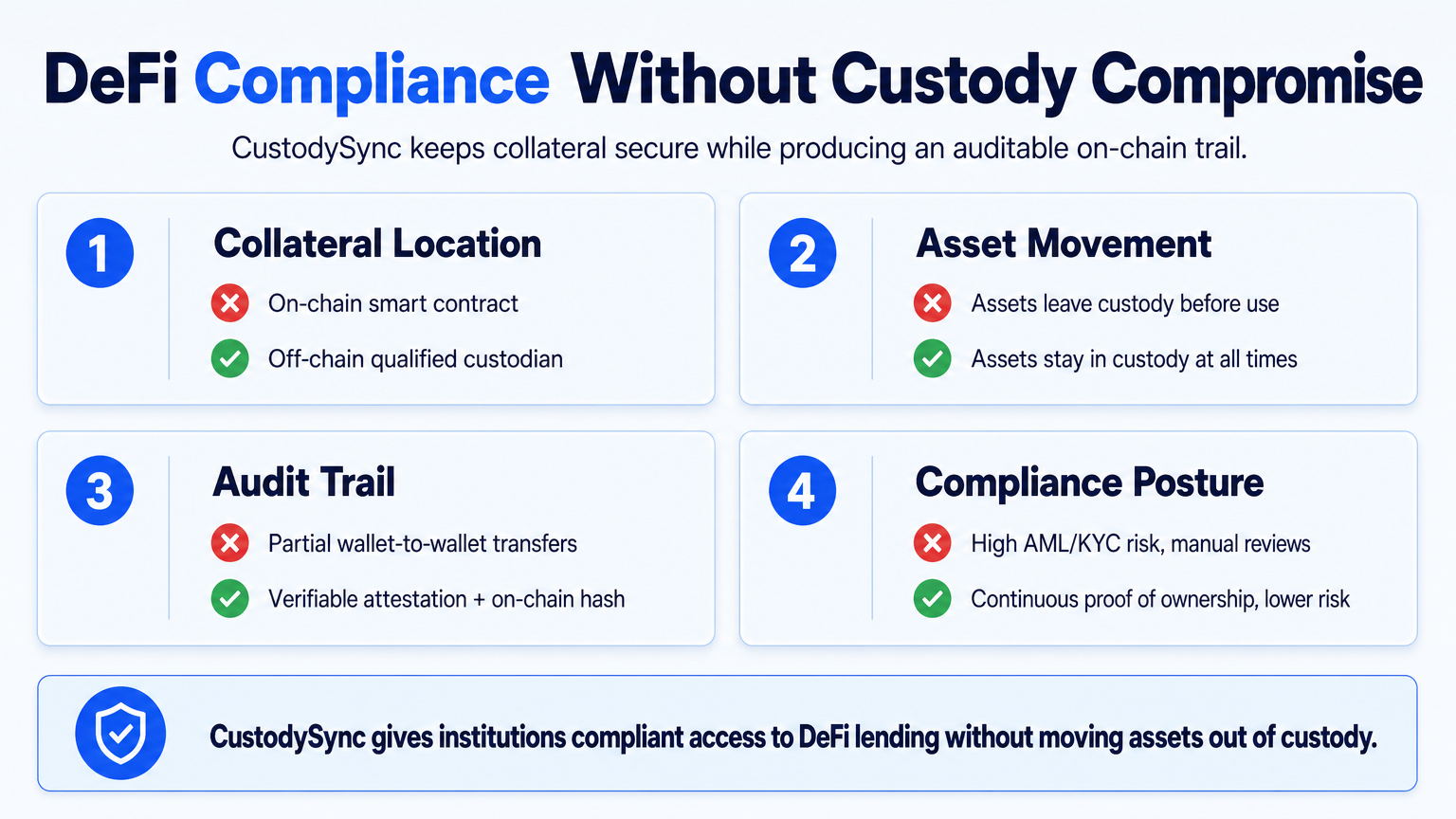
For DeFi lenders and borrowers: collateral stays secure
In a traditional DeFi lending transaction, collateral sits in a smart contract that may be subject to smart-contract risk, oracle manipulation, or governance attacks. With CustodySync, the actual collateral stays in a custodian’s vault, segregated and insured under the custodian’s operational framework. If a loan defaults, liquidation can be programmed at the protocol level without exposing the underlying assets to unnecessary on-chain custody risk. This fundamentally alters the risk calculus for institutions that have, until now, been reluctant to treat DeFi pools as acceptable lending counterparties.
For compliance officers and regulators: a verifiable, auditable on-chain footprint
Every CustodySync-enabled loan produces an auditable trail that ties the custodian’s attestation to the on-chain transaction, without requiring the institution to reveal proprietary wallet addresses to the public. That trail can satisfy DeFi AML and DeFi KYC requirements because it provides immutable evidence of ownership, value, and chain of control — the very elements that FATF’s 2026 targeted report on decentralized finance identified as necessary for mitigating money laundering and sanctions evasion risks (FATF, 2026). This is a meaningful shift for crypto compliance for institutions, which has long struggled with the pseudonymity of DeFi pools.
The Compliance Challenges That Led to This Innovation
Why does DeFi create compliance challenges?
DeFi’s fundamental design — pseudonymous wallets, permissionless smart contracts, and the absence of a central intermediary — makes traditional AML and KYC controls difficult to apply. Without a service provider that can perform identity verification, transaction monitoring becomes an exercise in tracing on-chain flows that can be obfuscated through mixers and cross-chain bridges. The Financial Action Task Force’s guidance and the ACAMS community have repeatedly noted that DeFi AML compliance requires a combination of on-chain analytics and off-chain due diligence, but until now there has been no clean bridge between the two worlds (ACAMS, 2026). Institutions remained stuck: either forfeit DeFi opportunities or accept a compliance posture that felt permanently incomplete.
How is DeFi regulation evolving?
The regulatory landscape in late 2026 has moved from theoretical to prescriptive. The UK Financial Conduct Authority’s draft DeFi guidance (GC26/7) proposes that entities facilitating on-chain activity — even when decentralized — must maintain on-chain compliance records (FCA, 2026). The US has seen the SEC and OCC issue frameworks that treat certain DeFi activities like securities issuance or money transmission, while the GENIUS Act has set stablecoin-specific safeguards. In this environment, a mechanism that anchors DeFi exposure to a regulated custody layer is not just convenient; it is rapidly becoming a compliance prerequisite for any institution that answers to a prudential regulator. As Grant Thornton’s 2026 crypto compliance outlook emphasized, firms must now show they can tie on-chain positions to auditable off-chain records — exactly what CustodySync delivers (Grant Thornton, 2026).
How Businesses Can Operationalize CustodySync for Compliant DeFi Access
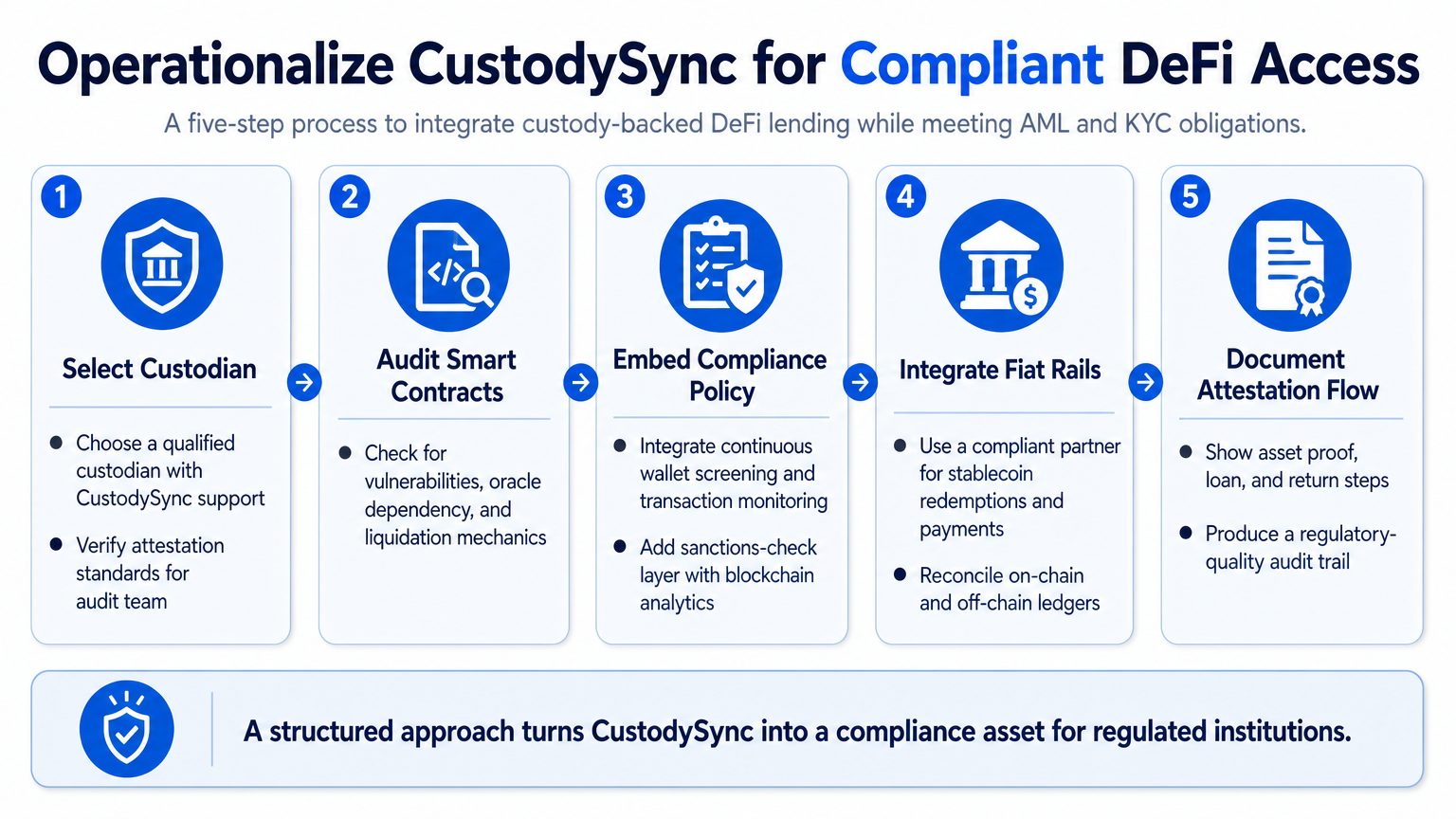
How can businesses manage DeFi compliance risk?
For finance leads at global businesses and DAOs, the arrival of CustodySync doesn’t replace a compliance program — it sharpens the tools available to run one. The following checklist provides a practical starting point:
- Select a qualified custodian that supports CustodySync integration and holds relevant regulatory licenses in your jurisdiction. Verify that the custodian’s attestation mechanism meets the proof standards required by your internal audit team.
- Audit the target DeFi protocol’s smart contracts for vulnerabilities, oracle dependency, and liquidation mechanics. Even though collateral stays off-chain, the borrowing-side code still carries risk.
- Embed a risk-based compliance policy that includes continuous wallet screening, transaction monitoring, and a sanctions-check layer for all on-chain interactions. Use a blockchain analytics provider to map any address that interacts with your CustodySync-generated position.
- Integrate fiat rails via a compliant financial partner that can handle stablecoin redemptions, corporate payments, and reconciliation between on-chain and off-chain ledgers.
- Document the custody and attestation flow for regulators, showing exactly how assets are proven, loaned, and returned — turning the CustodySync data feed into a regulatory-quality audit trail.
What are the implications for startups and DAOs using DeFi?
Startups and decentralized autonomous organizations often lack the legal and operational resources to build institutional-grade custody relationships on their own. CustodySync changes the equation by decoupling the storage of assets from their productive use. A DAO can keep its treasury in a qualified custodian while leveraging those assets as collateral for a DeFi loan to fund operations or protocol development — all without exposing the treasury to smart-contract risk directly. This preserves the DAOs DeFi compliance posture because the DAO’s assets are never freely floating in a hot wallet.
Operationally, this calls for a banking partner that can sit at the intersection of fiat and crypto — receiving the loan proceeds in stablecoins, converting to fiat for payroll, and managing the compliance reporting that ties both sides together. That’s where neo-banking for DeFi startups becomes more than a convenience.
How does OneSafe help with DeFi compliance in light of this development?
OneSafe provides a unified financial platform for businesses that operate in both fiat and crypto, offering global accounts, corporate cards, and on/off-ramp capabilities alongside secure digital asset custody via Fireblocks. For a startup or DAO that uses CustodySync to collateralize assets held with a qualified custodian, OneSafe can serve as the compliant on-ramp for the loan proceeds: converting USDC to fiat for operational expenses, issuing virtual cards with spend limits, and automatically reconciling on-chain transactions with accounting records. Because OneSafe is built for organizations that bridge the old and new financial worlds, it aligns with the compliance stack that CustodySync demands — keeping a clear paper trail from the custodian’s attestation down to the individual bill payment.
The platform’s support for customizable roles and permissions also lets DAOs enforce governance rules around who can move assets, trigger conversions, or approve wire payments, which reduces the human error surface that often compromises on-chain compliance in decentralized setups. As more DeFi protocols integrate CustodySync, having a single dashboard to manage fiat and crypto operations with robust KYB and transaction monitoring becomes a practical necessity rather than a nice-to-have. (For a deeper look at the regulatory backdrop shaping these decisions, see our analyses on DeFi compliance after Aave’s SEC filing and the SEC’s broader DeFi guidance in 2026.)
What to Watch Next: The Future of DeFi Compliance
CustodySync is not the end of the journey. Several open questions remain. First, cross-chain interoperability will test whether custody attestations can flow seamlessly across Ethereum, Avalanche, and other networks without introducing trust assumptions at the bridge layer. Second, the integration of real-world assets — tokenized treasuries, private credit — into custody-backed DeFi loans will force regulators to decide whether these instruments are securities when used as collateral in a permissionless pool. The OCC’s stablecoin pathway, which opened new doors for national banks to engage with blockchain, hints that federal agencies may eventually treat custody-secured DeFi positions as part of a bank’s permissible activities, but no formal rulemaking has emerged (OCC opens stablecoin path). Third, the GENIUS Act’s stablecoin provisions will shape the very asset that most CustodySync loans will denominate, and businesses need to track how issuer reserve and redemption requirements interact with custody-backed lending (GENIUS Act guide).
The broader arc is unmistakable: institutional-grade DeFi infrastructure is moving toward a compliance-native architecture, where the question is no longer “can we do DeFi and stay compliant?” but “can we afford not to participate when compliant tools exist?”.
Key Takeaways
- Chainlink CustodySync, announced November 5, 2026, lets institutions and DAOs access DeFi lending markets while keeping the underlying assets secured in a qualified custodian.
- The innovation shifts DeFi compliance 2026 from wallet-level screening to continuous, auditable proof of ownership, addressing key AML and KYC gaps that have kept regulated capital on the sidelines.
- Businesses can operationalize this by coupling a CustodySync-compatible custodian with a risk-based compliance program that includes smart contract audits, wallet monitoring, and a unified fiat-crypto banking partner.
- Platforms like OneSafe help startups and DAOs manage the off-chain side of compliance — converting DeFi loan proceeds to fiat, automating payments, and maintaining a clean audit trail — without needing a traditional bank’s overhead.
- Regulatory attention is converging on on-chain compliance; expect cross-chain and real-world asset integration to be the next frontier for custody-secured DeFi.
For teams that need to keep their own content engine running on topics like these, Joyrise plans, writes and publishes illustrated SEO articles to your Webflow blog every day. Read your first article before you pay.
Explore how OneSafe’s unified platform can help your business manage fiat and crypto compliance in one place at onesafe.io.
Get started with Crypto-custody in minutes!
Get started with Crypto-custody effortlessly. OneSafe brings together your crypto and banking needs in one simple, powerful platform.