Key points
- Nine Democratic senators sent a letter on November 16, 2026, to the Commodity Futures Trading Commission (CFTC) requesting that it allow states to handle their legal battles against platforms such as Kalshi and Polymarket.
- The dispute arises because several states consider that the sports event contracts offered by these platforms infringe upon local laws against illegal gambling.
- The CFTC issued an order on November 5 requiring prediction markets to eliminate geographic restrictions within 30 days, which intensifies the jurisdictional conflict.
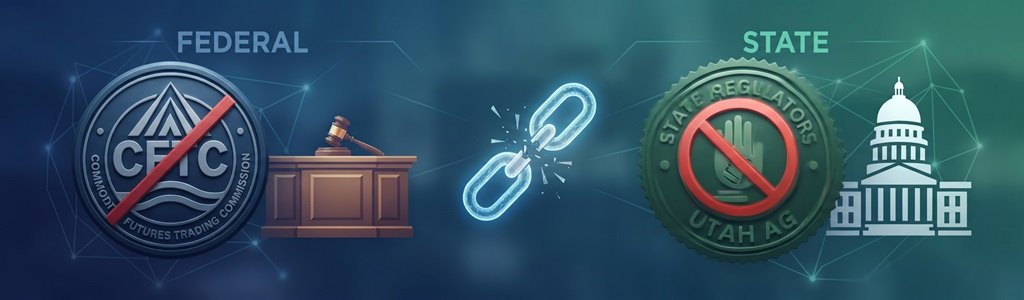
Regulatory tension surrounding prediction markets escalated this Monday when a group of federal legislators formally intervened in the debate. According to a report by The Wall Street Journal, nine Democratic senators formally requested that the CFTC cease its efforts to assume exclusive control of prediction markets in the United States, thereby allowing states to continue with their local legal actions.
The petition, sent on November 16, 2026, bears the signatures of high-profile legislators such as Adam Schiff (California), Amy Klobuchar (Minnesota), and Elissa Slotkin (Michigan). The congresspeople’s request comes amidst an open conflict of competencies between the federal regulator and state attorney generals concerning the jurisdiction applicable to contracts linked to sports, economic, and political results.
While the federal agency seeks to consolidate a unified oversight framework, state regulators argue that allowing betting on sports events on these platforms is equivalent to a traditional sports betting operation, which is subject to strict restrictions or prohibitions under the legislation of each state.

The Normative Clash Between Federal Regulation and the States
Prediction markets allow users to negotiate contracts based on future events, including sports matches and electoral processes. However, sports-themed contracts have become the main point of friction. According to The Wall Street Journal report, the CFTC -published on November 5- a directive ordering these platforms to suspend their geographic restrictions within a 30-day period, arguing that the regulations of Designated Contract Markets (DCMs) require fair and equal access for eligible users.
This federal directive increases pressure on the platforms to operate in jurisdictions where local authorities are attempting to block their services. In response, various states have redoubled their punitive actions. Nevada already has court orders in place to prevent Kalshi from offering its services to local residents, while Louisiana maintains litigation with similar objectives.
For its part, Utah intensified the conflict by filing a civil lawsuit and bringing criminal charges against Kalshi‘s top executives, Tarek Mansour (CEO) and Luana Lopes Lara (COO), who face 14 felony charges for the promotion of online gambling. The state attorney general’s office based its action on test operations conducted by a local investigator. The company termed these measures a political overreach.
The intervention by Democratic legislators anticipates greater political scrutiny in Congress starting next year, a period in which the Democrats will assume control of both chambers. According to the analysis of the events, one of the axes of legislative debate will be to determine whether the Dodd-Frank Act grants the CFTC absolute and indisputable authority over the prediction contract industry.