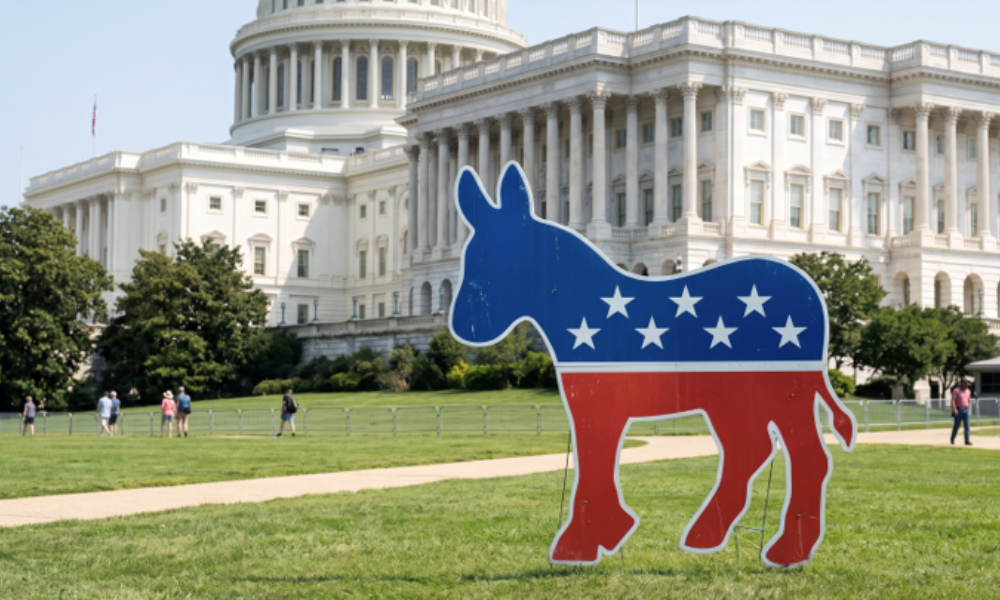
- The Democratic Party, according to preliminary results of the U.S. midterm elections, could win a majority in both chambers of Congress.
- Republicans risk losing a number of seats even in traditionally conservative states.
- Economic problems and the war with Iran are cited among the reasons.
- President Donald Trump congratulated the Democrats.
- A shift in the makeup of Congress could complicate the implementation of his agenda and affect regulation of the crypto sector.
In the U.S. midterm elections held on November 3, 2026, the Democratic Party, according to preliminary results, could win a majority in both chambers of Congress. Vote counting is ongoing, but early returns point to a significant strengthening of Democrats’ positions and a weakening of Republican influence, according to BBC.
The Incrypted editorial team reviewed the preliminary voting results, U.S. President Donald Trump’s reaction, and the potential consequences of a shift in the political balance for his administration and the cryptocurrency industry.
This story is being updated.
According to The Conversation, the vote was accompanied by a significant shift in the political balance in favor of Democrats. Among the factors influencing the results, analysts point to dissatisfaction with the White House’s economic policy, high consumer prices, and the ongoing military conflict with Iran.
In particular, Democrats could flip Senate seats from Republicans in Texas, Ohio, North Carolina, South Carolina, and Kansas.
The results in a number of traditionally conservative states became one of the main storylines of the vote. At the same time, ballot counting in some districts is still ongoing, and the final allocation of seats has yet to be determined.
According to The Washington Post, the results reflect a drop in support for the administration among several voter groups, including young people and Latinos. Additional pressure on Republicans came from inflation, the White House’s trade policy, and the fallout from the war in the Middle East.
Trump has already congratulated his political opponents on their victory in a phone call with CBS News.
“My message is congratulations to the Democrats. I look forward to working with you for the good of our country,” the president said.
“My message is congratulations to the Democrats. I look forward to working with you for the good of our country,” the president said.
At the same time, he disagreed that the results should be viewed as a personal defeat. According to the American leader, Republicans lost seats in Congress in part because he himself was not on the ballot.
“I wasn’t on the ballot, and there was nothing that could be done about it. If I had been running, we would have won,” Trump noted.
“I wasn’t on the ballot, and there was nothing that could be done about it. If I had been running, we would have won,” Trump noted.
The president also acknowledged that the war with Iran played a role in the Republican Party’s defeat. At the same time, he continued to defend his actions in the region and said he was confident voters understand why they were necessary.
What Consequences a Democratic Victory Could Have
Democrats taking control of both chambers of Congress could significantly limit Trump’s ability to pursue his domestic and foreign policy agenda. Republicans will no longer be able to single-handedly push through the president’s legislative initiatives, including budget, tax, and regulatory decisions.
At the same time, a Democratic majority does not mean full control over government policy. Trump will retain the right to veto bills passed by Congress, and overriding that veto requires support from two-thirds of both chambers. As a result, the most likely scenario is an escalation of confrontation between the legislative and executive branches.
In an interview with Fox News, the president suggested that Democrats would initially send him unacceptable bills that he intends to block. However, after several months of standoff, he predicted the sides could move on to negotiations.
Another potential consequence could be an expansion of investigations into the current administration. With a majority, Democrats would be able to chair relevant committees, launch congressional hearings, request documents, and summon White House officials to testify.
As The Guardian notes, particular attention could be paid to the Trump family’s business dealings, the actions of the Department of Justice, and materials related to the Jeffrey Epstein case.
Against this backdrop, the question of a possible impeachment has resurfaced. Back in January 2026, the president warned that a Republican loss in the midterms could lead to an attempt to remove him from office.
“You have to win the midterms. If that doesn’t happen, they [Democrats] will find a way to impeach me,” Trump said while speaking to fellow party members.
“You have to win the midterms. If that doesn’t happen, they [Democrats] will find a way to impeach me,” Trump said while speaking to fellow party members.
The American leader has already been through the process twice — in 2019 and 2021. In both cases, the Senate acquitted him.
Still, the prospect of a third impeachment remains uncertain. Former US Vice President Kamala Harris spoke out against immediately launching the process, suggesting that efforts should focus on investigations and ensuring the administration’s accountability.
In addition, removing a president from office requires a two-thirds vote in the Senate, which significantly raises the political bar for such a decision.
A Democratic victory could also have specific implications for the crypto industry. The Republican majority previously backed initiatives aimed at creating a favorable regulatory environment for digital assets, but a change in committee leadership could shift legislative priorities.
According to CoinDesk, Democrats may tighten requirements around combating illicit financial activity, investor protection, and restrictions on government officials’ involvement in crypto projects. At the same time, the outlook for passing a sweeping framework bill (CLARITY) remains uncertain.
TD Cowen analysts previously expressed a similar view. They suggested that a shift of Congress into Democratic control would lead to delays in advancing crypto market structure legislation and other White House initiatives.
The Block also cited comments from Democratic Senator Angela Alsobrooks, who questioned whether passing the CLARITY Act would remain a priority for the new majority. At the same time, crypto industry representatives expect to preserve bipartisan support for certain initiatives, including the taxation of digital assets.
As a result, the midterm election results create conditions for a rethink of the U.S. legislative agenda. Beyond tighter oversight of the Trump administration, the changes could affect the country’s budget, foreign policy, and crypto policy. The final impact will depend on the makeup of the new Congress, its priorities, and the White House’s willingness to compromise.
Note that we also discussed the midterms and the potential implications of a Democratic victory during the broadcast: