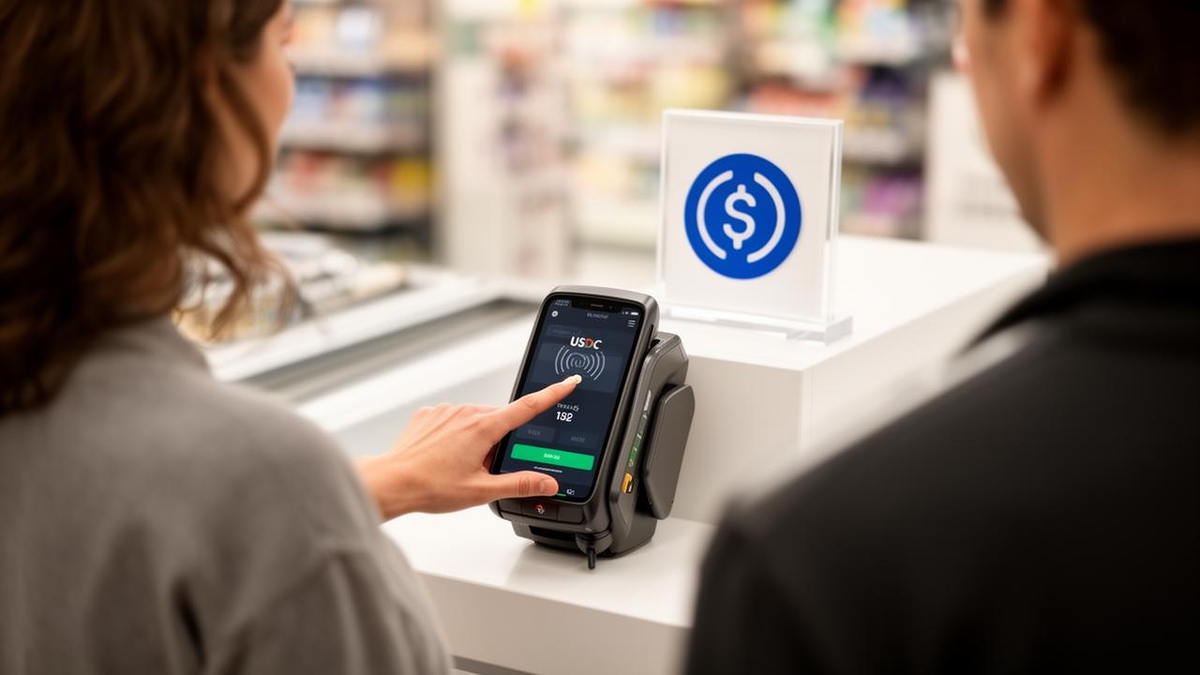
Digital Garage announced on November 10 that it has signed a memorandum of understanding (MOU) with an affiliate of Circle Internet Group, the US-based issuer of the dollar-denominated stablecoin USDC, to explore collaboration on promoting stablecoin payments in Japan. The centerpiece is that the company's stablecoin payment infrastructure "DG SPS (DG Stablecoin Payment Service)" will support "Arc," a layer-1 blockchain developed by Circle.
DG SPS is an infrastructure that connects to payment providers' existing systems via API to enable them to offer stablecoin payments to merchants. With Arc support, payment providers that have already adopted DG SPS will be able to offer USDC payments on the Arc chain to merchants without developing new systems for Arc. Digital Garage is emphasizing that this imposes no additional development burden on payment providers.
Arc is a blockchain designed for payments, foreign exchange (FX), and capital markets, whose mainnet Circle made publicly available on September 16. It is designed to finalize on-chain transactions in under one second, with network usage fees (gas fees) payable in USDC. Digital Garage explains that payment providers no longer need to separately hold price-volatile crypto assets (virtual currencies) for fee purposes, making costs easier to forecast.
Circle is currently developing a feature that selectively keeps transactions and balances private, disclosing information necessary for audits and other purposes only to authorized parties, with the aim of rolling it out across the entire Arc network.
On August 10, 2026, Digital Garage began commercial deployment of DG SPS supporting USDC payments on Base. It has recently started offering the service to JCB and plans to introduce it sequentially to its payment subsidiary DG Financial Technology (DGFT). Through the merchant networks of JCB and DGFT, the company aims to expand the use of USDC payments on Arc from physical stores to e-commerce (EC). With Circle, it will pursue technical and infrastructure collaboration as well as the development of new partner companies.
Digital Garage's stablecoin payment initiatives have accelerated this year. In January, it began collaboration with JCB and Resona Holdings toward practical application. From February 24 to March 2, it conducted a payment demonstration for general users at "Pangaea Cafe & Bar" in Shibuya, Tokyo, together with Mina Wallet. The demonstration used USDC on Base, Ethereum's layer-2 network, and the yen-denominated stablecoin "JPYC" on Polygon, assuming a model in which the store receives sales proceeds in Japanese yen.
On August 19, it announced a basic agreement with JCB and Lawson toward a demonstration of in-store payments. The plan was to verify a method in which users display a barcode on their smartphones that is read by POS registers at a Lawson store in Osaki, Tokyo, assuming a scenario in which foreign visitors to Japan pay with USDC on Base.
These efforts will serve as a litmus test for the role of stablecoins in Japan's payment infrastructure. USDC is designed to track the US dollar and has attracted business interest as a payment method that reduces the price volatility risk of crypto assets. Expanding the blockchains supported by payment infrastructure gives merchants more options at adoption and allows payment providers to incorporate new payment methods without major modifications to existing systems.
On the other hand, stablecoin payments in Japan have only just begun transitioning from the demonstration stage to commercialization, and how far the expansion of supported chains translates into actual transaction volume will depend on the progress of merchant development going forward. Digital Garage has indicated it will proceed in parallel with deployment to its payment subsidiary and the development of partner companies, and the focus will be on whether it can broaden the acceptance of USDC payments in both physical stores and e-commerce.