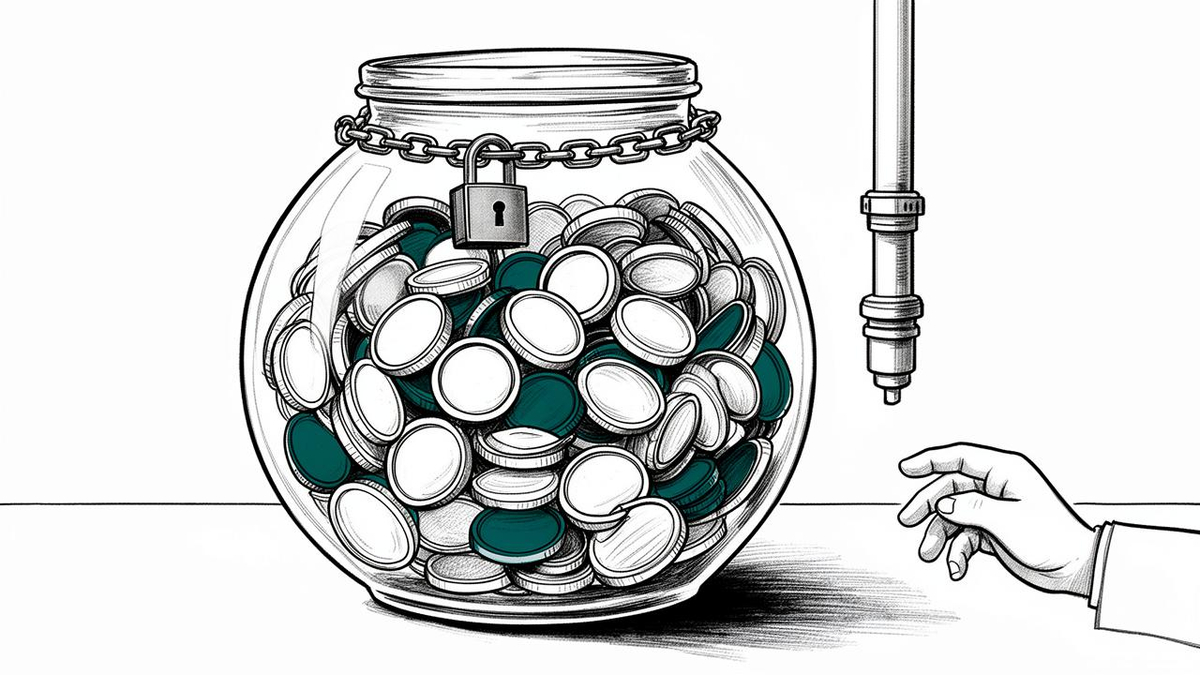
USDS, a stablecoin designed to trade one-to-one with the dollar, has climbed to the 7,800-won range in South Korean cryptocurrency exchanges — more than four times its global price. Analysts attribute the spike to a so-called "fishbowl market" created by deposit blocks after the token was designated a caution-listed asset.
As of 3:03 p.m. on the 25th, USDS was trading at 3,630 won (approximately $2.7) on Upbit's won market, down 25.92% from the previous day. At the same time, CoinMarketCap, the cryptocurrency price tracking site, put USDS at 1,341 won (approximately $1), close to $1. South Korean quotes are now more than double the global price. The previous day, the token jumped to 7,835 won (approximately $5.8) intraday, pushing its premium over the global price above 300%.
Prices went off the rails on the 23rd. Upbit, Bithumb and Coinone designated USDS and Sky Protocol's own token SKY as caution-listed assets and suspended deposits that day. Trading itself was allowed, but the channel for outside supply to enter was shut. On the day of the designation, USDS rose to 5,435 won (approximately $4) on Upbit, and the following day, the 24th, it hit 7,835 won. The unusual strength has now persisted for three days.
A similar pattern was observed on Bithumb. After deposits halted alongside the caution designation on the 23rd, USDS traded in the 1,600–2,200 won range (approximately $1.2–$1.6), above its intrinsic value. The gap was smaller than on Upbit, but it was still far outside the normal range.
The exchanges' decision to flag USDS as a caution-listed asset stems from withdrawal disruptions at Sky Protocol's savings product. The move was intended to protect users, but it ended up severing the arbitrage route that normally links South Korean and overseas prices. Typically, when South Korean prices run above those abroad, cheaper overseas supply flows in and narrows the premium. When deposits are blocked, however, quotes are set solely by the supply left inside the exchange.
"There is a possibility that buying flowed in from investors seeking short-term trading gains in a situation where supply was constrained by the deposit block," a cryptocurrency industry official said. "Once deposits resume or sell orders increase, it will be difficult for the premium to persist for long."
The root of the problem lies in Sky Protocol's lending structure. Debt in a wallet linked to Sky co-founder Rune Christensen totaled 77.1 million USDS — about 104 billion won (approximately $77.4 million) — as of the 19th, according to on-chain analytics firm Bitquery. Of the 161.6 million USDS in total loans, nearly half — 48% — was concentrated in a single wallet, and the top five borrowers accounted for 90% of the total. Even the liquidation function, which sells collateral to recover loaned funds, had been disabled.
On the 10th, the available funds for withdrawals ran dry, because virtually all deposited USDS had been lent out. Christensen repaid 3 million USDS on the 23rd, but the remaining debt stands at 77 million USDS. The repayment was exhausted in 24 seconds, unable to cover the backlog of withdrawal demand. At the time, 99.99% of roughly $159 million in deposited assets was tied up in loans.
If the premium attached to South Korean prices disappears, buyers at the top will struggle to avoid heavy losses. An investor who bought USDS at 5,870 won (approximately $4.4) would face a loss of 77% if the price reverts to around 1,350 won (approximately $1), the level corresponding to its dollar value. Even if the stablecoin holds $1 as designed, investors who bought it at inflated prices in South Korea stand to lose a large share of their principal.
There have been past cases in South Korea where stablecoin prices spiked abnormally, only to return to their intrinsic value in the end. "This is a high-risk speculative area far removed from fundamental value, so extra caution is needed," said Yoon Seung-sik, head of the research center at Tiger Research. "Investors must recognize that this is clearly speculation and that it cannot be predicted."
Industry observers say investors should watch both whether deposits resume and whether trading support could end. If the caution designation drags on or leads to delisting, volatility could increase further during the price normalization process. The timing of when supply trapped inside the exchanges is released is seen as the key variable determining the direction of USDS prices in South Korea.
Once added, BigGo Finance appears first in Google Search Top Stories, so you get the broadest, most up-to-the-minute, and most comprehensive global financial news first.


