PiCK
Summary
- A won stablecoin should be designed around global use cases and safety measures such as reserve assets and redemption rights, rather than around the identity of the issuer.
- Easing the so-called one-exchange, one-bank rule, expanding corporate and institutional crypto investment, and enacting a Basic Digital Asset Act were cited as the key tasks for improving the industry's competitiveness.
- Domestic stock tokenization technology is ready, while interest-like rewards on dollar stablecoins and broader participation by nonresident foreigners could become major variables for the competitiveness of the won and Korean exchanges.
Forecast Trend Report by Period
Min Byung-deok: Move Beyond Bank-Centered Issuance
Park Soo-min: Ease Rules on Exchange Bank Accounts and Corporate Investment
Kim Hyung-nyun: Tokenization Technology Is Already Ready
South Korea should broaden its debate over a won stablecoin beyond who gets to issue it and focus instead on use cases and service competition, speakers at an industry forum said. They also called for easing restrictions related to crypto exchange bank accounts and corporate investment, and for building an institutional framework for new financial services such as stock tokenization.
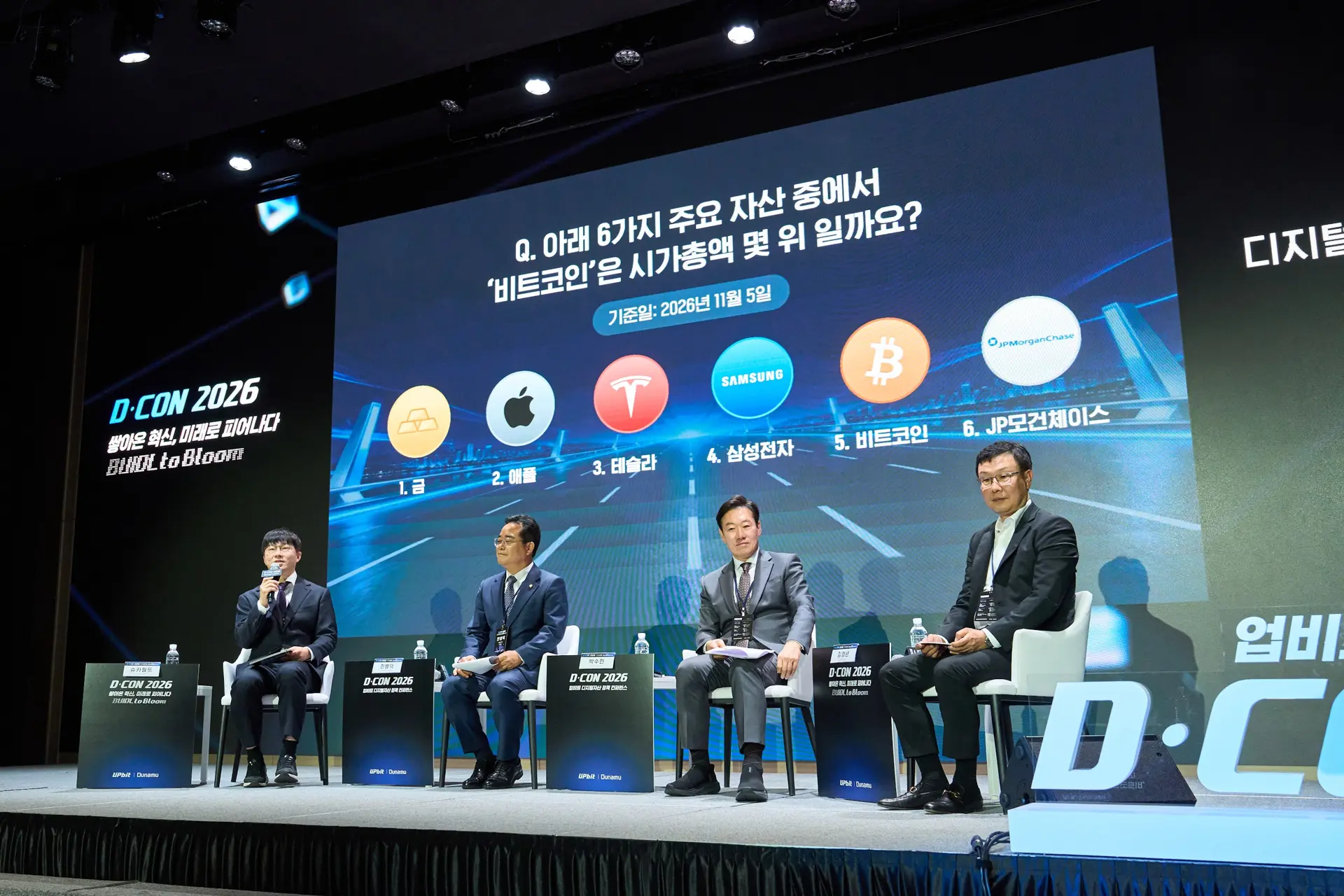
Democratic Party lawmaker Min Byung-deok, People Power Party lawmaker Park Soo-min and Dunamu Vice Chairman Kim Hyung-nyun discussed ways to strengthen the competitiveness of South Korea's digital-asset industry at a special session held on November 10 at Fairmont Ambassador Seoul in Yeouido. The session was part of D-CON 2026 and was moderated by economic YouTuber Shuka World.
Min Byung-deok: Service Competition, Not a Bank Monopoly
Min criticized discussions that would limit eligibility to issue a won stablecoin mainly to banks. "The focus should be on where it will be used and how it will circulate, but the debate is tied up in who gets to make it," he said. "We should not end up with a stablecoin that no one uses just because it was made by a bank and deemed safe."
He said policymakers should focus less on the issuer and more on practical safeguards such as reserve assets and redemption rights. "You only need to ask whether 100% reserve assets and redemption rights are guaranteed, and whether supervision, anti-money laundering and know-your-customer requirements are met," he said. "Any player that meets those standards should be able to participate so competition can emerge."
Min stressed that he was not arguing for banks to be excluded. Banks are strong in infrastructure, fintech firms in convenience, and crypto companies in technology and networks, he said. Those strengths should be combined in consortiums that compete on service.
As potential use cases, he pointed to K-content, smartphones and automobiles. The idea is to use the global customer bases already secured by Korean companies as channels for distributing won stablecoins. "Blockchain is a technology aimed at the world, so the market should not be narrowed to Korea," he said. "It has to be built for a global market from the start."
He also said a basic digital-asset law should pass during the current regular session of the National Assembly, or at the latest before January 18, 2027. Criticism that the government was trying to collect taxes before establishing a basic legal framework helped underscore the urgency of legislation, he said. The law should set broad principles while leaving room for creative experimentation.
Park Soo-min: End the One-Exchange, One-Bank Rule and Open the Door to Corporate Investment
Park said scrapping the so-called one-exchange, one-bank system should be a top priority if policymakers want to show they are serious about fostering the industry. Investors can use multiple bank accounts when trading through securities firms, so there is no reason crypto trading should be restricted to a single bank, he said. Allowing exchange users to access platforms through all banks would be a starting point for building trust in the market.
Even before a basic law is enacted, Park said financial authorities should reduce uncertainty around the business. "It would be better for the law to move quickly, even if it is somewhat loose," he said. Fear of being punished later in the absence of clear legislation could be eased if the Financial Services Commission and the Financial Supervisory Service provide administrative guidance.
He also called for broader access to crypto investment for corporations and institutions. If corporate and institutional money enters the market, it could lead to more research and analysis and help shape the direction of regulatory development, he said. Corporate and institutional investment should be opened up quickly alongside clearer administrative guidance.
Park said won stablecoins should be approached from the perspective of currency competitiveness. "Before thinking about what we can gain from a won stablecoin, it is urgent to protect the value of the won," he said. "When change comes, we need to preserve the won's value while also trying to internationalize it."
"What is possible in the US should also be possible in Korea, and we should approach this from a 'US-plus' perspective by offering better services," he said. "The ruling and opposition parties need to make bold decisions and reach agreement to give the global market confidence."
Kim Hyung-nyun: Tokenization Is Ready; Regulation Is the Key
Kim said it was regrettable that tokenized products based on Korean stocks are being traded overseas first. "It is painful to see flagship Korean stocks like Samsung Electronics and SK Hynix trading on overseas exchanges," he said. "Securities firms, financial companies and Dunamu itself have completed all the technical preparations. All that remains is the institutional framework."
He added that if regulations are approved or conditions are created to launch the business, the company is prepared to roll out what it has developed. Dunamu is studying projects that can be pursued with traditional financial institutions and has applied for regulatory sandbox programs in several areas.
Kim also raised concerns that the reward structure of dollar stablecoins could reduce the use of the won. "If dollars held in a wallet earn interest, people will only take them out when needed and will have less reason to convert back into won," he said. "US stablecoin issuers are already knocking on the doors of Korean exchanges." Some are trying to offer compensation under other names, such as rewards, instead of interest.
As a way to boost the global competitiveness of Korean exchanges, Kim called for broader participation by nonresident foreigners. "I want investors living in the US, Europe and Southeast Asia to be able to use Korean exchanges," he said. "If a market is created where foreigners can freely convert dollars into won and trade, that would open the way for the industry to take a step higher."
Doohyun Hwang