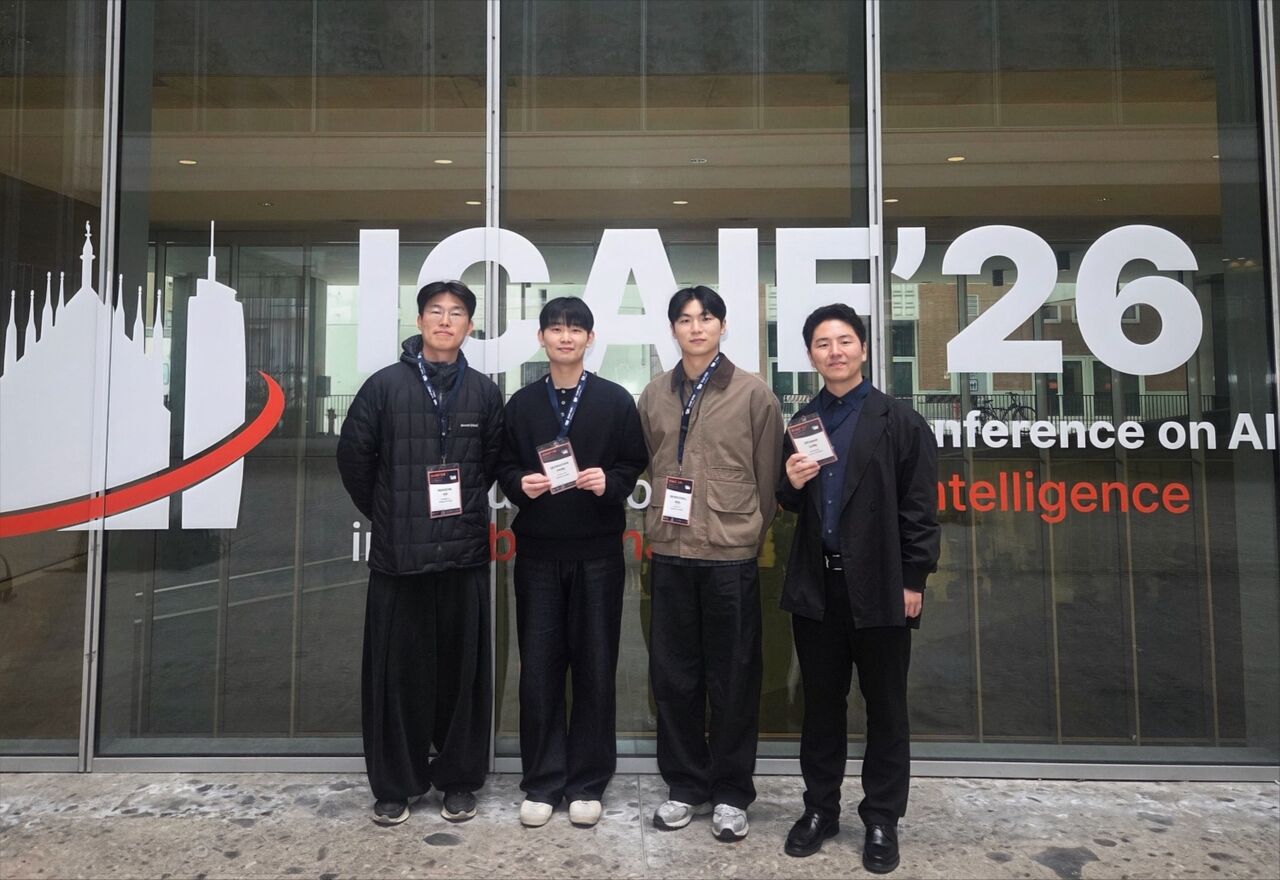
[DigitalToday reporter Sang-yeop Oh] Three Dunamu research papers on AI and blockchain convergence have been accepted at ICAIF2026, an international academic conference on AI in finance. Dunamu operates the digital asset exchange Upbit.
Dunamu said on Nov. 17 that 1 paper was accepted to the ICAIF2026 main conference and 2 were accepted to specialist workshops.
ICAIF2026 (ACM International Conference on AI in Finance) is an international conference specializing in financial AI hosted by ACM (Association for Computing Machinery), an academic organization in the computing field.
The study accepted to the main conference is titled "Classifying On-Chain Behavioral Characteristics of Ethereum-Based Centralized Exchange Wallets Using Proof of Reserves."
The research team, including Seong-chan Park (박성찬), a researcher in Dunamu's Quant team, analyzed about 3.03 million Ethereum wallet addresses using proof-of-reserves data disclosed by 15 exchanges.
The team extracted 58 behavioral characteristics, including transaction patterns, token movements and gas usage. It presented a machine learning methodology to distinguish centralized exchange wallets.
In performance tests on exchange wallets not used in model training, the PR-AUC metric averaged 0.9594. Dunamu explained that it confirmed the potential to use the approach to identify wallets not only from previously known exchanges but also from new exchanges.
The technology is currently being used in part in Upbit Data Lab's blockchain analysis service to analyze asset holdings by entity, such as exchanges, whales and foundations.
A specialist workshop accepted a study on digital asset classification using large language models (LLMs).
The study titled "Semantic Transformation for an Institutional Digital Asset Classification System," with participation by Hyun-ho Jeon (전현호), head of Dunamu's Quant team, presented a method that analyzes smart contract code with an LLM to determine the actual use of digital assets and classify them by financial function.
The research team conducted experiments on major decentralized finance (DeFi) protocols on the Ethereum mainnet, including Uniswap, Aave and Curve. Of 17 analyzed, 16 matched existing classification criteria, for an agreement rate of about 94 percent.
Dunamu plans to apply the methodology in the future to advance the Upbit digital asset classification system (UBCS).
Another workshop paper, titled "Range Estimation of Deposit Fund Spending from Incomplete Transaction Records," addressed conditions under which fund flows on the blockchain can be analyzed even when transaction records are incomplete.
The research team, including Seong-yong Kim (김성용), project leader of Dunamu's FDI team, and Min-seop So (소민섭), head of the FDI team, identified key information needed to improve the reliability of fund source analysis through Ethereum wallet transaction cases and blockchain execution experiments.
Dunamu plans to use the findings to improve the analytical reliability of its on-chain fund tracking solution, OTS (Onchain AI Tracer System), and to apply them to AI-based financial crime analysis technology in the future.
Dae-hyun Kim (김대현), Dunamu's chief data officer (CDO), said the research was meaningful in that it confirmed the potential to precisely analyze blockchain data using AI technology and enhance the reliability of the results.