Summary
- The government draft said major shareholders in digital-asset exchanges would be capped at 20%, or 34% with regulatory approval for financial companies.
- It said the major shareholders of South Korea’s five biggest won-based exchanges, including Upbit and Bithumb, exceed the proposed threshold and could face pressure to restructure their stakes after a three- to six-year grace period.
- It said a Dunamu-Naver Financial merger may require a review of its structure because a 100%-owned subsidiary model could create legal-compliance risks and disadvantages in licensing approvals.
Forecast Trend Report by Period
Major shareholder stake capped at 20%; up to 34% with approval
Three-year grace period after designation; up to six years for smaller exchanges
No forced sale order, but licensing disadvantages possible
The government on Monday unveiled its long-awaited draft of the second-stage digital asset law. The proposal could bring sweeping changes to the industry, particularly through new limits on exchange ownership.
We’ll go over the Financial Services Commission’s draft with reporter Lee Min-jae. Start with the key points.
Under the draft, major shareholders would in principle be capped at 20%. Financial companies could hold as much as 34% with approval from the Financial Services Commission.
The reasoning is that exchanges have become part of the country’s public infrastructure. With more than 10 million accounts, they should not be run at the discretion of a single shareholder. FSC Chairman Lee Eok-won said the issue could no longer be put off.
How would this affect Upbit and Bithumb?
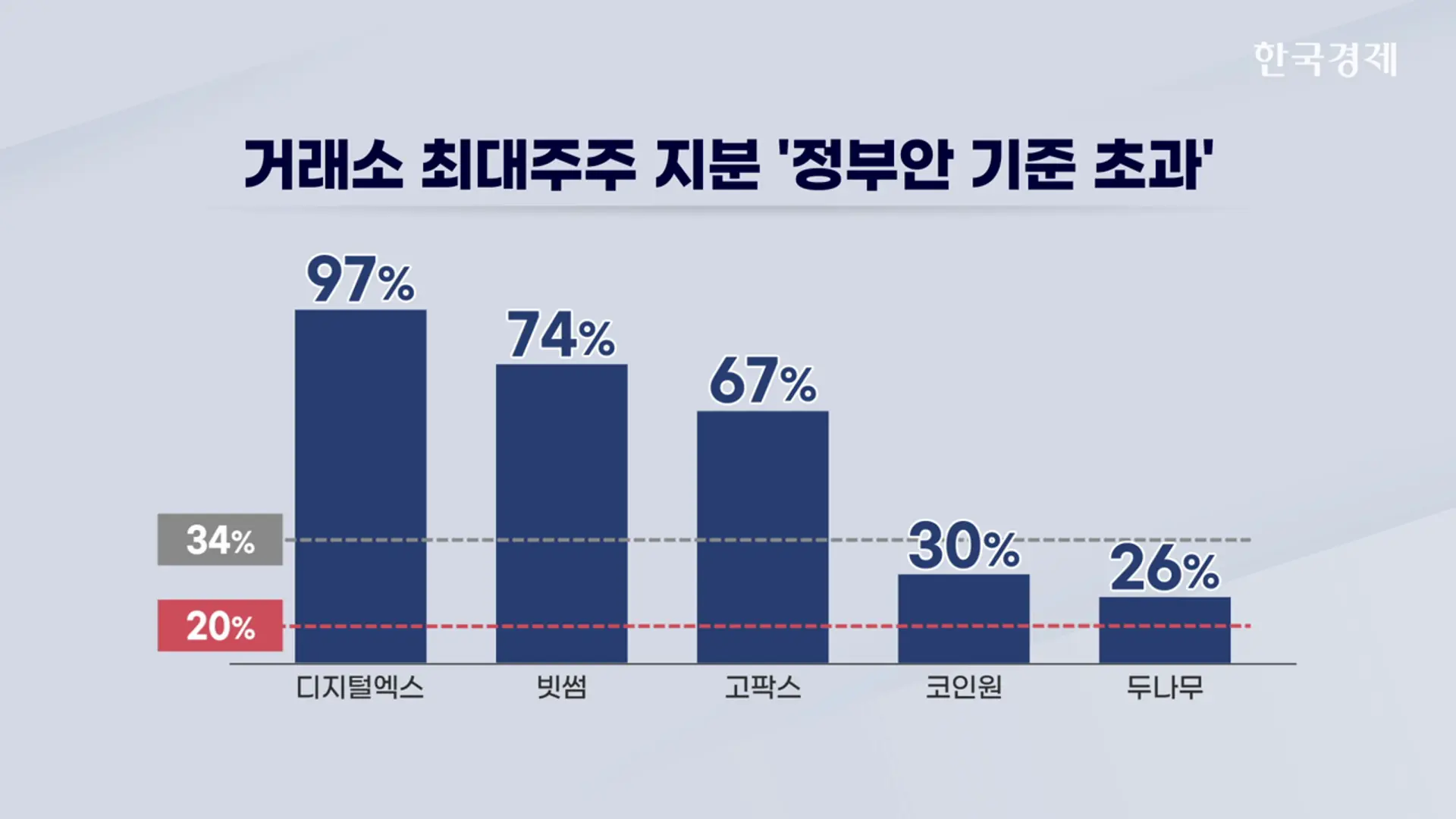
The issue is that all five of South Korea’s major won-based exchanges currently exceed the ownership threshold proposed by the FSC.
The draft looks at the major shareholder directly above the exchange.
At Bithumb, Bithumb Holdings owns 74%. At Dunamu, the operator of Upbit, Chairman Song Chi-hyung holds 26%. Coinone, Digital X and Gopax are in a similar position. Still, they would have some time to prepare.
The rules would be deferred for three years after an exchange is designated. Smaller exchanges could get as long as six years.
Isn’t Dunamu also pursuing a merger with Naver Financial?
That could make the ownership calculation even more complicated.
Once the share swap is completed, Naver Financial would own 100% of Dunamu. Under a rule that looks only at the immediate shareholder, that entire 100% stake would count against the cap. Digital X, in which Mirae Asset Consulting holds about 97%, would face the same issue.
If one shareholder effectively controls the company, limits on voting rights may not disrupt management right away. Even so, the company could continue to carry the label of being in violation of the law.
There may be no order to sell the stake, but the company could face corrective action or disadvantages in licensing and approvals.
That is why some in the market say Dunamu may have to choose between keeping a wholly owned subsidiary structure and combining the businesses into a single company, with Song, Naver, Hanwha Investment & Securities and Samsung affiliates splitting the equity.
In other words, the merger blueprint itself may need to be revisited.
Who would be allowed to issue the won-based stablecoin that investors are watching closely?
The government draft is a compromise. It gives banks the leading role while still leaving the door open to technology companies.
At first, only a consortium in which banks hold a majority stake would be allowed to issue the stablecoin, in the name of stability. Still, the plan leaves room for fintech firms to participate as the largest single shareholder.
In the example presented by the FSC, four banks could each hold 15%, for a combined 60%, while a fintech firm holds 30%. That would still make the fintech firm the single largest shareholder.
Still, a won-based stablecoin may take time to become reality. The law would take effect one year after promulgation and would also require a separate licensing process.
Another provision to watch is that exchanges would be required to compensate users for hacking losses even if the exchange itself was not at fault.
Will the government draft be finalized as it stands?
This is only the starting point, and there is plenty of room for revisions in the National Assembly.
The government draft is set to be introduced by Rep. Yoo Dong-soo, chairman of the National Assembly’s Political Affairs Committee. A public hearing is planned before mid-December, and passage could come as early as the first quarter of 2027.
The biggest point of contention is the ownership cap. Critics say it could infringe on property rights, and lawmakers are divided. The industry sees it as a signal to restructure ownership, but also worries that weakening the largest shareholder could give excessive influence to the second-largest shareholder.
Hwang Seok-jin, a professor at Dongguk University, said a compromise could emerge by raising the cap or extending the grace period.
That was Lee Min-jae from the securities desk.
Lee Min-jae, Korea Economic TV reporter [email protected]
Korea Economic Daily


