Summary
- Dunamu said it had successfully concluded D-CON 2026, a conference that discussed strengthening the competitiveness of the digital-asset industry and directions for regulatory reform.
- In the first session, participants stressed the importance of enacting a basic digital-asset law, improving regulations, securing use cases for won-denominated stablecoins, and boosting international competitiveness.
- Participants said they agreed on the need for a domestic institutional design framework and greater regulatory flexibility, based on real-world asset tokenization (RWA), broader stablecoin payment adoption, overseas regulatory trends and the BUIDL framework.
Forecast Trend Report by Period
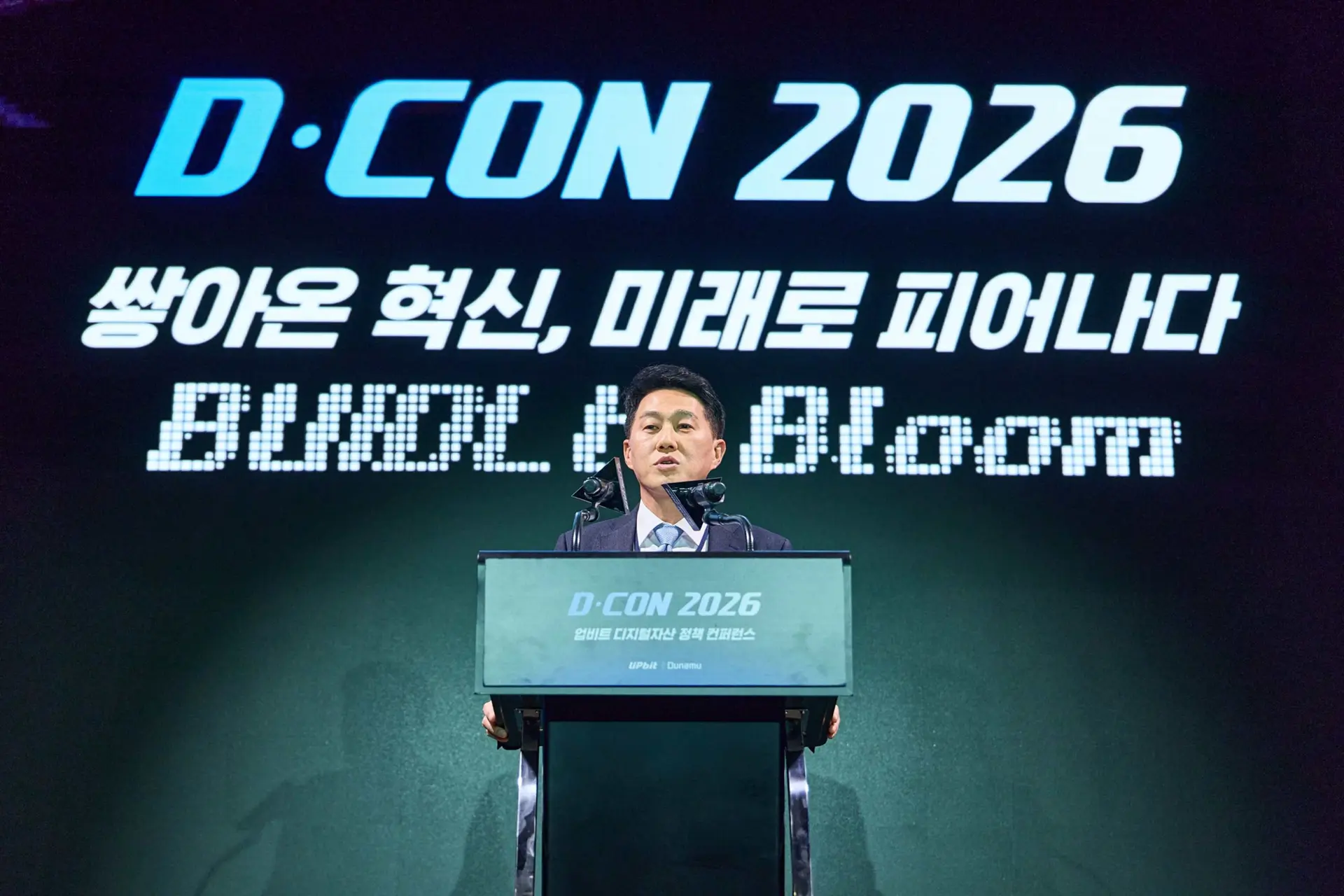
Dunamu said on November 11 that it had successfully concluded D-CON 2026, a policy conference on strengthening the competitiveness of the digital-asset industry and improving the regulatory framework.
The company held the event the previous day at the Fairmont Ambassador Seoul in Yeouido under the theme "BUIDL to Bloom." The conference, now in its fourth year, brought together ruling and opposition lawmakers as well as legal and financial experts to discuss institutional tasks for South Korea's digital-asset industry and ways to bolster global competitiveness.
In opening remarks, Dunamu Chief Executive Officer Oh Kyung-seok said the digital-asset industry had continued to build technological achievements and capabilities despite an uncertain environment. "Our industry has repeatedly proven that efforts made in dark times become the foundation for the next phase of growth," Oh said. "The innovation we have pursued steadily is now beginning to bloom."
He also said South Korea had reached a point where it must find concrete answers on what kind of competitiveness it can build in the digital-asset industry and how it will shape the future, as other major countries are doing.
The first session featured Democratic Party lawmaker Min Byung-deok, People Power Party lawmaker Park Soo-min and Dunamu Vice Chairman Kim Hyeong-nyeon discussing enactment of a basic digital-asset law and ways to improve regulation. Min said South Korea should speed up domestic legislation ahead of the implementation of the U.S. stablecoin law known as the GENIUS Act. He added that securing practical use cases for won-denominated stablecoins and strengthening international competitiveness mattered more than debating which entities should be allowed to issue them. Park presented broader market access for corporations and institutional investors, along with changes to the "one exchange, one bank" rule, as key policy tasks.
The second session examined cases in which blockchain technology is being applied to finance and the real economy, as well as its future development potential. Koh Ran, chief executive officer of Algoran, Kyung Hee University professor Kim Sang-yoon, Myongji University professor Park Jung-ho and U.S. attorney Seo Dong-joo discussed real-world asset tokenization, or RWA, and broader use of stablecoin payments. Participants also focused on the possibility that blockchain could serve as a new payment infrastructure in an environment where artificial intelligence agents autonomously carry out economic activity.
The final session reviewed how South Korea should design its domestic system based on digital-asset regulatory trends in major overseas markets. Kim Jun-young, an attorney at Kim & Chang, introduced examples from the U.S., the European Union, Japan, Singapore and the United Arab Emirates and proposed a "BUIDL framework." The framework consists of five principles: common rules, regulation based on financial functions and risks, international interoperability, flexible regulatory tools and legal certainty.
That was followed by a discussion moderated by Seoul National University professor Chung Joon-hyuk, with Yonsei University professor Eo Jun-kyung and Park Hyo-min, a legislative researcher at the National Assembly Research Service, taking part. Participants agreed that South Korea should establish an institutional foundation through a basic digital-asset law while also ensuring regulatory flexibility to respond to changes in technology and market conditions.
A Dunamu official said the conference was intended to explore ways to turn the innovation accumulated by the digital-asset industry into tangible industrial competitiveness. The company will continue to work for the sound development of South Korea's digital-asset industry and stronger global competitiveness through discussions with various stakeholders, the official added.
Suehyeon Lee