Crypto payroll has been quietly solving the cross-border compensation puzzle for years, but a November 13, 2026 move by PNC Bank and ADP now shows that traditional banks are ready to compete on the same turf—embedded payments in payroll. The collaboration, reported by Yahoo Finance (American Banker) on November 13, 2026, embeds ADP’s payroll and HR functions directly into PNC’s digital banking platform for small businesses. That convergence matters because it mirrors what crypto-native payroll platforms have been delivering for global teams: a single flow where banking, payments, and workforce management merge in real time. This analysis unpacks how a traditional bank’s entry into embedded payroll reshapes the trajectory of payroll in crypto adoption and what decision-makers should do now.
Table of Contents
- What Just Happened: PNC and ADP Embed Payroll into Banking
- Why This Matters for Crypto-Payroll Right Now
- Crypto-Payroll 101: What Global Teams Need to Know
- Where Crypto-Payroll Fits in the Embedded Revolution
- Security, Compliance, and Infrastructure: What's Different Now
- Actionable Insights: Should Your Business Adopt Crypto-Payroll in 2026?
- What to Watch Next in Crypto-Payroll
- Key Takeaways
- Sources
What Just Happened: PNC and ADP Embed Payroll into Banking
On November 13, 2026, PNC Bank partnered with ADP to integrate payroll, HR, benefits, and compliance tools directly into PNC’s digital-banking interface for small businesses. Dave Shorten, head of SMB Treasury Management at PNC, told American Banker that payroll “is usually the largest and most time-sensitive recurring expense a small business manages,” highlighting why the bank would embed this function within its core service. The PNC ADP payroll integration eliminates the friction of separate ADP and bank portals, giving business owners a unified view of cash flow, payroll liabilities, and funding. Jessica Pinkston of Cornerstone Advisors noted the deal could “be the start of a new trend if other national and regional banks follow suit,” showing that banks are strategically moving into the workflow layer where crypto payroll platforms have operated largely uncontested.
Why This Matters for Crypto-Payroll Right Now
Traditional payroll meets embedded finance — where crypto payroll already leads
Crypto payroll providers have long offered an integrated experience: a single dashboard where an employer funds payroll with fiat or digital assets, triggers real‑time settlements, and lets employees receive stablecoin or cryptocurrency directly to their wallets — often with instant conversion to local currency. The PNC/ADP deal brings a bank-grade version of that same embedded logic, but without crypto-native flexibility. For the first time, a major U.S. bank is competing head‑on with the user experience that made cross-border crypto payments attractive. The difference? PNC’s rails are still fiat-only, while crypto payroll platforms settle across borders in seconds via blockchain.
The real-time, cross-border shift
As of November 2026, stablecoin payments account for 18% of global crypto transfer volume, according to OneSafe’s analysis — a signal of how comfortable enterprises have become with digital dollars. That mainstreaming makes embedded payroll the logical battleground: if a bank owns the payroll experience, it captures transaction fees and deposit relationships. Crypto payroll already delivers the real‑time cross-border crypto payments promise that traditional banks are only beginning to approximate.
Crypto-Payroll 101: What Global Teams Need to Know
What are the advantages of crypto payroll?
Crypto payroll eliminates the 3–5‑day settlement delay of international bank wires. Payments settle in minutes, even on weekends. Stablecoin payroll shields both employer and employee from volatility while dramatically lowering cross‑border fees. Additional advantages include programmability (smart contracts automate token vesting and multi‑sig approvals), on‑chain auditability, and access to a global talent pool that prefers digital assets.
What are the disadvantages of crypto payroll?
The most persistent disadvantages are regulatory fragmentation, tax complexity, and custody risk. Paying wages in crypto is not legally straightforward in many jurisdictions, and tax treatment varies wildly between countries — creating compliance overhead. Even with stablecoins, employees may face foreign exchange friction when converting to local currency, and crypto payroll compliance infrastructure for automated tax reporting is still maturing.
What’s the difference between crypto payroll and traditional payroll?
Traditional payroll relies on batch processing through ACH or wire networks, with multiple intermediaries, cut‑off times, and opaque fees. Crypto payroll operates on blockchain rails, enabling near‑instant, peer‑to‑wallet transfers with full transaction traceability. The settlement asset itself can be a cryptocurrency (e.g., USDC) that represents a dollar claim, but the payment path skips correspondent banks entirely.
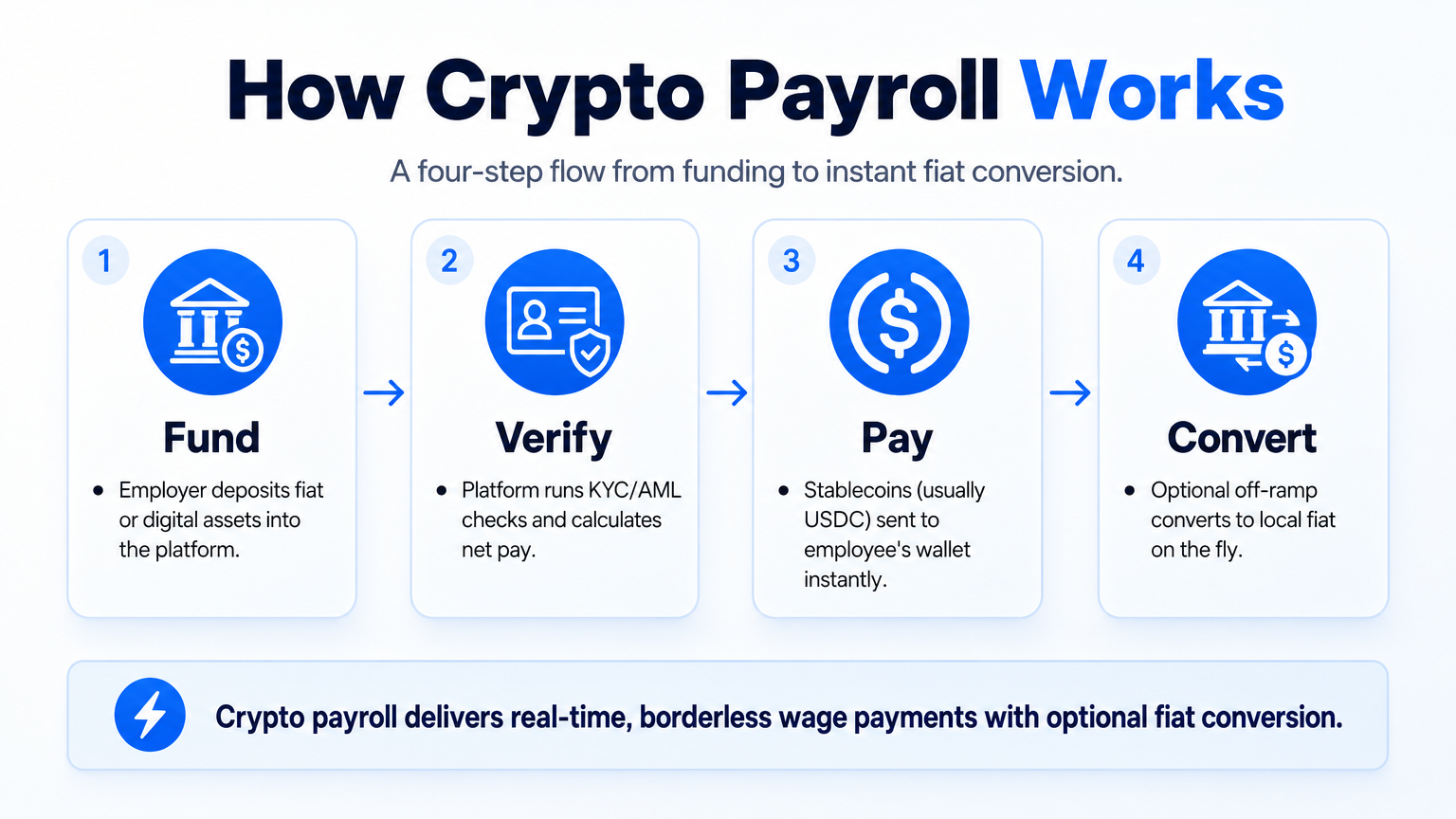
How does crypto payroll work?
An employer funds a crypto payroll platform with fiat or digital assets. The platform handles compliance checks (KYC/AML), calculates net pay, and sends the agreed amount — usually in USDC — to the employee’s wallet. For employees who prefer fiat, an integrated off‑ramp converts the stablecoin to local currency instantly, a true crypto to fiat payroll flow. Tax withholding and reporting are managed by the platform, syncing with the employer’s accounting system.
Is it legal to pay wages in crypto?
The answer is jurisdiction‑dependent. In the U.S., the Fair Labor Standards Act requires employees to be paid “in cash or negotiable instrument payable at par.” The Department of Labor has not issued definitive guidance that stablecoins qualify, though some states have allowed limited trials. Countries like Switzerland, Japan, and the UAE have clearer paths. Employers must consult local counsel before offering payroll in crypto.
How is crypto regulated?
Crypto payroll platforms typically register as money transmitters or partner with licensed entities to remain compliant. In the U.S., FinCEN requires state-level money transmitter licenses and robust AML/KYC programs. The SEC and CFTC may have overlapping jurisdiction. Many platforms lean on regulated stablecoins like USDC, issued by entities that frame them as consumer utility tools — a shift explored in OneSafe’s coverage. Senator Lummis has advocated for stablecoin settlement speed as a consumer protection measure, a position that could accelerate federal clarity (see OneSafe’s analysis).
How is crypto taxed?
Wages paid in cryptocurrency are treated as ordinary income and taxed at fair market value on the day of receipt. Employees must track cost basis for any future sale, and employers must report the value on W‑2 (U.S.) or equivalent forms — and withhold payroll taxes in fiat. Crypto payroll compliance with automated tax reporting is not yet universal, making it a critical selection criterion.
Where Crypto-Payroll Fits in the Embedded Revolution
How DAOs and Web3 teams operate natively
DAOs and Web3 startups have never operated like traditional companies — and their payroll reflects that. Compensation flows in a mix of stablecoins, governance tokens, and fiat. Crypto payroll platforms designed for DAOs allow multi‑sig approvals, on‑chain vesting contracts, and automated token disbursements that line up with governance votes. DAO payroll is already a reality, operating on the same embedded‑finance logic banks are now embracing.
The value of a unified fiat+crypto platform
The PNC/ADP announcement highlights a pain point many global businesses still face: fragmentation of financial tools. A company paying international contractors in stablecoins while paying domestic employees via ACH typically juggles multiple bank accounts, crypto wallets, and payroll providers. Platforms that unify fiat and crypto — offering ACH, wires, foreign exchange, and cross-border crypto payments in one interface — remove that friction. OneSafe, for instance, provides multi‑currency accounts, corporate cards, crypto on‑ and off‑ramps, and automated payroll in a single dashboard, a design that mirrors the embedded‑payroll vision but with the ability to settle in both fiat and stablecoins.
Security, Compliance, and Infrastructure: What's Different Now
Custody and multifactor authentication
Crypto payroll introduces a new attack surface: if an employer’s or platform’s wallet is compromised, payroll funds can disappear irreversibly. Institutional-grade custody and mandatory Multi-Factor Authentication (MFA) are non‑negotiables. OneSafe, for example, secures digital assets through Fireblocks custody using multi‑party computation (MPC). Businesses evaluating solutions should demand penetration testing, SOC 2 reports, and proof of segregated on‑chain reserves.
Integration with accounting and reporting
No payroll solution survives in isolation. The real test is how smoothly it integrates with QuickBooks, Xero, or an ERP, and whether it can produce a consolidated general ledger entry for payments in both USD and USDC. The best crypto payroll platforms now offer direct API integrations or pre‑built connectors, so finance teams don’t have to manually reconcile on‑chain transactions against fiat bank feeds — a gap that earlier decentralized tools left open. This level of integration is what banks like PNC hope to provide within their walled garden, but the crypto‑native world has been building it for years.
Actionable Insights: Should Your Business Adopt Crypto-Payroll in 2026?
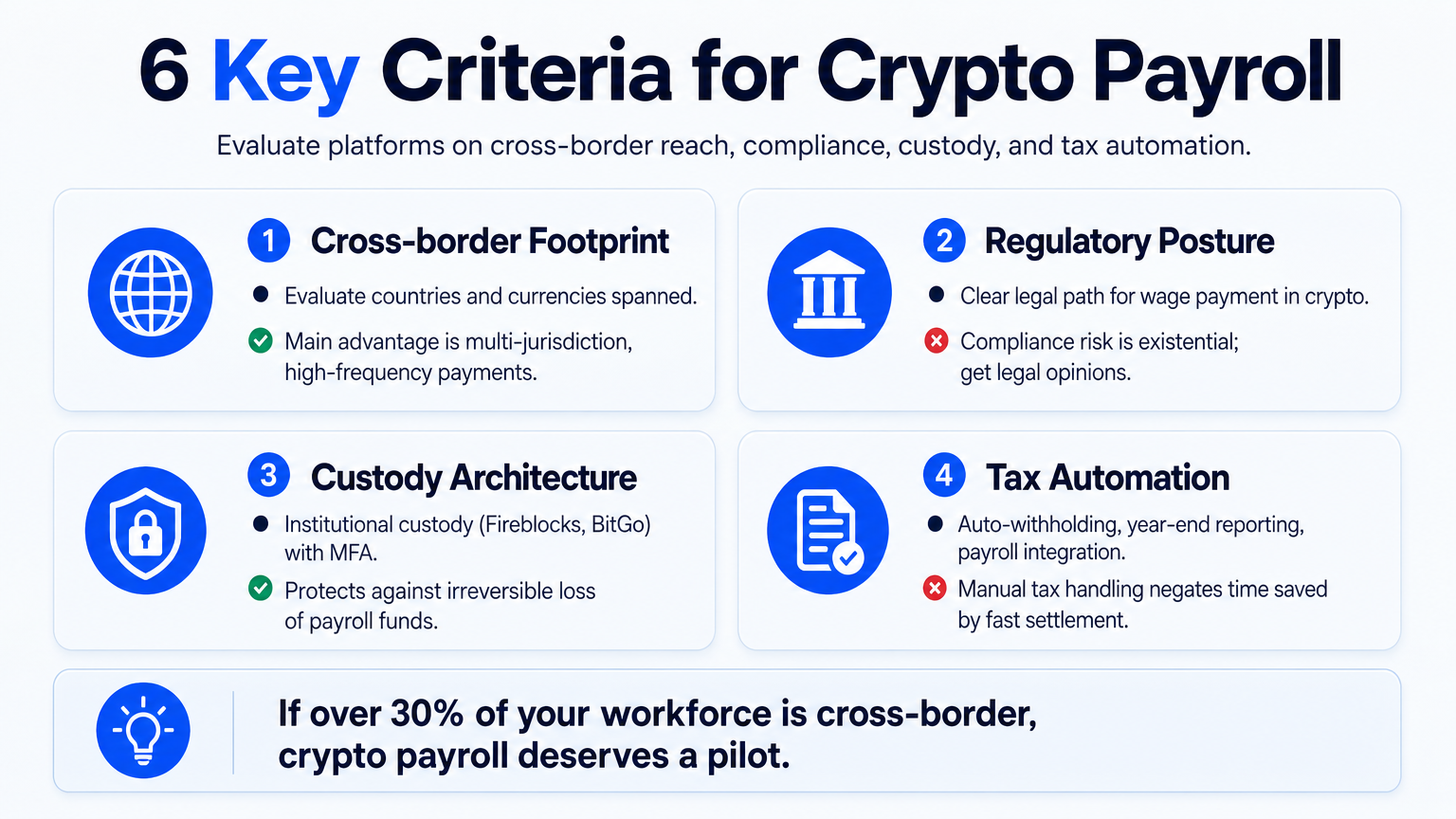
Criteria for choosing a solution
The deciding factor: If you pay more than 30% of your workforce across borders and settlement delays cost you talent or operational speed, crypto payroll warrants a serious pilot.
Preparing for a hybrid payroll future
The PNC ADP payroll integration signals that traditional payroll will not remain static. By 2027, expect multiple banks to offer embedded payroll with at least a toe in stablecoin settlement (PNC itself piloted USDC for treasury management earlier in 2026). A smart hybrid strategy today:
- Run a pilot with a small contractor group using a crypto to fiat payroll platform that supports instant conversion.
- Audit your accounting integration and tax workflows in parallel so you can scale without surprises.
- Monitor your own banking partners’ roadmaps; your current bank could soon offer an embedded solution that overlaps with — or replaces — standalone tools.
As you build your payroll infrastructure, maintaining an SEO-optimized content strategy can help educate your team on the nuances of payroll in crypto. Joyrise — a service that writes and publishes SEO articles to your Webflow, WordPress, or Shopify site daily — can help grow your organic traffic while you sleep, starting with a free first article.
What to Watch Next in Crypto-Payroll
Regulatory developments
The SEC’s posture on staking and stablecoins, the progress of stablecoin legislation (like the Lummis‑Gillibrand framework), and individual state labor rulings will determine how quickly crypto payroll moves from “early adopter” to “mainstream.” The Illinois crypto tax case (see OneSafe’s DeFi compliance analysis) is a reminder that tax authorities are watching on‑chain payment activity closely.
More banks entering the space
JPMorgan’s $1 billion crypto move and a separate custody launch by Deutsche Bank in early 2026 (covered by OneSafe) both point to a world where traditional institutions feel comfortable holding digital assets. The logical next step is for these institutions to embed payroll functionality — possibly by acquiring or white‑labeling crypto payroll platforms. The convergence of banking and crypto payroll is inevitable; the question is whether businesses will be ready to integrate it without sacrificing the flexibility they already have.
Key Takeaways
- PNC Bank’s embedded PNC ADP payroll partnership on November 13, 2026, validates the “all‑in‑one” experience that crypto payroll platforms pioneered.
- Crypto payroll still leads in real‑time cross-border crypto payments and programmability, but traditional banks are closing the experience gap.
- The regulatory and tax landscape remains fragmented; businesses must perform jurisdiction‑specific crypto payroll compliance due diligence before paying wages in crypto.
- A unified fiat‑crypto platform that combines custody, compliance, and accounting integration offers the most resilient path for hybrid teams.
- 2027 will bring more bank‑anchored payroll solutions that blur the line between traditional and crypto payroll — start piloting now.
For global businesses that want to manage both fiat and crypto payroll in one place, explore how OneSafe simplifies multi‑currency operations.
Sources
- What is Crypto Payroll? Definition, Explanation, Pros & Cons
- The potential of blockchain in payroll
- Stablecoin Payroll for Global Teams - Toku
Get started with Crypto in minutes!
Get started with Crypto effortlessly. OneSafe brings together your crypto and banking needs in one simple, powerful platform.