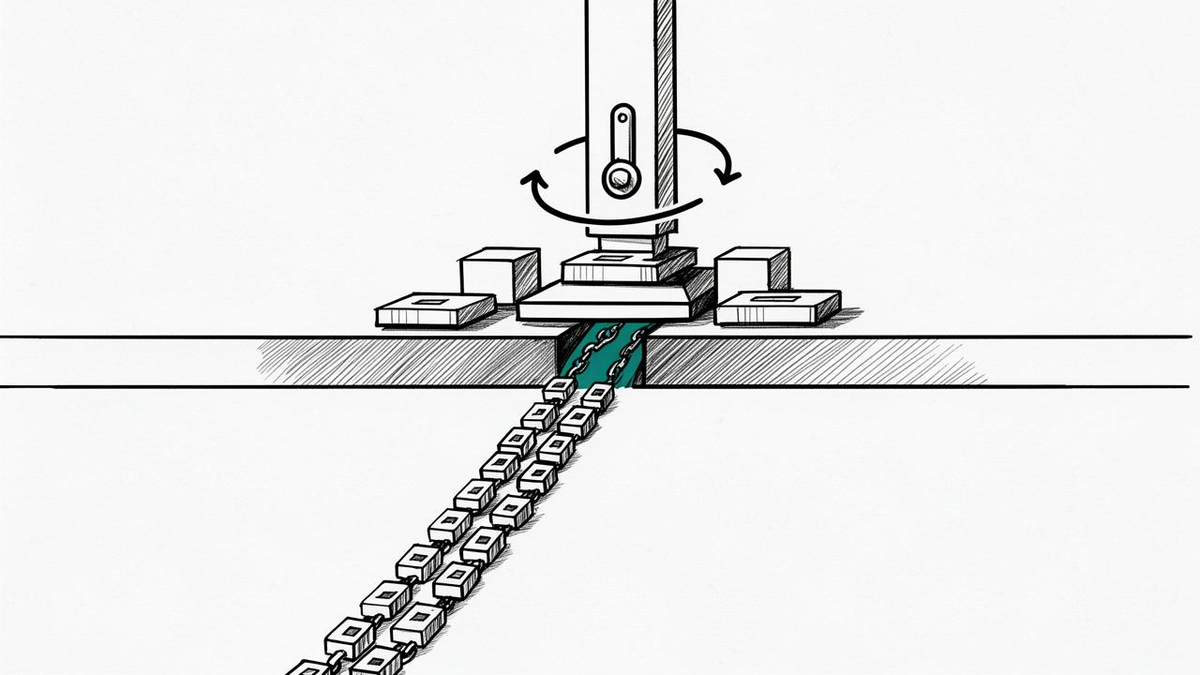
Ethereum's core developers are reviewing a draft change to how gas is accounted for when validators make deposits, aiming to close a gap that could let blocks carry more data than their gas limits imply.
The proposal, circulated on Nov. 22, 2026, would fold the request bytes produced by deposit events into the minimum gas charge. Today that 192-byte payload rides along with the block after execution but is excluded from the floor, meaning the same gas ceiling can admit more data than the original calculation anticipated. No network upgrade has been scheduled for the change.
The issue sits with data size rather than execution cost. Under the Gloas design, there is no fixed cap on deposit requests per block, and the execution layer imposes no ceiling of its own, leaving gas as the only practical brake. Neither EIP-8131 nor EIP-8279 accounts for the request bytes, according to the draft, raising the risk that deposits become another route around the gas floor once EIP-8279 shuts the cold-storage read loophole.
The draft's authors point to a concrete path: a relay contract can call the deposit contract repeatedly at roughly 26,000 gas per deposit, a cost that stays under the threshold at which zero-byte calldata begins lifting the total fee. The resulting data load can climb to about 1.44 times the base value, divided by 64 for block gas limits, from roughly 1.15 times previously.
The remedy is to check for the deposit contract's log event topic and count it as 192 bytes, mirroring the condition EIP-6110 uses to turn logs into requests. Developers behind the draft argue that measuring the existing data path is a more straightforward technical route than alternatives.
Note: Figures are as stated in the draft proposal.
Ordinary depositors are unlikely to see higher costs. The execution cost of a standard deposit already exceeds the proposed minimum, so the extra 12,288 gas only lifts the floor. The burden instead falls on client teams, which would need to implement, test and verify the new check across different clients before any hard fork could include it.
The work is part of a broader push to tighten Ethereum's gas mechanics ahead of potential upgrades. Leaving the request bytes uncounted would undermine the gas floor that EIP-8279 is meant to establish, allowing blocks to carry more data than the limit suggests and complicating predictable block-space usage as staking infrastructure evolves.
For validators and developers, the trade-off is added implementation work against the risk of unintended behavior in deposit processing. Whether the change lands depends on core developers deciding to slot it into a future hard fork; no timeline has been announced.
Ether traded at $1,723 on Nov. 22, up 2.5% over 24 hours but down 4.8% on the week, according to CoinPaprika data. The market capitalization stood at $210.59 billion, with 24-hour volume of $5.97 billion.
Once added, BigGo Finance appears first in Google Search Top Stories, so you get the broadest, most up-to-the-minute, and most comprehensive global financial news first.