The Ethereum Foundation has recommended Keccak-256 as the single hash function to anchor the network's migration to post-quantum cryptography, a decision that sets the cryptographic foundation for a transition the foundation aims to complete internally by 2029.
Researcher Kev Wedderburn laid out the recommendation in a foundation post published November 24, framing the choice as one hash function serving several roles rather than a patchwork of specialized algorithms. The guidance is not an Ethereum Improvement Proposal and does not schedule a network upgrade; it is a research milestone that gives client teams a fixed reference point for work still ahead.
Keccak-256 is already native to Ethereum's execution layer, where it underpins wallet addresses, the state trie and an opcode in the Ethereum Virtual Machine. That history, spanning roughly two decades of public cryptanalysis, was the decisive factor. The foundation weighed it against Poseidon and Poseidon2, BLAKE3, BLAKE2 and SHA2-256.
"We recommend Keccak-256 as the hash function for Ethereum's hash-based cryptography," the foundation's post said.
The choice closes a debate that opened in August, when researcher Justin Drake announced that Poseidon had been dropped and that SHA2 and BLAKE variants were under initial consideration. In the end, none of those alternatives was adopted.
Security margin outweighed speed
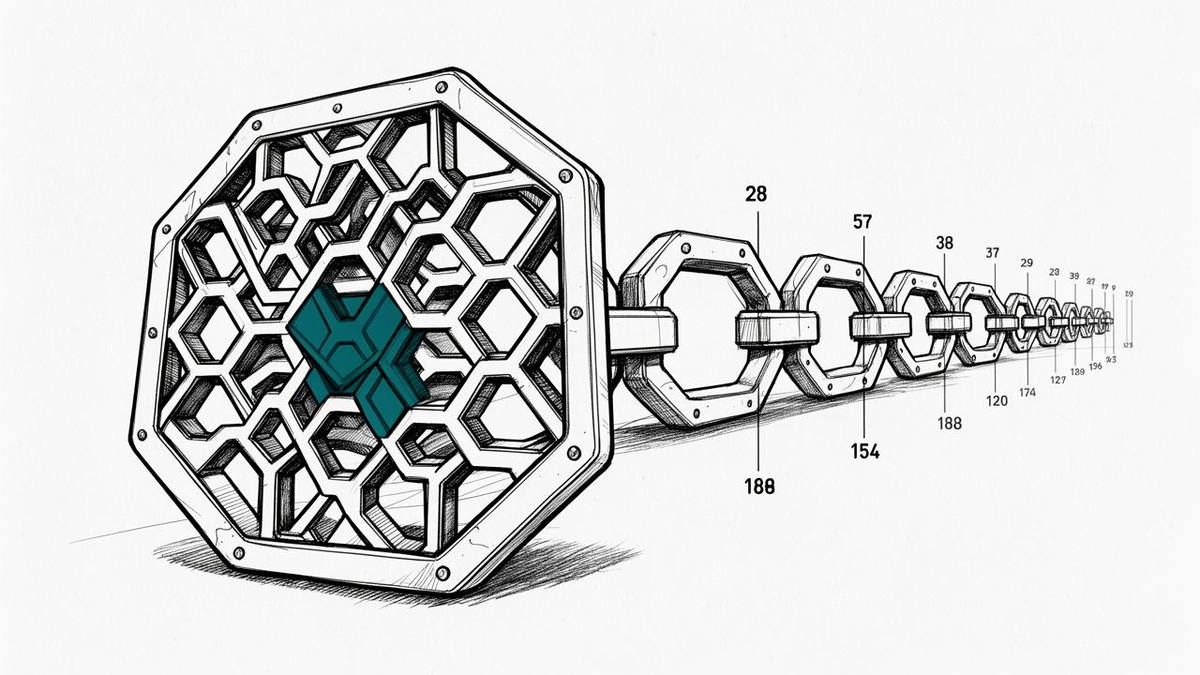
Foundation researchers gauge hash safety by how much of an algorithm's round structure a practical attack can reach. On that measure, Keccak-256 holds a wide advantage over the SHA2-256 function Ethereum's consensus layer currently uses for Simple Serialize merkleization.
Note: Figures as cited in the Ethereum Foundation's research post; a separate count attributed to Goldreich 2026 put the SHA2-256 figure at 38 of 64 rounds.
Keccak-256 is slower than SHA2-256 when computed directly and is outpaced by BLAKE3 in proof settings, but the foundation judged the security margin more valuable than raw throughput. Its resistance to AI-assisted cryptanalysis has held so far, according to the post.
"That tradeoff is gone, now that SNARKs handle standard hashes efficiently," the post said, referring to the proof-cost disadvantage that once made Poseidon attractive for aggregating validator signatures. Prover advances now allow more than 500,000 standard hashes per second inside SNARKs, and LeanVM exceeds 500,000 Keccak-f operations per second on the foundation's target hardware.
Three primitives were selected together: Keccak-256 for standard hashing, Keccak-duplex for Fiat-Shamir sponge constructions, and SHAKE256 for pseudorandom bit generation and key derivation.
Client impact is uneven
The operational burden falls unevenly across Ethereum's two client layers. Execution-layer clients need no new hash function because Keccak-256 is already in place there. Consensus-layer clients are advised to move SSZ merkleization from SHA2-256 to Keccak-256, a longer-term objective that node operators and exchanges will need to track.
The foundation's internal deadline for completing the hash-based migration is 2029, with a timetable review scheduled for January 2027. Drake has floated an earlier target of December 2028, a researcher proposal rather than a confirmed network milestone.
The effort sits inside a research series the foundation calls PQAI, for post-quantum and post-AI, and follows the January formation of a dedicated post-quantum cryptography team. The framing is deliberate: the foundation treats artificial intelligence as a nearer-term pressure on elliptic-curve cryptography than quantum computing itself, and the hash recommendation was evaluated with AI-assisted attack methods in mind.
Hash selection is only one component of a much larger migration. A quantum-resistant Ethereum would also need new signature schemes, revised key management and backward compatibility with existing addresses and transactions. Settling the hash function early gives developers a stable base for that work.
The recommendation carries no near-term consequences for Ether holders or for live transactions, and markets showed little reaction. Ether perpetual futures on Hyperliquid traded near $1,703 at publication time, up about 1.1% from $1,685 when the first report on the decision appeared on November 24, with open interest around $1.10 billion and a funding rate implying longs pay shorts roughly 11% annualized.
The longer-term significance lies in institutional due diligence. Custodians and large holders assessing blockchain security over multi-year horizons increasingly ask how networks plan for quantum risk, and a documented, evaluated roadmap gives Ethereum a concrete answer where many networks offer only intentions. Whether the recommendation becomes a formal EIP, and whether consensus-layer merkleization actually shifts to Keccak-256, are the milestones that will show how far the plan has moved from paper.
Once added, BigGo Finance appears first in Google Search Top Stories, so you get the broadest, most up-to-the-minute, and most comprehensive global financial news first.