Which topics should we dive deeper into?
Select what genuinely interests you. Your picks feed directly into our editorial planning.
Crypto news that's actually worth your time.
Weekly. 60 seconds. Carefully curated by our editors: no hype, no promo flood, no spam.
Ether is trading at around $1,896 on Saturday morning, roughly €1,720, its lowest level since mid-August. The same week brought a technical announcement that carries more weight for the medium-term outlook than the price suggests: the developer team behind the Ethereum client Lighthouse has submitted a fix for a vulnerability that would have become exploitable around the next major upgrade, Glamsterdam.
What is confirmed: the fix exists as a pull request and is still awaiting review, and the price briefly fell below $1,890 overnight into Saturday. Our assessment follows further down. In short, we see ETF flows as the stronger lever over the coming weeks, but the code as the factor that determines when Glamsterdam arrives at all.
Where the price could head over a horizon of months is covered in our Ethereum price prediction. This piece sticks to the short term: what lies behind the Lighthouse vulnerability, which levels have broken or held since Friday, and which steps investors can sensibly take now.
Lighthouse bug ahead of Glamsterdam: what the pubkey cache is
Lighthouse is one of several consensus clients for Ethereum. A consensus client is the software validators use to check and attest to blocks and to agree on which version of the blockchain is valid. Alongside Lighthouse, the network runs Prysm, Teku, Nimbus and Lodestar, among others. This diversity is deliberate: if one program has a bug, the whole network does not depend on it.
The vulnerability concerns the so-called pubkey cache. This is a buffer in which a node keeps the public keys of all validators so that it can check their signatures quickly instead of reading each key afresh from the state of the blockchain. According to the description in pull request 10569 in the Lighthouse repository, a key could enter this cache before the associated deposit was finally confirmed. On a side branch of the blockchain, this could have led to conflicting mappings between validator and key.
The trade site U.Today describes the consequence as follows: affected nodes would have rejected valid signatures from a validator and thereby split off from the valid branch of the blockchain. Exploiting it would take effort. Before the upgrade, an attacker would need three pending deposits, namely a large top-up for an existing validator and two new keys, one of them with builder permissions, plus a penalty (slashing) at the right moment and a side branch. A chance hit is therefore considered unlikely.
The fix comes from Lighthouse developer Michael Sproul. Under it, keys only enter the global cache once the epoch from which the validator may be activated has been finally confirmed. A new structure called HeadPubkeys links the keys from the current state with the global cache, so that no key is missing if the blockchain goes for a while without finalising new blocks. The pull request carries the labels “gloas” and “v9.0.0”, so the change is meant to land in a new major version before the upgrade. Sproul himself points out that rolling back to an older version afterwards will no longer work smoothly.
One detail matters because conflicting reports are circulating: U.Today reported the fix as merged on Friday. On GitHub, the pull request was still open when we checked on Saturday morning, and approval from a second developer was missing. Whether other consensus clients have a similar weakness has not been confirmed, according to U.Today.
Gloas and Glamsterdam: the upgrade is still stuck on testnet
Glamsterdam is the umbrella name for the next Ethereum upgrade. It combines Gloas, the consensus-layer part, and Amsterdam, the execution-layer part. The Lighthouse vulnerability belongs to Gloas, because it would only have become exploitable with the changes to deposits and builder roles planned there.
The timetable had already slipped before this announcement. Activation on the Hoodi testnet, originally planned for October 26, was postponed; crypto.news cites eight affected invariants, meaning rules the code must always uphold. On November 6, according to the same report, the Ethereum Foundation wrote that it was working with the audit firms ChainSecurity and Dedaub on the proposals EIP-8037 and EIP-8038. There is no new date for Hoodi yet, let alone for mainnet.
For the price outlook, this means an upgrade that traders could price in as a catalyst is not getting any closer. Every vulnerability found before launch, however, is one that can do no damage after launch. That is exactly the tension ether is caught in right now.
Ether since Friday: $1,890 briefly broken, $1,875 held
On Friday evening, in our analysis of the Foundation wallet's sales, we named three levels: $2,000 as resistance, and $1,890 and $1,875 below it as support. Here is what has happened since. At the start of Friday (UTC), ether still stood at around $2,017 according to CoinGecko. The 24-hour high was $1,981.82, just below the round number, and the low was $1,880.84.
Support at $1,890 thus broke briefly overnight, while the lower one at $1,875 held. On Saturday morning ether is trading just above it again. Against bitcoin, one ether stands at around 0.0283 BTC. Over seven days the decline adds up to just over 16 percent, according to market data on crypto.news.
What is new compared with Friday is above all the distance to the summer: according to CoinGecko's daily prices, ether last closed below $1,900 in mid-August, at around $1,874 on August 17. The setback has therefore wiped out the entire autumn recovery.
Ether ETFs: six straight days of outflows to November 12
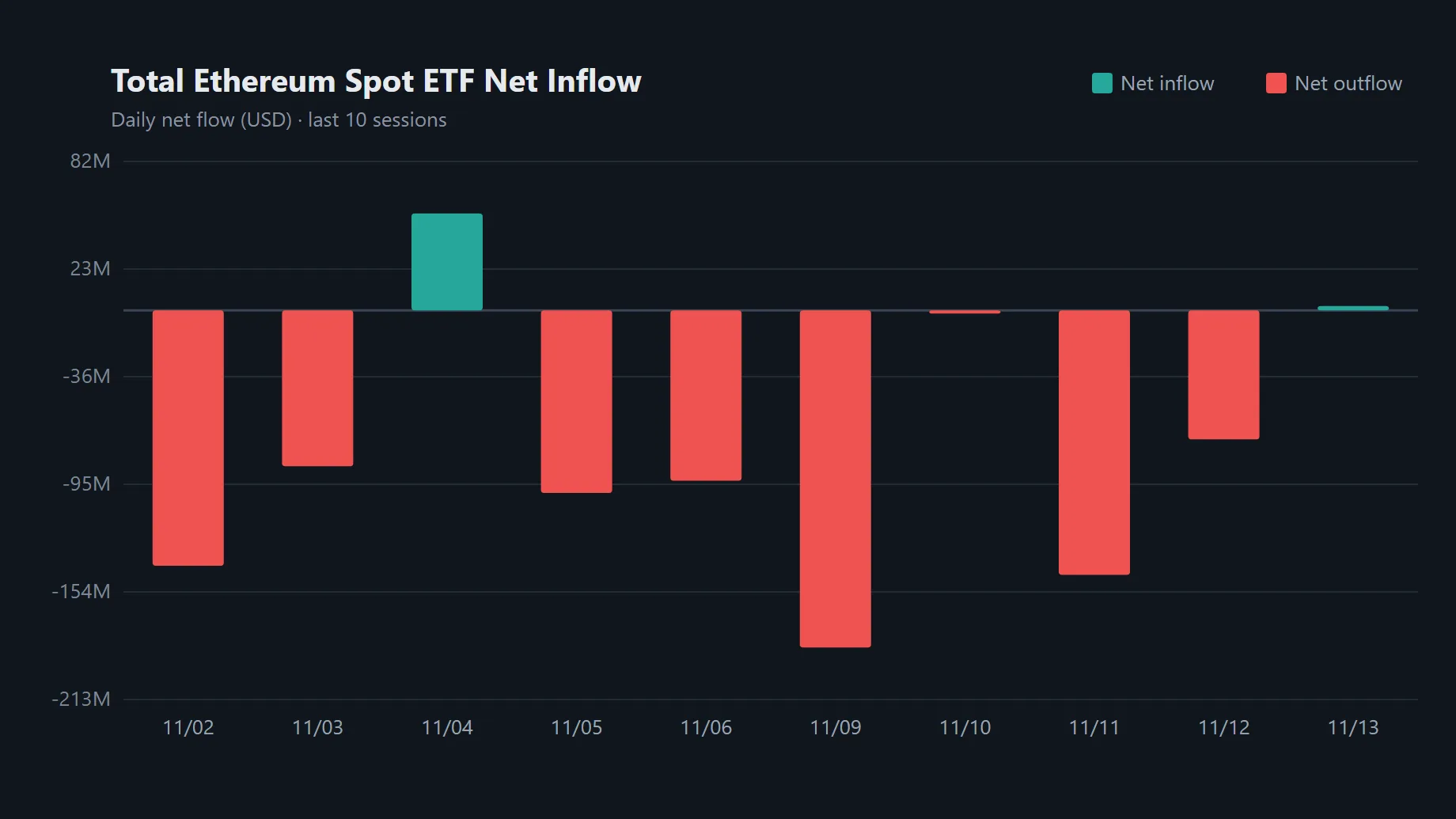
We continue to see the greatest selling pressure in the US exchange-traded ether funds. According to data from the analytics firm SoSoValue, the spot ETFs lost a net $70.57 million on November 12, the sixth consecutive day of outflows. In November, outflows up to that point total $695.9 million. Friday's figures were not yet complete on Saturday morning.
The mechanism is simple. A spot ETF holds real ether. When investors redeem shares, the issuer has to shrink its holdings and hand over ether, either by selling on the market or by transferring it to the trading partners returning the shares. Either way, supply enters a market where few buyers are standing by. For comparison: the Foundation wallet we reported on Friday sold 2,000 ETH for around $3.87 million.
Fees and burn: cheap transactions let the ETH supply grow
A second reason for the weak sentiment lies within Ethereum itself. Since the EIP-1559 proposal, the base fee of every transaction is burned, meaning permanently destroyed. crypto.news shows how strong the effect is with a simple example: a transfer uses 21,000 gas. At a base fee of 10 gwei, one million such transfers burn 210 ETH; at 1 gwei, only 21 ETH. To burn the same amount at 1 gwei would take ten million transfers.
Because Ethereum has deliberately lowered fees with its latest upgrades, the burn is small. If issuance to validators exceeds the amount burned, the supply of ether grows. Co-founder Vitalik Buterin nonetheless stood by the model on November 8, saying EIP-1559 including the burn was “good” and should stay. Markus Hämmerli, head of asset management at the crypto bank Sygnum, told crypto.news that institutions holding ETH for the long term increasingly think in ETH rather than dollars. For them, the staking yield matters more than whether supply is shrinking.
Ether price levels: where $1,841 and $1,982 come from
Three levels for the coming days emerge from the price data; none of them is a recommendation. On the downside, the overnight low of $1,880.84 comes first, with the August 17 daily close at around $1,874 directly below it. If this area gives way, the next documented zone is the summer low: on July 18, ether closed at around $1,841 according to CoinGecko, its lowest daily close of the past 200 days.
On the upside lies the 24-hour high at $1,981.82 and above it the round $2,000 mark, where ether has failed several times since Thursday. Only a daily close above $2,017, Friday morning's level, would partly make up for this week's setback.
Our view: the code fix reassures, ETFs set the price
From the newsroom's perspective, the Lighthouse announcement is more of a good sign. The vulnerability was found before Gloas goes live, it has been publicly described and the fix is available. That speaks for the review process currently delaying Glamsterdam. On the other hand, every further finding extends the wait, and as long as there is no date for Hoodi, ether lacks an event buyers could bet on.
For the next two weeks we therefore consider two scenarios supported by the data. In the first, ETF flows turn positive, and a return above $1,982 and $2,000 becomes realistic because the largest seller drops out. In the second, outflows continue at their current pace, and the summer low at $1,841 comes within reach. Both scenarios are readings of the data, not price targets. Anyone holding or planning to buy ether should size every position so that even a total loss remains bearable.
Ether staking: what separates solo stakers from exchange customers
If you run your own validator with Lighthouse, you now have a concrete task: wait for the release of version 9.0.0, read the release notes and update before the upgrade. Given the warning about rolling back to older versions, it is worth backing up your configuration beforehand. If you stake through an exchange or a staking provider, you do not need to do anything; the provider runs the software. What makes sense there is to ask which clients it uses and whether it spreads them.
Buying ether under MiCA: licence, fees and custody
Since the transition period ended in late 2025, full MiCA obligations apply to purchases in the EU: anyone brokering crypto-assets to customers in the EU needs a licence as a crypto-asset service provider. Which platforms hold this authorisation is shown in our overview of regulated crypto exchanges. With a falling price, fees deserve particular attention: a spread of one percent costs almost $19 per ETH at $1,896 before the price has even risen.
For custody the old rule applies: what is not being traded is better kept in your own wallet over the long run than in an exchange account. If you want to stake, though, you give up the convenient exchange option and have to organise it yourself.
Ether below $1,900: without ETF inflows there is no path above $2,000
- Compare where to buy: Fees and spreads differ markedly between providers. Our crypto exchange comparison sets out the terms for ether side by side.
- Check staking providers: Yield, lock-up periods and the clients used are the criteria that matter after the Lighthouse announcement. The overview of staking platforms puts them in context.
- Decide on custody: For ether you hold for longer, a hardware wallet is the safest solution. Which devices support ether and staking is shown in our hardware wallet comparison.
(As of November 14, 2026. This article is not investment advice. Prices and fee structures change; check the terms with the provider before you buy.)
Frequently asked questions about Ethereum
The biggest pressure comes from US spot ETFs: according to SoSoValue, $695.9 million flowed out in November up to November 12, on six consecutive days. Added to that are low fees, which mean less ETH is burned, and an upgrade without a date.
Glamsterdam is the next major Ethereum upgrade. It consists of Gloas for the consensus layer and Amsterdam for the execution layer. Activation on the Hoodi testnet was postponed in October, and no new date has been set yet.
Lighthouse is a consensus client that validators use to run the network. A vulnerability found there affects the Glamsterdam upgrade. The fix is available as a pull request; every bug found before launch can lengthen the timetable.
On the downside, the overnight low at $1,880.84, the August 17 daily close at around $1,874 and the summer low at around $1,841. On the upside, the 24-hour high at $1,981.82 and the round $2,000 mark.
Partner links: some links on this page are partner links. If you become a customer through one of them, we may earn a commission at no extra cost to you. Selection, ratings and ranking are decided independently by our editorial team. Ethics and Independence · Ownership and Funding
Transparency note: This article was produced with the assistance of artificial intelligence and reviewed by our editorial team before publication. All figures and claims were checked against the primary sources linked in the text. The feature image was generated with AI.
For later? Save this article and find it again in your profile.
More on Ethereum: All Ethereum news at a glance
Related articles
- Ethereum price prediction: Foundation wallet sells for a fourth time, ETF outflows 87 times larger
- Ethereum Price Crashes Below $2,000: How Low Can ETH Go?
- Ethereum price at $1,958: exit queue grows to 269,951 ETH as ETF outflows reach $696 million
- XRP price prediction: can record whale wallets offset $18 million in ETF outflows?
- Ethereum price below $2,000: record staking meets ETF outflows
Which topics should we dive deeper into?
Select what genuinely interests you. Your picks feed directly into our editorial planning.
Crypto news that's actually worth your time.
Weekly. 60 seconds. Carefully curated by our editors: no hype, no promo flood, no spam.
November 12, 2026 7:25 PM
Ethereum price prediction: Huang's exit pushes ETH below $2,000 as ETF outflows hit day five
Analysis: The surprise resignation of Nvidia CEO Jensen Huang also hit ether on Thursday, with ETH falling as low as $1,983. On top of that came $144.8 million in ETF outflows on the fifth day in a row; which levels count now and what investors can do.
November 11, 2026 7:24 PM
Ethereum price prediction: can buyers hold $2,000 as ETF outflows shrink 99 percent?
Analysis: outflows from US ether ETFs shrank to $1.32 million on November 10, after $184.5 million the day before. Why ether is still stuck around the $2,000 zone and what role Friday's producer prices play.
November 10, 2026 3:21 PM
Ethereum price prediction: Buterin bets on store of value as Bitmine adds 9,587 ETH
Analysis: Vitalik Buterin wants Ether valued as a store of value rather than a fee-burning token, and Bitmine now holds 4.97 percent of all ETH. Why the price still sits below the 200-day moving average at $2,154 and which levels matter until Friday's expiry.
November 9, 2026 1:17 PM
Ethereum falls below $2,100: weakest against bitcoin since July
Ether fell 5.3 percent on November 9, 2026, to around $2,119, losing almost three times as much as bitcoin. One ether now buys only 0.0283 bitcoin, the lowest since July, as long liquidations and ETF outflows add to the pressure.
November 8, 2026 11:13 PM
Ethereum price: $343 million in long liquidations push Ether to $2,120
Analysis: Ether loses around 5 percent on Sunday evening and stands at $2,120, its lowest since August. The trigger is a wave of liquidations in which Ether positions made up the largest share, more than Bitcoin.
November 7, 2026 7:12 PM
Ethereum price holds €2,000 as ether ETFs log a sixth straight week of outflows
Analysis: Ether is hovering around €2,000 on Saturday evening after the US spot ETFs lost money for a sixth consecutive week. Which figures are confirmed, why the euro level matters more than the dollar price for investors in Germany, and which steps you can check now.
November 7, 2026 5:13 PM
Ethereum Upgrade Glamsterdam Halted Before Hoodi Over Eight Gas Traps
Analysis: The Ethereum Foundation is holding Glamsterdam back from the Hoodi testnet because two gas changes could put existing smart contracts at risk. What lies behind EIP-8037 and EIP-8038, how the options market looks through December and which levels around $2,233 matter.
November 6, 2026 3:16 PM
Ethereum Price After the Jobs Report: 165,000 New US Jobs Sharpen Fears of a Fed Hike
Analysis: US payrolls grew by 165,000 in October, more than twice the forecast, and futures now put the odds of a Fed rate hike in December at around 80 percent. Ether sits at $2,236, its lowest level since August, as the 200-day line at $2,157 draws closer.
November 6, 2026 3:12 AM
Ethereum Price Falls 7.9 Percent to $2,237 After Seven Days of ETF Outflows
Analysis: Ether lost 7.9 percent in 24 hours to around $2,237 and fell harder than Bitcoin after a chip sell-off on the Nasdaq wiped out leveraged positions. The role of ETF outflows, the levels that matter now and what investors in Germany should consider on tax and buying.
November 5, 2026 12:07 PM
Ethereum Price Prediction: 77,441 Puts for November 13, Then the Options Market Flips
Ether just gained 5.5 percent, yet the options market is split: for November 13 there are three times as many puts as calls, for November 27 twice as many calls as puts. What that means and which levels count now.
November 4, 2026 7:23 PM
Ether ETF buyers sit at an average of $3,200: the Ethereum price levels that count until then
Analysis: According to an estimate by Bloomberg Intelligence, buyers of the US Ether ETFs paid just under $3,200 on average, while Ether trades at $2,425 after the election jump. We recalculate the funds' paper loss, put the outflows in context and show which levels count on the way to the cost basis.
November 4, 2026 5:20 PM
Ethereum price jumps above $2,400: why Ether is outpacing Bitcoin after the US midterms
Ether (ETH) has recovered almost 8 percent in twelve hours from its US election-night low and is rising faster than Bitcoin (BTC). What is driving the move, which chart levels matter now and what investors in Germany should consider on buying, tax and custody.
November 4, 2026 7:42 AM
Bitcoin ETF Outflows Pass $1 Billion: Why Institutions Are Selling After the Midterms
Spot Bitcoin ETFs bled over $1 billion in three sessions as the Binance hack and the midterms spooked institutions. Where does BTC go next?
November 3, 2026 8:59 AM
Ethereum Price Below $2,300: Is $2,000 Next or Is This the Bottom?
Ethereum price slips toward $2,250 as $3 billion leaves DeFi. Whales are buying the dip. Does ETH hold $2,200 or test $2,000 next?
November 3, 2026 7:20 AM
Ethereum price prediction: BlackRock fund sheds 580,145 ETH, and BitMine absorbs only a fraction
Analysis: BlackRock's ETHA fund has shed 580,145 ETH in a month, and US ether ETFs have been losing money for six trading days. We work out how much of it is genuine outflow, why BitMine is not offsetting it and which levels the price now hinges on.
November 1, 2026 12:18 AM
Ethereum price prediction: Glamsterdam upgrade delayed, what matters now
Analysis: the developers have halted the Glamsterdam activation on the Hoodi testnet, and there is no new date. A different number matters more for the price: the base fee stands at 0.058 Gwei, and supply is growing again as a result.
October 29, 2026 9:50 PM
Ethereum Crash: The Binance Hacker Sits on 195,000 ETH. Is a Sell-Off Coming?
Ether fell 2.6% within an hour after the Binance hack. The bigger risk: about 195,460 ETH sit with the attacker and, unlike stablecoins, cannot be frozen. How big the selling pressure really is, which price levels matter and why Ethereum itself was not hacked.
October 22, 2026 10:24 AM
Ethereum price prediction: Glamsterdam forks Hoodi on October 26 with a 200 million gas limit, what to watch
Context: the Ethereum upgrade Glamsterdam forks the Hoodi testnet on October 26 at 17:42:48 UTC, where the gas limit rises to 200 million. A mainnet date is still missing, and that is exactly what decides what the fork is worth for the ETH price at $2,406.
October 16, 2026 10:15 AM
Ether gains 4.22 percent, Glamsterdam clients are due today: Hoodi forks on October 26
Ether trades at $2,451.86 on Friday morning, 4.22 percent above the previous day, while $60.22 million left the US funds on Thursday. The documented date of the day sits with the developers: client releases for Glamsterdam are due today, and on October 26 the last public testnet, Hoodi, forks.
October 8, 2026 1:16 PM
Ethereum Price Prediction: “We Thought It Would Take Five Years”, and 100,000 Ether Separate BitMine From Its Buying Cap
BitMine holds 6,016,414 Ether and stops buying at five percent of the circulating supply, around 100,000 Ether short of that line. At the same time the spot ETFs pulled $506.3 million over five days, and Glamsterdam has no date for mainnet.
October 7, 2026 1:18 PM
2,598 dollars and a sixth day of ETF outflows: will Ethereum hold the 2,500 line?
The Ethereum price stands at $2,598 on Wednesday morning, 3.9 percent below the previous day, while the US spot ETFs report a sixth consecutive trading day of net outflows. This article shows which levels below still hold, how far your leverage sits from the liquidation price, and what the German one-year rule under section 23 of the Income Tax Act means for a sale at a loss.
October 3, 2026 1:22 PM
Ethereum Price Prediction: Ether ETFs Lose $118 Million in Three Days, Bitcoin Funds Gain
Roughly $118 million has left the US spot Ether ETFs over three consecutive trading days, while the Bitcoin funds are gathering cash again. ETH closes at its lowest level since September 20. These are the levels that now count.
September 28, 2026 4:15 PM
Ethereum Price Prediction: The Level That Decides ETH Before the October 6 Sepolia Fork
Ethereum trades at $2,675.39 on September 28, just under 3 percent below the supply zone at $2,750 to $2,800. On October 6 the Sepolia test network forks to Glamsterdam, and separately from that, holders in Germany still have to settle before the year end what the holding period and the exemption limit allow.
September 22, 2026 7:20 PM
ETH Price Prediction: What to Check at the $2,800 Mark Now
Ether stands at $2,735.96 on September 22, 2026, right below the zone at which it has failed repeatedly. Instead of a target number, you get four checks that count before your next order: holding period, buying route, the staking line and the distance to liquidation.
September 21, 2026 1:13 PM
Ethereum Rises While ETF Money Leaves: What ETH Holders Should Check Now
US ether funds lost $140 million in the week to September 18, ending four weeks of inflows. The ETH price still gained a good 5 percent.
September 18, 2026 11:39 AM
Ethereum Price Prediction: Why ETH Is Closing In on $3,000
Ethereum is coiling between $2,400 and $2,600 with a rising 200 EMA underneath. Here is what the ETH chart says about $3,000.
August 30, 2026 10:56 AM
Ethereum Price Prediction: Can ETH Blast Toward $2,750 Next?
Ethereum price prediction after a 30% August rally: ETH sits at $2,453 with RSI cooling. Here are the bullish and bearish ETH price targets.
More from CryptoTicker