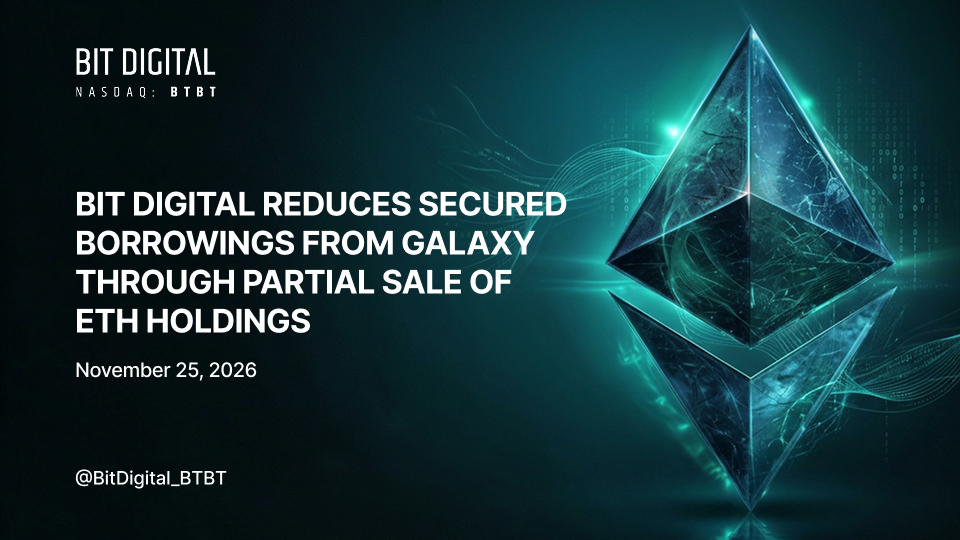
Ethereum treasury company Bit Digital sold 29,825 Ethereum for about $50 million to cut its Galaxy Digital debt by half. The Nasdaq-listed firm completed sales between November 15 and 23 at an average price of $1,676 per token.
Table of Contents
According to its November 25 announcement, the repayment cut secured debt from $100 million to $50 million. The transaction decreased the amount of debt while keeping their investment in AI startup WhiteFiber intact.
Bit Digital expects WhiteFiber to repay its $100 million bridge loan. The company anticipates full repayment by the second quarter of 2027.
How Ethereum Sales Reduced Galaxy Debt
Bit Digital started borrowing from Galaxy in March through a loan agreement. It borrowed $50 million in May and $10 million in July. Repayments in September decreased the amount owed to $30 million before borrowing an additional $70 million in October.
This credit facility has an annual interest rate of 5.5% based on the company’s quarterly filing. The lender may require additional collateral in case the value of collateral falls below certain levels. The lender also has the right to cancel the loan with a notice period of seven days.
Also Read: X Wins Massive $277,000 Judgment Over 9-Account Bot Farm
The November sell-off cut the latest balance in half. This reduced the debt that was backed by Ethereum-related collateral. However, the company did not provide any loan-to-value or liquidation threshold for the new balance.
Sam Tabar, the CEO of Bit Digital, said that the company would continue with its commitment to Ethereum and WhiteFiber. He referred to this payment as reducing leverage without sacrificing exposure to the investment opportunities.
What Ethereum Holdings Remain After the Sale
On November 23, Bit Digital had 134,532 ETH and ETH equivalents on hand. These comprised 36,811 ETH under native staking and another 69,089 LsETH, which secured the Galaxy loan of $50 million.
LsETH refers to liquid staked Ethereum and not any separate holding beyond the total of 134,532 ETH equivalents stated. Bit Digital has explicitly counted the pledged tokens as part of its balance. Hence, there is no need to include the collateral of the loan in the headline balance.
As of September 30, Bit Digital had 163,726 ETH and equivalents amounting to a total of $439.4 million based on an Ethereum reference price of about $2,684. This balance stood 17.8% lower than the September quantity despite being a snapshot of other treasury transactions.
During the third quarter, Bit Digital had swapped 73,683 ETH for 66,192 LsETH and had sold 1,625 ETH for $3.4 million at an average price of $2,114.62. Here, the latest price of $1,676 was 21% lower than this average price.
How WhiteFiber’s Financing Fits the Repayment
Galaxy borrowing contributed to the bridge financing of Bit Digital’s WhiteFiber NC-1 data center located in North Carolina. WhiteFiber is a majority-owned subsidiary concentrating on AI and high-performance computing hardware. At September 30, Bit Digital owned 59.7% of its shares.
On November 9, WhiteFiber announced a financing deal made between two of its subsidiaries amounting to $300 million. The deal includes a $200 million initial term loan and an extra $100 million via delayed draws. Morgan Stanley Senior Funding serves as an administrative and collateral agent.
Initial financing is conditional upon readiness and customer approval of the first 40 megawatts of the NC-1 project. Additional financings will depend on further milestones of the project and the financial state of the business. No loans were financed under this agreement according to the filings by WhiteFiber.
The projects mature five years after their initial financing. Project financing is separate from the borrowings by Bit Digital Galaxy and expected repayment of bridge financing of the subsidiary. This financing does not imply the repayment of the parent company by WhiteFiber.
Other Ethereum treasury companies also sold tokens in order to hedge against borrowing risks. On November 20, BTCS sold 27,300 ETH for $43.8 million in order to pay off Aave borrowings. Bit Digital’s recent filing shows lower crypto reserves along with lower secured debt.
Related: Franklin Templeton Prepares to Add HYPE to EZPZ Crypto Index ETF
This article contains market analysis and price predictions. These are not guarantees. Crypto markets are volatile. Always DYOR. Not financial advice.
Arslan Tabish is a Technical Reporter and Market Analyst at Tron Weekly with over five years of experience covering cryptocurrency markets and blockchain developments. His reporting focuses on Bitcoin, Ethereum, altcoins, and decentralized finance, alongside NFTs, crypto regulation, policy, and Web3 innovations.
Arslan covers blockchain technology, Layer 2 scaling solutions, and emerging use cases, including AI-driven crypto applications, while delivering clear market analysis on how technical and regulatory developments impact digital asset markets. His work is designed for both beginners and experienced readers, offering accurate, easy-to-understand reporting without speculation or investment guidance.