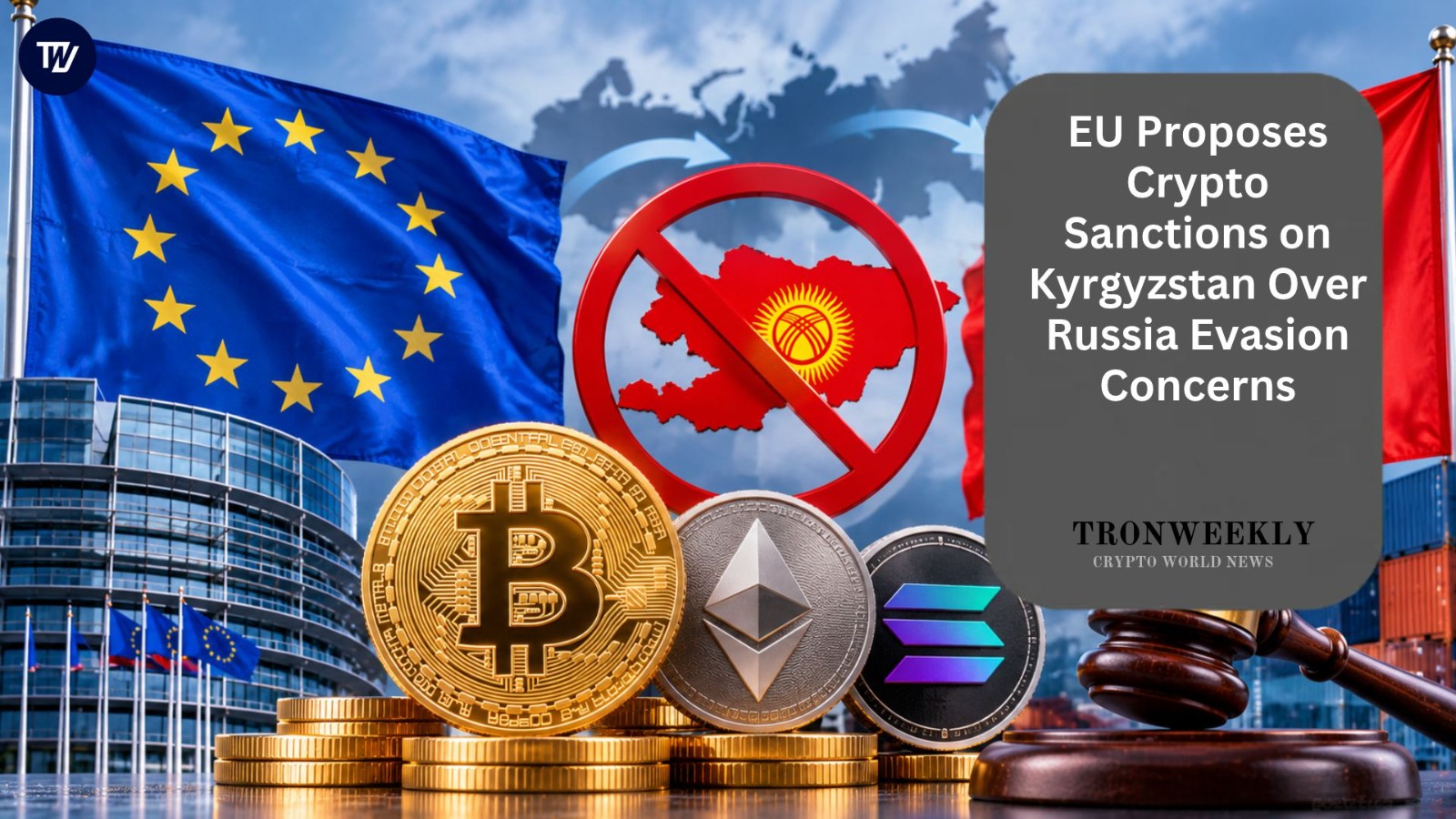
The European Union has proposed adding Kyrgyzstan to its Crypto Sanctions list, potentially making it the first country targeted under a mechanism designed to prevent sanctions evasion through cryptocurrency services. If approved, the measure would restrict EU operators from conducting direct or indirect transactions with crypto service providers established in Kyrgyzstan.
Table of Contents
The proposal is part of the EU’s 22nd sanctions package against Russia. It requires unanimous approval from all 27 member states before taking effect. The proposal may have implications for the way that financial companies in Europe would evaluate their cryptocurrency partners since the nationality of the platform will now determine whether the companies within the EU can continue using the service or not.
The proposal comes amid reports on cryptocurrency exchanges based in Russia and operating via third parties. One case involves Garantex, a Russian exchange disrupted by enforcement action in March 2025. In accordance with the US Treasury, former employees created a new crypto exchange called Grinex in Kyrgyzstan.
Also Read | SUI Stablecoin Supply Surpasses $631M as SUI Price Eyes Bullish Recovery
Crypto Sanctions Proposal Could Restrict EU Exchange Access
The EU introduced the country-level mechanism through its 21st sanctions package on July 23, 2026. It is possible to impose restrictions on crypto service providers in those countries that have systematically and repeatedly failed to ensure that their services are not used for sanctions evasion. The corresponding regulation establishes Annex LVII without country entries at all.
It seems that Kyrgyzstan will be the first state to enter this annex. As against individual exchange designations, this new method covers providers in the country included into the list. As a result, European firms may suffer from restrictions without any individual designation of the exchange by the EU.
Indirect payments are also covered by the rules. Thus, operators of the EU cannot bypass the restrictions through using intermediaries. It may concern European brokers, financial institutions, and other enterprises that use cryptocurrency exchanges as a means of transaction, settlement, or other services.
Crypto Sanctions Focus on Shared Wallets and A7 Transfers
More information regarding blockchain links between the exchanges can be found in the analysis conducted by the blockchain intelligence company TRM Labs. It issued a report regarding Kyrgyzstan-based TokenSpot exchange on October 6, 2026. According to TRM, it is highly confident that TokenSpot acts as a front company for Grinex. Similar wallet infrastructure was identified for the two independently registered exchanges.
TRM found out that TokenSpot and Grinex have six identical TRON addresses and one aggregation address where they send transaction fees. Also, a deposit aggregator was identified that received $146.3 million from 126 TokenSpot deposit addresses. Later, the exchange itself disclosed that it was using that address.
Financial linkages with Russian-affiliated entities were found. Between December 8, 2023, and September 27, 2026, TRON addresses of TokenSpot received $3.54 billion and sent $3.14 billion. Those figures refer to the on-chain activities of the exchange in question within the period in question, not illicit transactions.
A7 was the largest counterparty of TokenSpot outside its exchange. The exchange sent $679.5 million to the network and received $48.5 million from it. Also, TokenSpot sent $26.5 million directly to A7A5, the ruble-pegged stablecoin of the network.
UK Sanctions Target Kyrgyz Crypto and Payment Companies
On October 8, 2026, the United Kingdom initiated its own sanctions enforcement against some other companies involved in these networks. The set of sanctions included 38 designations related to Russia, with companies involved in cryptocurrency exchanges, payment processors, oil companies, and suppliers of goods related to Russia’s military industrial complex being targeted.
One of the companies being designated was Xeltox Enterprises Ltd, which was described by TRM as a Canadian company operating through Cryptomus and Heleket. The analysis showed how the two payment services were utilizing the same infrastructure, employees, brand, and funding source.
The sanctions designations made in October 2026 show that international regulators are not only targeting cryptocurrency exchanges but payment processors, financial intermediaries, and even those companies that support transaction networks. Nevertheless, the sanctions imposed by the UK and the EU’s proposed restrictions are different sanctions enforcement actions.
Crypto Sanctions Could Increase Compliance Requirements
The Crypto Sanctions Proposal could increase compliance obligations for the cryptocurrency firms doing business in European jurisdictions. The brokerages and financial organizations would have to reassess their service provider registries, analyze alternative methods of transactions, and revise their screening procedures if the decision to sanction Kyrgyzstan via Annex LVII becomes final.
The proposal would also impact the legitimate cryptocurrency companies located in Kyrgyzstan. Companies that have no ties with the sanctioned Russian service providers would become restricted in their relations with EU operators upon the adoption of the country-level measure.
The TRM Labs research helps to understand better the rationale behind the regulation by identifying financial ties between TokenSpot, Grinex, Garantex, and A7. However, the blockchain analyses by TRM Labs should be distinguished from the EU legal assessments and the proposals for the country-level designation.
As of November 26, the decision on the proposal was pending the approval of all 27 EU member states unanimously. In case of approval, the decision could become a precedent for designating the jurisdictions instead of crypto sanctions service providers. The next stage is to decide on the country’s designation.
Also Read | Injective Launches INJ on KyberSwap as INJ Price Outlook Draws Attention
Bena Ilyas is a Global News Correspondent and Market Analyst at Tronweekly with over four years of experience covering global cryptocurrency, blockchain, and Web3 developments. She has written 1,000+ articles for leading crypto news platforms, reporting on Bitcoin, Ethereum, altcoins, DeFi, and global crypto regulation, alongside Web3 trends, Layer 2 ecosystems, and AI-driven crypto use cases. Her work is based on verified sources and fact-based reporting for global market participants.