Bitcoin Slips Below $60,000 Again This Month
'Alternative Assets' Precious and Industrial Metals Also See Prices Collapse
Amid 'Cash Preference,' Only the Dollar Index Rises
Fears of an “Everything Crash,” in which every investment destination—from risk assets such as stocks and cryptocurrencies to traditional safe havens like gold and silver and industrial metals like copper—collapses at the same time, have swept global financial markets. As extreme cash preference has spread, with the U.S. dollar virtually the only major asset class to post gains in November, the KOSPI fell below 5,000 in a single day and Bitcoin dropped below $60,000 again. U.S. stocks have also remained weak. Commodity prices have continued to fall recently, sending even major metal commodity exchange-traded funds (ETFs) listed on the Korean stock market to simultaneous 52-week lows.
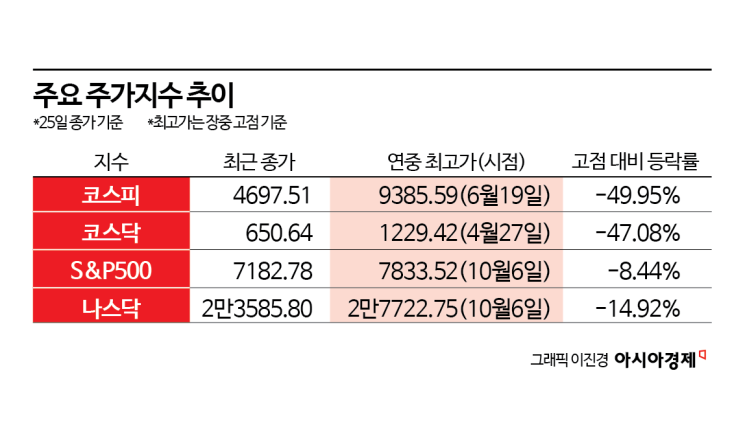
On Nov. 25 (local time), the Nasdaq Composite and S&P 500 closed down 0.62% and 0.25%, respectively, in New York, as investor sentiment toward artificial intelligence (AI) and semiconductor stocks remained weak and concerns about high interest rates persisted. Compared with their intraday highs for the year, both recorded on Oct. 6, the Nasdaq was down 14.92% and the S&P 500 was down 8.44%.
Losses on the Korean stock market were even steeper. On Nov. 25, the KOSPI closed at 4,697.51, down 308.52 points, or 6.16%, from the previous trading day's close of 5,006.03, falling below 5,000 in a single day. Compared with its annual high of 9,385.59, recorded on June 19, the index had dropped 49.95%. The KOSDAQ also closed at 650.64, down 2.06% from the previous session, and had fallen 47.08% from its annual high of 1,229.42.
The cryptocurrency market was also hit hard. Bitcoin, once called “digital gold,” had fallen to around $59,000 per coin as of the afternoon of Nov. 25, slipping below $60,000 again. It had been cut in half from its record high of $126,198, recorded on Oct. 6 last year. Downward pressure on Bitcoin appears to have increased as market prices factored in a December rate hike by the U.S. Federal Reserve (Fed) and the possibility of further hikes thereafter.
Even the commodities market, often regarded as an alternative investment, has weakened in tandem. According to the Korea Exchange, five major gold, silver and copper ETFs listed in Korea—SOL International Gold, TIGER Gold Futures (H), KODEX Silver Futures (H), TIGER Physical Copper and KODEX Copper Futures (H)—all hit 52-week lows during the previous day's session.
This reflects the steep correction in international metal prices, which had rallied sharply since the start of the year. Based on the December 2026 contract traded on the Commodity Exchange (COMEX), the international gold price closed at $3,561.90 per troy ounce on Nov. 24, down 36.70% from its intraday high of $5,626.80 for the year, recorded on Jan. 29. Silver, which suffered the largest decline, plunged from $121.79 to $40.78 per troy ounce over the same period, a 66.52% drop from its peak. Copper, known as “Dr. Copper” because it can signal the direction of industrial activity, surged to $6.9300 per pound on Sept. 9 but closed at $5.3690 on Nov. 24, down 22.53% from its peak.
“Alongside the weakness in stocks, funds are also flowing out of commodities, with copper and gold down 18.4% and 9.8%, respectively, this month, while the U.S. 10-year Treasury yield is below 4.87%,” said Kang Jinhyeok, a researcher at Shinhan Investment Corp. “Major assets are undergoing position adjustments as expectations for AI-driven growth are reassessed.”
Concerns about the AI industry, fears of U.S. interest rate hikes and risks from China are cited as causes of the Everything Crash. “At one point, the Everything Rally took hold, with asset prices rising together on the back of the Fed’s rate-cutting cycle. Recently, however, an Everything Fall, in which prices of major assets decline together, has become increasingly evident,” said Park Sanghyun, a researcher at iM Securities. “Various headwinds are emerging simultaneously, including persistent uncertainty surrounding Nvidia and the resulting risk of circular financing, increased concentration of funds related to Anthropic’s listing, an increasingly hawkish stance by the U.S. Fed, U.S. technology restrictions on China and concerns about an economic slowdown in China. These developments are driving a simultaneous decline in major asset prices, led by stock prices.”
Meanwhile, as stocks, cryptocurrencies and commodities all weakened in November, the dollar index (DXY), which measures the dollar’s value against the currencies of six major economies, was the only major indicator to continue rising. It has gained 1.76% this month. The dollar’s appeal has been particularly pronounced, with the index setting a 52-week high of 104.53 on Nov. 23. Global investors are flocking to the dollar as “the safest form of cash.”
Hot Picks Today
- The Era of Getting 200 Million Won After 30 Years Is Over... A Japanese Bank's "Perpetual Department Head" Who Just Clocked In Cries Out
- Spain Hit by Its Worst Tragedy... Lee Kangin, Moreno and Real Madrid Join Soccer World in Mourning
- They Said, “Make It Your Home for Life” - Then Suddenly Kicked 200 Passengers Off... What Happened to the Around-the-World Cruise?
- "130 Rice Bowls Sold Out in a Day"... 'Unfiltered Face' Adds 8 Million Won to Night Market Sales: China's Bungeunwoo
“Risks related to Nvidia, tighter U.S.-China technology restrictions and the increasingly hawkish tone of the Fed are widening the correction in global stock markets and triggering a sharp, simultaneous decline in major asset prices,” Park said. “Stabilizing oil prices and other factors could limit further declines in stocks, but a recovery in investor sentiment toward AI will be key. The dollar is therefore likely to continue strengthening for the time being.”
© The Asia Business Daily. All rights reserved. Unauthorized AI training and use prohibited.