The News
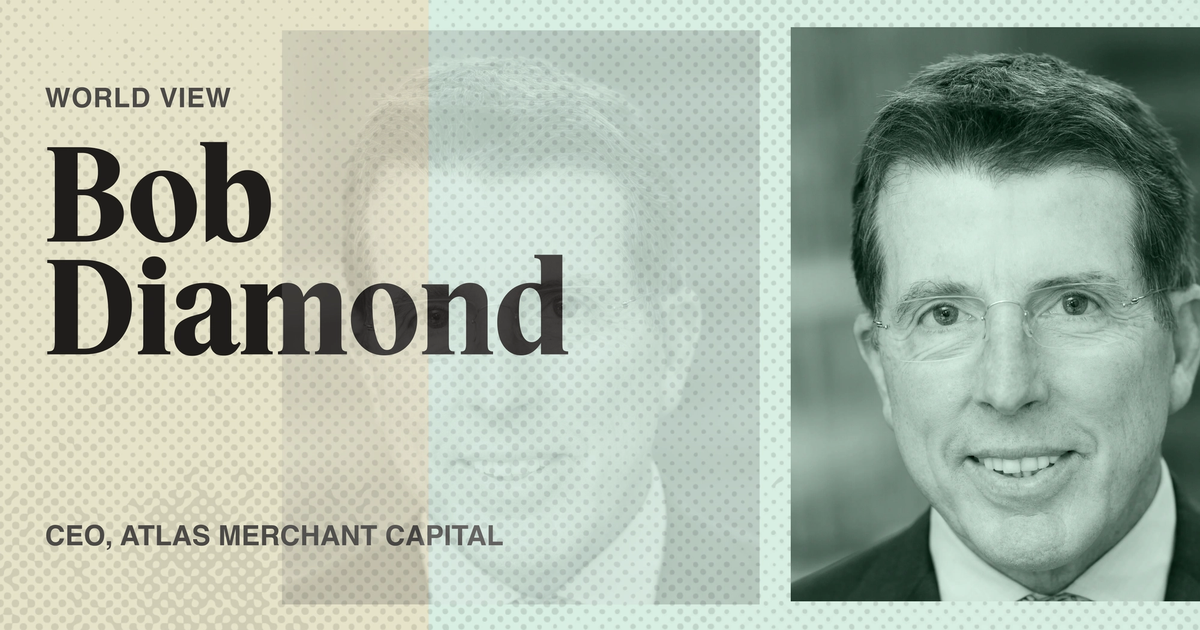
Speaking from the Bahrain capital Manama, which a few months earlier had been bombarded in Iranian attacks, Bob Diamond, chief executive of private equity firm Atlas Merchant Capital, says he’s still optimistic about the outlook for the Gulf’s future, the US economy, and the prospect to raise more capital to consolidate the banking industry around the world.
Panmure Liberum, a UK investment bank he’s invested in, is expanding into the Gulf. Wall Street investors increasingly see the region as a place to invest, not just a place to raise money, and the war isn’t deterring that. “This is a really serious economy,” he said.
Diamond has experience in the region spanning decades. His contacts in Abu Dhabi and Qatar helped secure a £11.8 billion bailout for Barclays during the Great Financial Crisis, enabling the bank to avoid a taxpayer-funded rescue. He left Barclays in 2012 in the wake of a scandal around its role in manipulating interbank rates, and has since reinvented himself as a private equity investor, backing bank consolidation deals and fintechs. He is also chairman of the advisory committee of the Export-Import Bank of the US and chairman of Abu Dhabi’s tokenization platform Finstreet.
Diamond also said that Bitcoin, the most well-known and biggest digital asset by market capitalization, is “irrelevant” (though useful as a store of value untethered from governments) and that the future of finance is tokenization — an industry is being led by the US as well as the Middle East.
Q&A
This interview has been condensed and edited for clarity.
Matthew Martin: You just announced Panmure Liberum, the UK investment bank you own, is expanding into the Gulf — how do you think about the opportunities in the Gulf now, particularly with the conflict that’s still going on?
Bob Diamond: I don’t mean to be dismissive of the severity of the situation here for a second, with the invasion of Iran, but when you’re here, as you and I are today, it feels pretty normal. For people who have not spent time in this region, I don’t think there’s a recognition of how developed the economies are, how developed the leadership is.
And then I’d say that since we started Atlas Merchant Capital just over 10 years ago, I’ve been as interested in investing Middle Eastern money in other parts of the world as I have been in how we can find ways to help develop business here on the ground.
I think there’s just a tremendous opportunity in this region for an on-the-ground advisory and M&A business for middle-market and family-owned businesses, because, as we are seeing here, the entrepreneurial spirit is very, very strong in many of these countries.
Financial services here is a great example of an industry where the vast majority of banks are ultimately state-controlled. As governments need to redirect capital to other things in the wake of the war, is there an opportunity for private equity investors to come in and play more of a role in the financial services industry in the Gulf?
One hundred percent. But I think you hit on a key issue, which is that traditionally that state control made things more opaque, so you couldn’t get outside investment because it was opaque. And two, it was intrusive and more focused on subsidized business. And you can see why, right? Because as the Middle East was growing, much of the commercial real estate, for example, had to be “if we build it, they will come.” So some of the unbelievable commercial real estate, whether it’s in Abu Dhabi or Dubai or Qatar, or the financial services center that was built in Riyadh, was done really with strategic impetus, if you will, as opposed to pure commercial activity.
And I think that’s changing, because a lot of those initial strategic investments have been done. I think it was the same in the early days of the development of Singapore. You could say the same thing, that it was strategic investing, but if you go to Singapore today, it’s a very commercial city. You don’t see commercial buildings being put up.
What impact do you see the conflict in the region having on how Wall Street sees the Gulf?
I think sometime around 2024, 2025, we hit an inflection point where the Middle East being seen purely as a source of funding for the Western world changed to “this is a really serious economy.” Going forward the Gulf will be focused much more on inward investment, as well as outward investment. I think it probably happened already with Saudi Arabia, and they’ve been a little bit ahead of it. But I think it’s really true across the region.
But there are still significant pools of capital in this region — if you just look at the sovereign wealth funds, that’s the best example but not the only example — for investment in good ideas wherever they happen to be.
Dubai and Abu Dhabi are both making this big play into fintech and tokenization. How much are you getting involved in that, and what do you see as the chances of centers in the region becoming hubs for this new asset class?
I feel very strongly. Bitcoin’s irrelevant. It’s not that Bitcoin isn’t going to go up or down, and I’m not questioning whether Bitcoin’s going to have a significantly higher price or not. I’m personally not an investor, but I have a number of close associates who believe strongly. My point is different. In its best version, Bitcoin is a store of value away from a government, much as gold is. And if it doubles or triples or quadruples in value, it doesn’t have a single strategic implication for financial services. It’s just made somebody money, and it’s a good store of value.
Compare and contrast that to stablecoins, basically making payments electronic institutionally for the major currencies around the world. Compare and contrast that to blockchain, which is 24/7, instantaneous settlement, a permanent record of every transaction that happens, everything at the speed of the internet and a fraction of the cost of conventional financial services. That’s the future. That’s the underpinning of financial services going forward: blockchain, and finally tokenization.
In the last two to three years, the US has moved very, very aggressively forward in terms of recognizing Circle, USDC, stablecoins, payments. Under Gensler at the SEC, it was just ignored. Nothing was approved. Outside of the US, we’re not seeing the same kind of attitude in London or Europe, but we are seeing it in the Emirates and in the Middle East. Abu Dhabi’s only a few hours’ time difference from London and Europe, and I think it has a real chance to emerge as a more important financial center with the progress of tokenization and the advance of digital.
What do you have planned for the future of your digital asset business Hyperliquid Strategies?
I’m very, very positive on Hyperliquid. Everything I’ve said to you about the potential for blockchain going forward, I was a believer in, and I became a much bigger believer the more we understood what Jeff Yan and his team had done at Hyperliquid, and created Hyperliquid Strategies Inc., took it public. We’ve gone from a market cap of 500 million when we launched last December to a market cap of closer to 3 billion now, because we’ve been able to issue equity and buy more tokens. We have absolutely no debt. We have — this is public — over 200 million in cash on the balance sheet.
What’s your next play for bank consolidation, do you see something in the US, Europe, or elsewhere?
The US is pretty consolidated at the big banks. We have a fund focused on regional and community bank consolidation. I continue to believe 1,000 to 2,000 is probably the right number. I think we’ll see consolidation there. In the consolidation that’s occurred so far since SVB failed — I guess it’s three years ago now — in most cases we’ve seen real value created. The consolidation has allowed costs to come out and get some real synergies. I think that will continue for the next couple of years — not in an avalanche, but it will just continue for the next few years — and it creates good competition for the bigger global banks.
If you had asked me when the single currency was created in Europe, would we still not have banking union, would we still not have cross-border consolidation, I’d say no, we would definitely have financial services consolidating a lot more. And I still think Europe would be stronger with some kind of integrated banking union, allowing bank consolidation across borders. I think it’s kind of happening right now as we speak in Italy and Germany, with the Commerzbank transaction.
Since COVID, we’ve seen a very high percentage of our actual investment in the US, more because the opportunity’s been there than anything else. It’s not because we’re looking more at the US. We’d love to do more in the UK and Europe. I think the economy’s been slower. I think the rebound from 2008 has been slower. I think regulation is higher. All the things that you hear most people talk about with Europe. But we’re very, very interested in opportunities there. Kepler Cheuvreux, which is a Paris-based broker-dealer, has been a very successful investment for us; we’re still invested in them. So there are great opportunities, but if I’m giving you the perfectly frank answer, our second fund was heavily weighted toward the US — not by design, but by opportunity.
And would you be doing any more fundraising over the next 12 months for the banking consolidation fund?
We’re doing it as we speak. Fundraising is in earnest.
How are you seeing the global interest rate environment going forward?
Higher for longer. The US economy is still very strong, and we see it particularly with middle-market companies. I’m chair of the advisory board of the US Export-Import Bank. From that perch, as well as co-founder and CEO of Atlas Merchant Capital — where we’re focused, not exclusively, but much more as a middle-market private equity firm than mega-bank type — middle-market companies and CEOs are really happy. They’re doing well. And I think a lot of that is that this administration has really gotten regulation out of their way. As opposed to the previous administration — this is an apolitical statement, it’s just true — Gary Gensler and the SEC were very anti-business, pro-regulation, and it was just much more difficult to get business done in the US.
So, the economy is strong, but we have inflation. I’ve known the chairman of the Fed for years. I think very highly of him, both when he was with the New York Fed and in his career before that. And I support what he’s saying, which is that they have a very, very clear focus on getting inflation back to target.
There are very, very volatile trading days going on at the moment. Do you have any fear — does this bubble pop and does this create a recession in the US?
I think that what’s happening in AI is real. We’re big believers in execution and efficiency, and if you believe in those things, you absolutely have to recognize that the impact of the developments in AI is very, very positive for the efficiency of businesses, certainly of the financial services businesses we’re involved with. In any technological period of innovation, whether it was the internet or electricity or railroads, you’re going to see some very volatile corrections. So are we having a healthy correction right now? I think so. I think it’s raising a lot of good questions, and I think it’s been healthy for the markets.
What sort of role do you see Ex-Im playing in US and Gulf ties? There are obviously opportunities there around critical minerals, around the AI investments the Gulf is looking at doing, and potentially nuclear as well.
Energy independence, whether it’s nuclear or non-nuclear, and critical minerals are huge priorities for the US Export-Import Bank, and the CEO, John Jovanovic, is very focused on that and has spent a lot of time here in the Middle East with his relationships here around just those issues.