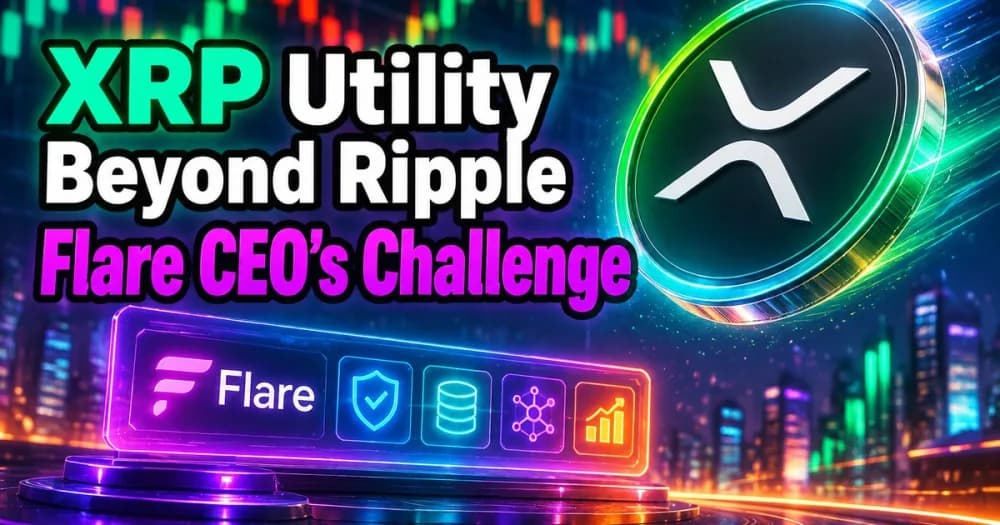
Flare CEO Hugo Philion urged XRP▼$1.15 holders on Nov. 8 to focus on building practical uses for the token rather than judging its future mainly by Ripple, as XRP traded at $1.16. His Flare CEO XRP utility argument puts the emphasis on turning XRP from a largely speculative asset into usable capital.
Philion’s remarks land during a difficult stretch for XRP. U.Today said the token had fallen around 50% over the past year, while CoinGecko data showed a 0.47% decline over the 24 hours ending Nov. 8.
- 📎Philion's XRP Utility Challenge Starts With Holders
- 📎Who Is Hugo Philion and What Does Flare Do?
- 📖Why Ripple's Role Became a Flashpoint for XRP Holders
- 📖How XRP and FLR Fit Together on Flare
- 🎯XRP Price Context: $1.16 and Technical Levels
- 🟢What Could Strengthen or Weaken the Utility Case?
- 📎How the Binance Theft Added Pressure to XRP's Market Context
- 📌What Happens Next for XRP and Flare?
- ❓FAQ
Philion’s XRP Utility Challenge Starts With Holders
Three questions behind the appeal
Philion asked XRP holders to consider what they are doing with their holdings, how they can persuade potential investors to hold XRP, and how the community can move the asset from speculation toward usable capital. The questions shift the discussion from what Ripple might do to whether holders and developers can create demand through activity.
His point was not that Ripple has no role in XRP’s story. Rather, he argued that the token’s value and narrative should not depend on one company or actor. Philion said holders should take a more active role in creating practical use.
Why Flare is part of his pitch
Philion invited XRP holders to try Flare, describing the network as one way to make XRP less dependent on Ripple. He said Flare was created because more could be done with XRP.
That is a pitch for an approach, not proof that XRP has already become independent of Ripple or that Flare has changed the token’s market performance. The distinction matters: Philion is making a case for where activity could develop, while holders still have to decide whether the ecosystem is useful to them.
Who Is Hugo Philion and What Does Flare Do?
Philion’s role in the argument
Philion is Flare’s CEO. His comments combine a broader view about XRP’s future with a direct invitation to use Flare, giving him a clear stake in the ecosystem he is promoting.
He said XRP holders should think beyond Ripple’s decisions and work toward broader utility. His proposed direction is that XRP becomes usable capital rather than an asset whose story is mostly speculation.
FXRP and the role of FLR
FXRP is a tokenized version of XRP on Flare. Philion disputed an X user’s claim that holders could use Flare’s decentralized finance ecosystem with FXRP without needing FLR.
He said Flare Smart Accounts make managing FLR less visible to users, but do not remove the token’s role: FLR pays transaction fees on the underlying networks. In other words, a simpler account experience can abstract fee management without eliminating the fees or the token used to pay them.
Why Ripple’s Role Became a Flashpoint for XRP Holders
Frustration over performance
Philion’s comments came amid frustration over XRP’s performance and what he described as a habit of evaluating the token through Ripple’s actions. The market backdrop gives that argument urgency, though it does not show that utility alone will reverse XRP’s price trend.
U.Today also described recent criticism directed at Ripple’s former chief technology officer David Schwartz over XRP’s performance. Schwartz said his influence on XRP’s price was very limited, another reminder that a prominent figure’s public profile does not necessarily translate into control over the market.
A debate about responsibility
Philion’s appeal places some responsibility on the XRP community: holders should use the asset and help persuade others to hold it. That is different from waiting for a company announcement to set the narrative.
The proposal also raises a practical question for the ecosystem: whether applications built around XRP can attract sustained activity. A call to build utility is a direction, not a measurement of how much XRP is currently being used through Flare.
How XRP and FLR Fit Together on Flare
Smart Accounts and fee abstraction
Philion’s explanation distinguishes the user experience from the network’s fee mechanics. Flare Smart Accounts can abstract away the need for users to manage FLR directly, making the process more convenient, according to his comments.
But abstraction is not the same as removing FLR from the system. Philion said FLR is still used to pay transaction fees on the underlying networks. That distinction is central to the exchange: users may not have to handle every fee step themselves, yet the token remains part of the transaction process.
Beyond transaction fees
Philion said he expects FLR to have more use cases over the long term than paying transaction fees. He also said the ecosystem needs broader fee generation.
Those goals point to two related but separate questions: whether Flare can support more activity involving XRP, and whether that activity can produce wider sources of fees and uses for FLR. Philion gave no specific future launch or date, so the comments set out an ambition rather than a scheduled change.
XRP Price Context: $1.16 and Technical Levels
Market figures as of Nov. 8
CoinGecko listed XRP at $1.16, with a market capitalization of about $73.52 billion and 24-hour trading volume of about $878.42 million. The token’s 24-hour change was -0.47%, a modest decline rather than a sharp move.
The current price context is separate from Philion’s argument about utility. His comments did not announce a product launch or market catalyst, and the price figures do not measure adoption on Flare.
Support and resistance areas cited by CryptoPotato
CryptoPotato’s technical analysis identified $1.09–$1.14 as a nearby demand area after XRP fell below the $1.24–$1.28 zone. The outlet also pointed to the $1.15 low as a near-term downside reference.
On a recovery, the analysis highlighted $1.18–$1.20 as an initial area to overcome, followed by $1.24–$1.28 and then the $1.30–$1.34 supply zone. These are chart levels in that analysis, not promised outcomes; they provide context for traders watching whether XRP stabilizes or continues lower.
What Could Strengthen or Weaken the Utility Case?
The constructive case
Philion’s constructive case is that holders and developers can make XRP more useful through activity that extends beyond speculation. Flare is presented as one place to pursue that goal, with FXRP bringing a tokenized form of XRP into the network’s ecosystem.
For that case to gain weight, the ecosystem would need broader use and fee-generating activity, the outcomes Philion himself called for. The reporting does not quantify current XRP use through Flare or the fees generated, so the argument remains focused on what the network should build next.
The execution risk
Utility does not automatically translate into a higher XRP price. The token can remain under pressure even as builders pursue new applications, and Philion’s comments provide no timetable for broader use cases or a market recovery.
There is also a distinction between XRP and FLR that users should keep clear. FXRP represents XRP on Flare, while Philion says FLR remains necessary for network fees even when Smart Accounts make fee management less visible. Confusing the two tokens can lead to mistaken assumptions about how the ecosystem works.
How the Binance Theft Added Pressure to XRP’s Market Context
About $50 million moved into bitcoin
Separate security news also put a large amount of XRP under scrutiny. Bitcoin Magazine reported that hackers linked to the Binance theft had swapped about 42 million stolen XRP, worth roughly $50 million, mostly through THORChain into bitcoin. The conversions lifted the bitcoin recovered from other stolen assets to about 1,650 BTC▲$75,797.00, valued at approximately $124 million at the reported prices.
About 192 million XRP, worth roughly $226 million, remained in addresses linked to the theft at the time of the report. The figures describe assets associated with the attack, not ordinary XRP selling by holders, but the potential movement of that remaining balance is a separate supply and market concern from Flare’s utility debate.
The earlier transfers and what comes next
The XRP came from the Oct. 29 drain, when five hot wallets sent 233.46 million XRP to an attacker address between 20:05 and 20:09 UTC. The FBI attributed the campaign to North Korea’s TraderTraitor group. Binance later put the total theft at $6.34 billion, reopened withdrawals in stages, froze or intercepted about $2.85 billion, and said it would cover customer losses from its own funds.
Elliptic said the stolen XRP stayed quiet initially. Between 02:12 and 04:00 UTC on Nov. 2, about 233 million XRP moved into six new addresses, where it remained until Nov. 5. From the afternoon of Nov. 5, two of those addresses began sending XRP to dozens of new accounts that swapped it, mostly through THORChain into bitcoin.
The movement has not been limited to XRP. More than 20,000 wallets across 16 blockchains and at least 65,000 transactions were tied to the laundering trail, while about $3.11 billion remained in addresses linked to the theft, mostly as ether and bitcoin. The main bitcoin and ether holdings had not moved in the reported update, leaving the next question as whether more XRP and later the parked assets follow the same route into bitcoin.
Issuers can freeze many stablecoins, whereas XRP and bitcoin cannot be frozen in the same way. That helps explain why the attacker prioritized those assets after large stablecoin tranches were locked on Oct. 29. THORChain operators and other bridges will be watched for whether they continue blocking published attacker addresses quickly enough to slow further XRP-to-bitcoin conversions.
What Happens Next for XRP and Flare?
Building activity is the next test
Philion did not announce a dated launch, decision, or deadline. The next practical test is whether holders and developers respond to his challenge by building broader XRP utility and fee-generating activity in Flare’s ecosystem.
That leaves the immediate story centered on execution rather than a calendar event. A future use case would need to move from an objective to something users actually adopt before it could support a stronger claim that XRP has become more useful.
What holders can watch
For XRP holders, the useful signals are concrete activity around FXRP, the role of FLR in transactions, and whether Flare’s ecosystem develops uses beyond paying fees. Those are the areas Philion identified; his comments did not set a target for XRP or FLR prices.
On the market side, traders can watch whether XRP holds near the demand area cited by CryptoPotato or recovers the levels that outlet identified overhead. Price action and ecosystem development are separate tests, and neither should be treated as a guarantee of the other.
FAQ
What did Flare CEO Hugo Philion say XRP holders should focus on?
Philion urged holders to find ways to use their XRP, encourage potential investors to hold it, and help shift the asset from speculation toward usable capital. He pointed to Flare as one possible place to pursue that goal.
Why does Philion want XRP to be less dependent on Ripple?
He argued that XRP’s value and narrative should not hinge on the actions of a single actor. His view is that broader community use could give the asset a wider basis than Ripple’s decisions alone.
What is FXRP on Flare?
FXRP is a tokenized version of XRP on Flare. Philion referred to it when discussing how XRP holders can use Flare’s decentralized finance ecosystem.
Why does FLR still matter when Flare Smart Accounts simplify fees?
Philion said Smart Accounts abstract away the need to manage FLR directly, but FLR is still used to pay transaction fees on the underlying networks. The account experience can be simpler without removing the fee token’s role.
What was XRP’s price when Philion made his comments?
XRP traded at $1.16 in the coverage published Nov. 8. CoinGecko’s 24-hour figure was a 0.47% decline.
Did Philion announce a date for new Flare use cases?
No dated launch or deadline accompanied his comments. He called for broader use cases and fee generation over time, without naming a specific milestone.
Which XRP price levels are traders watching?
CryptoPotato’s analysis cited $1.09–$1.14 as a nearby demand zone and $1.24–$1.28 as a former support area that could act as resistance. It also identified $1.30–$1.34 as a higher supply zone.
This article is for information only and is not financial advice.
Related Articles
CLARITY Act Could Unlock 11 Crypto Activities for US Banks Under Senate Plan
The Congressional Research Service reports on opportunities that would be created for US lenders...
Ripple Secures Full CASP License Under MiCA in Europe
This is a major step for Ripple, opening up the entire European Economic Area. We break down what...
XRP Ledger Slowdown Slows Consensus as XRP Rises 5%
XRP Ledger slowdown dragged consensus rounds as validators hit peak load; David Schwartz detailed...
SLX Crypto Rise and Collapse: What Is Slimex and Why Did It Crash Over 90%?
Contents🧩What Is Slimex (SLX) Crypto?🟠The Origins of Slimex📎Why Slimex Gained Massive...
Top 5 Sui Tokens to Watch in 2026: Early Positioning in the Ecosystem Rotation
With its high performance and scalable nature, the Layer 1 blockchain Sui has emerged as one of the...
Curve Founder Says Claude Mythos May Hit OpSec Before DeFi
Claude Mythos may pose more immediate risk to multisig key security than to DeFi, Curve Finance...