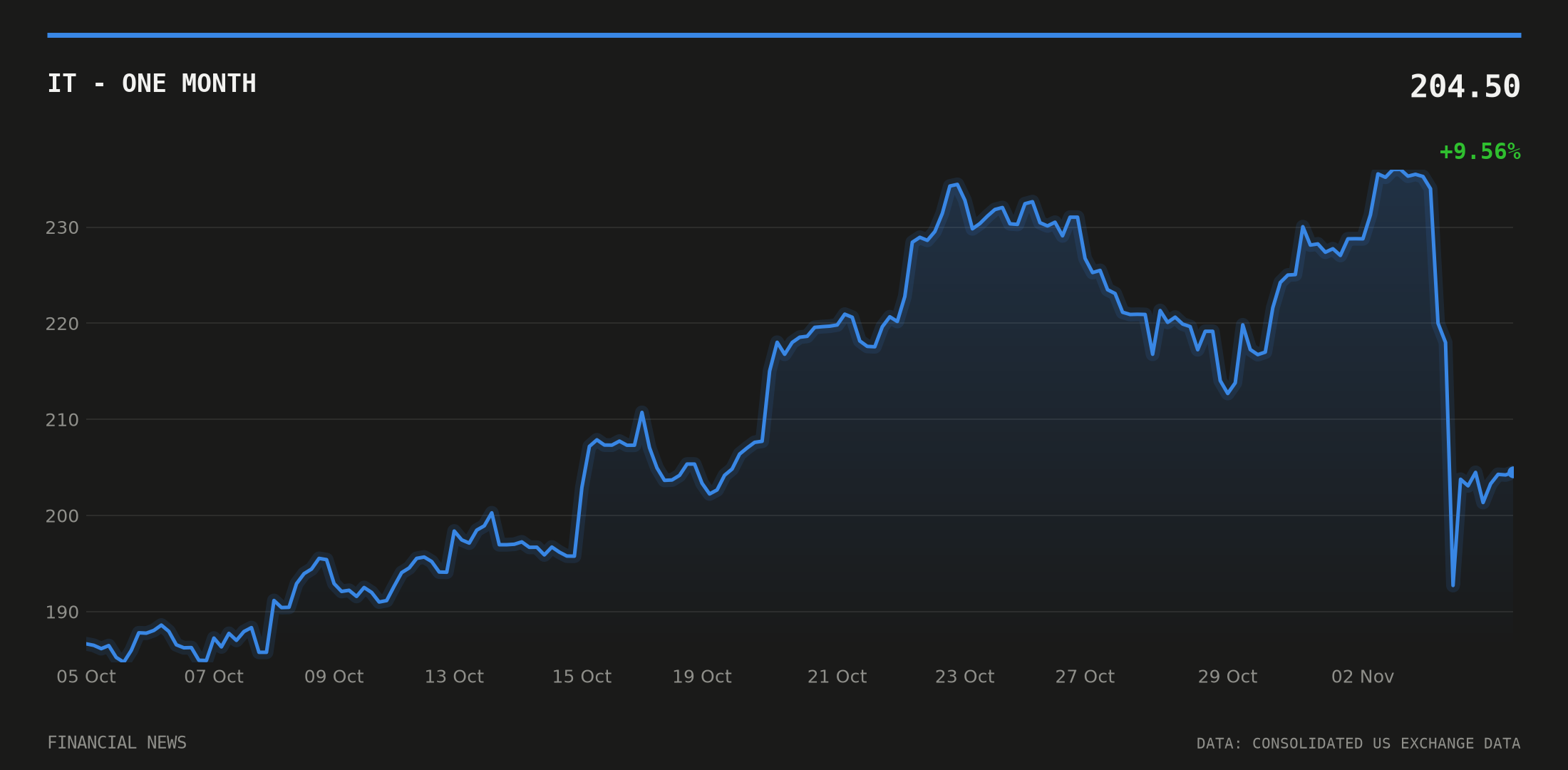
Gartner (NYSE: IT) reported Q3 2026 earnings on 3 November 2026, beating revenue estimates even as underlying sales fell year-on-year.
Shares in the research and advisory firm dropped roughly 13%, according to Seeking Alpha, as investors looked past the headline figures to revenue that shrank 1.3% from a year earlier.
Headline beat, underlying decline
Gartner posted third-quarter revenue of $1.505bn, ahead of the roughly $1.49bn FactSet consensus, according to fiscal.ai. But that figure was down from $1.524bn in the same quarter last year, a decline Gartner’s own earnings release put at 1.3% as reported.
Net income came in at $214.4m, with diluted earnings per share of $3.35, versus $35.4m and $0.47 a year earlier – a jump that looks dramatic on its face but reflects a weak comparison period rather than fresh strength. The prior-year quarter was dragged down by a goodwill impairment charge and the absence of a gain on event-cancellation insurance claims booked in 2024, according to Gartner’s filing. Strip that base effect out and the swing in profitability looks far less like growth and far more like one-off noise working through the comparison.
Guidance raised, market unconvinced
Gartner raised its full-year 2026 guidance for revenue, EBITDA, adjusted earnings per share and free cash flow, according to transcripts carried by Investing.com and Benzinga. On paper, that is the combination – a beat and a raise – that typically lifts a stock.
Instead, Gartner shares closed at $204.50, well below their 20-day high of $236.00, with trading volume running at 2.49 times the 20-day average on the day of the release. GuruFocus described the drop as unexpected given what it called a solid quarter. FINRA short-sale data show the share of trading volume tied to short sales jumped to 0.802 on 3 November, up from a range of roughly 0.60 to 0.73 over the prior two weeks, consistent with heavier bearish positioning or hedging activity as the stock sold off.
A pattern of flat-to-declining revenue
The quarter extends a run of choppy results. Gartner’s Q2 2026 revenue was $1.676bn, down 0.6% year-on-year, with net income of $275.5m, according to the company’s second-quarter filing. Over the past several quarters, reported revenue has hovered between roughly $1.48bn and $1.69bn, with net income swinging far more widely as one-off items move through the accounts – a pattern that makes single-quarter profit comparisons an unreliable guide to the underlying business.
That underlying business – subscription research and advisory work sold largely to corporate IT and executive clients – sits against a softening labour market. US unemployment ticked up to 4.2% in September 2026 from 4.1% the prior month, according to Federal Reserve data, a backdrop that bears on corporate budgets for the kind of advisory contracts Gartner sells.
What the numbers actually show
Set against the consensus, Gartner’s Q3 2026 earnings technically cleared the bar: revenue beat the roughly $1.49bn FactSet estimate, and management lifted its outlook for the rest of the year. But the year-on-year numbers that framed the release as a surge – net income up roughly sixfold, EPS up similarly – owe almost entirely to a weak prior-year quarter distorted by an impairment charge, not to any acceleration in Gartner’s core subscription and advisory revenue, which fell.
Investors appear to have reached that conclusion quickly. The roughly 13% share-price fall on volume nearly two-and-a-half times the recent average suggests the market priced in the shrinking top line rather than the headline profit jump. Gartner’s next scheduled update, its fourth-quarter and full-year 2026 results, will show whether the revised guidance holds and whether the revenue slide stabilises.
This article is for information only and is not investment advice or a recommendation to buy or sell any asset. Markets move quickly; figures are correct as sourced at the time of writing. Always do your own research before making financial decisions.