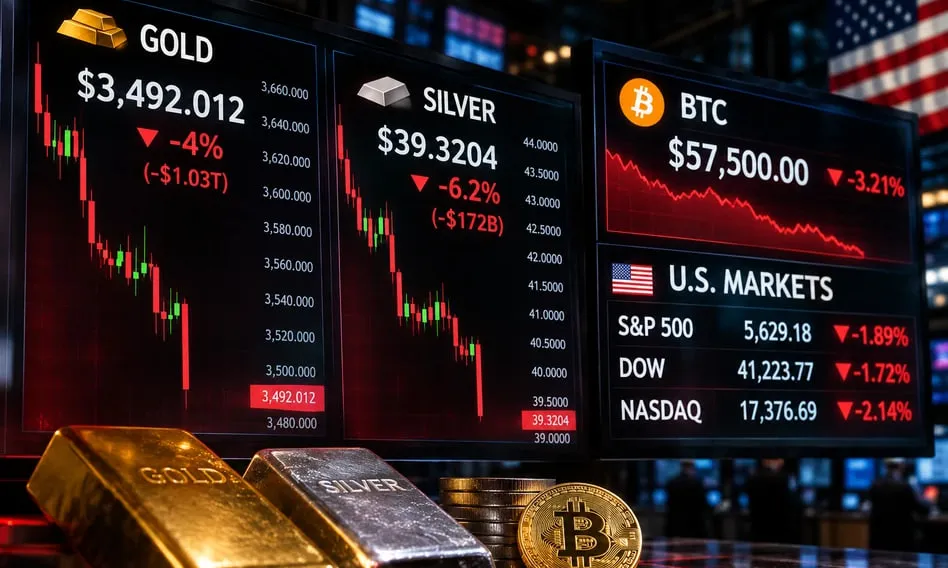
Investors are selling off financial assets en masse amid concerns about inflation in the U.S., trade tensions, and expectations of further tightening of monetary policy. Expectations of interest rate hikes and doubts about the future profitability of investments in artificial intelligence have put additional pressure on the markets. Against this backdrop, prices for gold, silver, and Bitcoin have plummeted.
Gold and silver fell to 15-month lows
On Wednesday, November 25, the spot price of gold fell by 3% to $3,445.89 per troy ounce. This is the lowest level since August 2025. For the first time since September of last year, the precious metal fell below $3,500.
Silver fell even more sharply—by 5.4%—to $38.65 per ounce. This is also the lowest level since August 2025. The decline also affected other precious metals: platinum lost 4.1% of its value, falling to $1,224.13 per ounce, while palladium fell 3.2% to $826. Its price fell to its lowest level since 2017.
According to Reuters, gold has lost about 37% of its value from the all-time high set in early 2026.
Bitcoin fell below $60,000 again.
The negative trend has also spread to the cryptocurrency market. On Wednesday, Bitcoin fell to $57,500, failing to hold above the psychological $60,000 mark. This followed a brief rebound to $64,500 on November 23.
Additional pressure is coming from outflows of funds from U.S. exchange-traded funds (ETFs) that invest in Bitcoin. According to CoinDesk, as of November 24, net outflows from such funds for the month had reached $4.71 billion. In just one trading session, investors withdrew approximately $570 million. November has already become the worst month in this regard since the launch of U.S. spot Bitcoin funds.
U.S. stock markets also fell
One of the most notable epicenters of the decline was the U.S. technology sector. During Wednesday’s trading, the Nasdaq Composite Index lost about 4%, and shares of chipmaker Nvidia fell 8.7%.
Investors are increasingly doubting whether tech giants will be able to recoup the massive amounts of money invested in the development of artificial intelligence. Expenses related to building data centers, purchasing equipment, and developing new models are causing particular concern.
Fears about the return on these investments are exacerbating the overall uncertainty in the stock markets. Sales of tech company stocks are putting additional pressure on cryptocurrencies and precious metals.
Inflation in the U.S. has intensified pressure on the markets
One of the main factors behind the decline was new data on U.S. inflation. In October, the Personal Consumption Expenditures (PCE) price index—which the Federal Reserve (Fed) uses to gauge inflation trends—rose 0.3% month-over-month. On an annual basis, the rate accelerated to 3.8% from 3.6% in September.
Core inflation, which excludes food and energy prices, stood at 3.3% on an annual basis. A month earlier, it was 3.1%.
These figures have reinforced expectations that the U.S. Federal Reserve may raise interest rates again as early as December. Markets had priced in a 0.25 percentage point increase.
Higher yields on government bonds and other financial instruments make gold less attractive to investors, as the precious metal does not generate interest income. Higher borrowing costs may also curb demand for risky assets, particularly cryptocurrencies.
Oil prices initially fell, then rose
Unlike gold and silver, oil prices fluctuated throughout the day. During morning trading on November 25, Brent futures were down 1.6% at $89.93 per barrel. U.S. WTI fell 1.9% to $80.53.
The market was weighed down by fears of a global oil supply glut in 2027. Investors were also monitoring upcoming OPEC+ decisions regarding production levels.
The situation subsequently changed. Following reports of an attack by Yemeni Houthis on the Saudi Ras Tanura oil refinery, prices began to rise. According to Reuters, Brent rose to $93.20 per barrel, and WTI to $83.01. Concerns about disruptions to oil supplies from the Middle East once again boosted demand for crude.
Why Investors Are Selling Even Safe-Haven Assets
Gold is traditionally considered a safe-haven asset that investors turn to during times of economic and geopolitical instability. However, large-scale financial turmoil can force market participants to sell even precious metals to raise cash, cover losses on other investments, or meet margin requirements for exchange-traded contracts.
In this situation, Bitcoin behaves more like a risky investment than a digital equivalent of gold. Its decline coincides with outflows from exchange-traded funds and deteriorating sentiment in the stock markets.
The current market situation is driven by several factors: persistent inflation in the U.S., expectations of a tighter Fed policy, trade uncertainty, and doubts about the profitability of large-scale investments in artificial intelligence.
This was reported with reference to Reuters.
The price of gold in Ukraine has risen: here’s how much a gram of the metal costs as of November 24.