An attacker who seized control of the validator signing key on Gonka AI's Ethereum bridge walked away with roughly $1.06 million in stablecoins and freshly minted tokens, according to blockchain security firm Blockaid and on-chain analytics provider Onchain Lens.
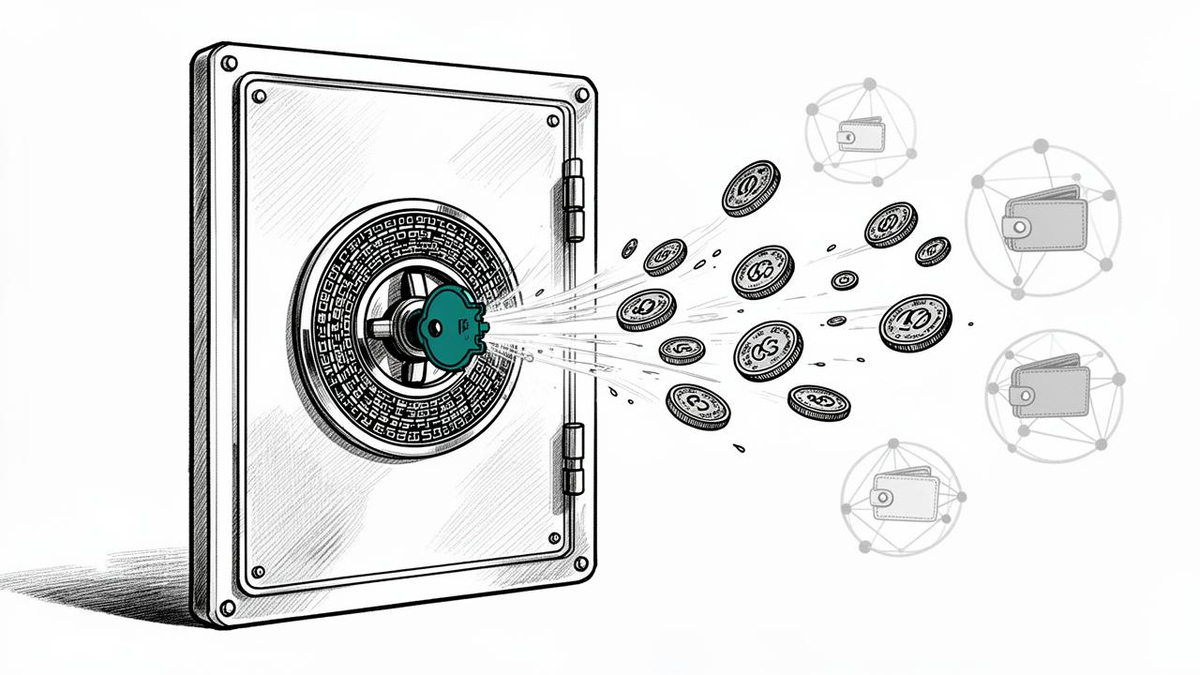
The breach, disclosed on Nov. 18, targeted the cross-chain bridge that moves assets between Gonka's native network and Ethereum. The intruder obtained the bridge's BLS group key, a cryptographic instrument that aggregates signatures from the network's validator set to authorize withdrawals, and used it to empty the stablecoin reserves held on the Ethereum side while issuing Wrapped Gonka (WGNK) tokens with no collateral behind them.
Onchain Lens put the stablecoin haul at about $884,800, split between Tether (USDT) and USD Coin (USDC), plus $172,000 of unbacked WGNK, for a combined figure near $1.06 million. Blockaid's initial alert counted five transactions totaling about $1.05 million and warned that the exploit was still running as the estimate was published.
Note: Figures are Onchain Lens estimates as reported by Blockaid; other security firms have published slightly different totals, all just above $1 million.
Under normal operation, Gonka's documentation states, stablecoins are locked on Ethereum so their wrapped versions can circulate on the Gonka network, and the reserve balance is what backs redemptions when holders move assets back. Native GNK moving in the opposite direction is held in escrow on Gonka while an equivalent amount of WGNK is issued on Ethereum. The bridge contract itself doubles as the WGNK token contract.
The BLS group key is renewed at each network epoch, a fixed interval set to keep the cryptographic authorization fresh. Onchain Lens attributed the breach to direct manipulation of that epoch key, which gave the attacker both the ability to release stablecoins from the reserve and the ability to mint WGNK without the corresponding GNK ever entering escrow.
Tracing the money has proven difficult. The stolen assets were routed through Uniswap, the decentralized exchange, and then scattered across multiple wallets, a dispersal pattern that obscures where the funds ultimately landed and raises the cost of recovery. The unbacked WGNK adds a second problem: if those tokens circulate without reserves behind them, the bridge's backing and user confidence in the Gonka ecosystem both come under strain. Gonka AI has not publicly released further technical details or a recovery plan.
The Gonka incident landed the same day as a larger and unrelated exploit at K3 Capital, where Blockaid estimated about $3.43 million left the sBOLD vault across roughly 34 transactions. K3 Capital said at 13:08 UTC that it was investigating malicious activity tied to sBOLD and had paused the relevant contracts, without giving a loss figure or a timeline for reopening. Combined, the two events account for an estimated $4.48 million, a total that assigns no separate value to the newly minted WGNK.
Accounts of the sBOLD drain diverge. Blockaid said attackers used flash loans of wrapped staked ether, self-liquidated a Liquity V2 position into the stability pools, minted cheap sBOLD shares and redeemed them for BOLD belonging to other depositors. Bitquery's later review priced the loss at $3.42 million, counted 97 transactions across 37 Ethereum blocks, attributed 57 of them to a single bot and found no evidence of the trove liquidations Blockaid initially cited. The review placed the drain in an eight-minute window starting at 12:25:23 UTC, roughly 35 minutes before K3 Capital announced the pause, and traced $1.78 million in payments to Ethereum block builders, about 52% of the loss it calculated, with no indication the builders knew what the bot was doing.
Liquity's documentation identifies sBOLD as a third-party vault built and maintained by K3 Capital that pools BOLD deposits and reinvests rewards earned through Liquity V2 stability pools. A May 2025 audit by ChainSecurity had flagged a high-severity accounting issue in which an earlier version of the software could undervalue vault shares after liquidations, a finding the auditor listed as corrected. Whether the Nov. 18 attack exploited that flaw or a different one has not been established.
The two breaches underscore how much value now sits behind bridge signing keys and vault share accounting, and how quickly that value can move once a single control point fails. For Gonka, the immediate exposure is the credibility of WGNK as a claim on escrowed GNK; for holders of bridged assets generally, the episode is a reminder that reserve balances on the Ethereum side are only as safe as the key that authorizes their release. Security teams are watching wallet flows for any attempt to convert the stablecoins, while the unbacked WGNK supply remains a live liability on the token contract.
Once added, BigGo Finance appears first in Google Search Top Stories, so you get the broadest, most up-to-the-minute, and most comprehensive global financial news first.