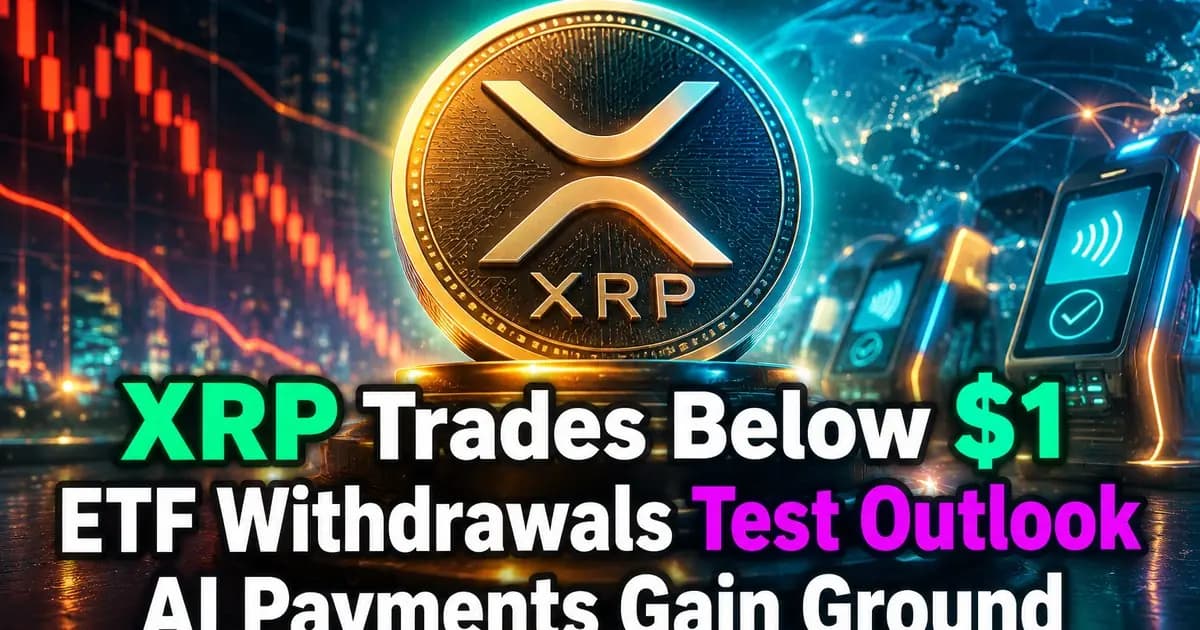
XRP▲$0.9550 traded at $0.951163 on November 16, 2026, down 0.71% over 24 hours, as ETF withdrawals and growing AI-payment activity shaped the outlook for readers searching for a Grok AI XRP price prediction. Franklin Templeton’s fund disclosed 293.1 million XRP in quarter-end holdings, while t54.ai described rapid growth in automated payments on the XRP Ledger.
No attributable Grok forecast accompanies those developments; the outlook below assesses XRP’s market conditions and payment adoption. The immediate question is whether returning investment demand can support a recovery above $1 while the network expands its use in small, frequent transactions.
- 🟣Grok AI XRP Price Prediction: Facts Behind the Market Search
- 💳How Ripple, XRP and the AI Payments Story Connect
- 💳What XRP Is Used For in Payments and on the Ledger
- 📖XRP Price, Market Cap and November Trading Levels
- 🧩Why XRP ETF Holdings and AI Activity Draw Attention
- ⚠️XRP Outlook Risks: Token Confusion, Supply and Demand
- 🛠️Where XRP Trades and How to Verify the Asset
- 📖XRP Compared With Bitcoin and RLUSD: November's Tests
- ❓FAQ
Grok AI XRP Price Prediction: Facts Behind the Market Search
What Asset Does This XRP Outlook Cover?
XRP is the native asset of the XRP Ledger, a payments-focused Layer 1 blockchain. It serves as a bridge between currencies and pays transaction fees on the ledger.
Related: Nine Straight Daily Losses Send XRP Below $1 as ETFs Shed $19M
That identity matters when searching by ticker. Other assets use the XRP or Ripple name on Solana and other networks. This outlook concerns native XRPL XRP, including the asset held by the Franklin XRP ETF.
Which Recent Developments Matter to XRP?
Franklin Templeton’s fund held 293.1 million XRP at September 30, according to BeInCrypto’s account of its 10-Q. Its holdings had grown from roughly 225 million XRP at the start of the quarter.
The November backdrop is weaker. XRP broke below $1 after a run of daily losses, and spot XRP ETFs experienced withdrawals. Meanwhile, an interview published by the XRPL Foundation on November 15 described millions of AI-agent payments, adding a separate adoption argument to the price debate.
How Ripple, XRP and the AI Payments Story Connect
How Are Ripple and XRP Different?
Coinpaper distinguishes Ripple, the private technology company, from XRP, the digital asset. The two names are often used interchangeably, but buying XRP gives exposure to the token’s market price.
Imperator describes the XRP Ledger as an independent distributed ledger governed through network validators. Ripple develops payment products, while the ledger supports payments, issued assets and on-chain trading. Those activities can overlap without every Ripple product using XRP in the same way.
What Did t54.ai Say About AI-Agent Payments?
Chandler Fang, founder of t54.ai, said its x402 Facilitator had processed more than 10 million AI-agent transactions. The interviewer put the total at 11.7 million payments, per U.Today. Fang said activity had grown from almost nothing three or four months earlier.
Fang also described more than 200 merchants on the network. The most common use was buying AI compute by the task, with payments of roughly $0.50 or $1 instead of monthly subscriptions costing $20 to $200. He expects agents to move into real-world purchases over the next few quarters.
The startup participates in Mastercard’s agentic payment program, Fang said. He also described discussions among t54.ai, Ripple and Mastercard about a three-way collaboration, with initial results planned for an upcoming hackathon. Those discussions are a potential development to watch.
What XRP Is Used For in Payments and on the Ledger
How Do Cross-Border Payments and AI Agents Use XRP?
XRP’s payment role centers on transferring value between currencies, with settlement typically taking three to five seconds. For the adoption case, the relevant issue is whether payment providers and users choose XRP for those flows.
Fang said agents using the x402 Facilitator can pay with either XRP or the RLUSD▲$1.0000 stablecoin, without setting up a separate wallet for every agent. The platform therefore gives developers more than one settlement option as they build automated purchasing services.
Ripple says its own payments product covers more than 60 markets and settles in more than 17 fiat currencies, alongside major stablecoins. Its company page promotes accepting, holding, exchanging and paying out in fiat and stablecoins through a single integration.
How Do XRP Supply and Transaction Fees Work?
XRP began with a maximum supply of 100 billion tokens, all created at the outset. It is not mined. Transaction fees are destroyed rather than paid to validators, according to Imperator’s description of the ledger.
Ripple’s escrow arrangements govern the release of a portion of its holdings, with unused amounts returned to escrow. For the price outlook, the important supply question is how much XRP ultimately reaches active trading through exchanges or over-the-counter channels.
This creates two moving parts for investors to follow: demand for XRP in payments and investment products, and the amount entering circulation. Fee destruction also affects supply, while the payment network’s low fees remain part of its appeal for frequent small transfers.
XRP Price, Market Cap and November Trading Levels
What Was XRP’s Price on November 16?
According to CoinGecko market data, XRP traded at $0.951163 at 06:38 UTC on November 16, with a market capitalization of roughly $60.4 billion. Its 0.71% daily decline was modest against the broader November sell-off.
The asset ranked No. 6 by market capitalization. Trading volume remained substantial, but the current-month outlook depends on whether buyers can sustain recoveries as investment flows and broader risk appetite change.
Which XRP Levels Matter for the November Outlook?
XRP briefly touched roughly $0.89 during the sell-off, NewsBTC reported on November 15. The downturn came as investors reduced exposure to riskier assets and liquidity retreated across crypto markets.
The earlier $0.99 support assessment has given way to a recovery test, with XRP now trading below it. Reclaiming $0.99 and then $1 would put the token back above the threshold it lost during November’s decline.
A move to $1 from $0.951163 would require a gain of about 5%. On the downside, $0.80 was cited as a conditional extension of the correction. Reaching that level from the November 16 price would mean a further decline of about 16%.
For November, the bullish scenario is a sustained recovery through $0.99 and $1 alongside improving demand. The bearish scenario is renewed selling toward the recent $0.89 low, with $0.80 a deeper risk if the correction continues.
Why XRP ETF Holdings and AI Activity Draw Attention
What Did Franklin’s XRP Holdings Disclosure Show?
The Franklin XRP ETF’s September 30 holdings were valued at $439.7 million. During the quarter, the fund bought approximately 26.6 million XRP through cash creations and received roughly 41.3 million XRP through in-kind contributions.
The fund recorded no redemptions during that quarter. Shares outstanding reached 27 million, and net asset value stood at $16.28 per share. Those figures show substantial institutional exposure built through the fund.
November brought a different flow pattern. Spot XRP ETFs lost approximately $36 million between November 9 and 13, according to SoSoValue. Aggregate net assets stood at $1.16 billion, compared with $1.51 billion in late October.
What Could Strengthen the XRP Recovery Case?
Improving ETF flows would give the investment side of the recovery argument more support. Stronger spot volume during price recoveries and steadier derivatives funding are also indicators to monitor as trading conditions develop.
On the payments side, Fang expects AI agents to account for more XRPL transactions than humans next year. That is his forecast for network activity. Merchant expansion and more uses beyond compute purchases would be practical developments to follow.
The near-term test is whether investment demand improves while developers broaden payment use. Continuing ETF withdrawals and weak recoveries would keep pressure on the November outlook, even as the ecosystem adds services.
XRP Outlook Risks: Token Confusion, Supply and Demand
Why Should XRP Buyers Check the Asset and Network?
Multiple listings use XRP or Ripple branding. A Solana token with either name is a separate asset from native XRP on the XRP Ledger. Readers following this outlook should check the network and asset identity before placing an order or transferring funds.
The same care applies to custody. An XRPL-compatible wallet is necessary for native XRP, and the receiving platform’s network and tag instructions matter. Imperator identifies incorrect tags, misconfigured transfers and phishing as potential causes of loss.
What Could Weaken the Bullish XRP Case?
Institutional ownership still carries price risk. Franklin’s filing-period holdings had a cost basis of $501.4 million, against a fair value of roughly $439.7 million. The account of the filing described an unrealized shortfall of approximately $61.8 million, or 12.3%.
Payment growth also leaves investors with a demand question because the facilitator supports RLUSD as well as XRP. Which asset agents choose for settlement matters to XRP’s investment case. Ripple’s fiat and stablecoin products add another route for payment activity within the wider ecosystem.
Supply distribution and governance deserve attention as well. Escrow releases can change the amount of XRP available to the market, while the composition of trusted validator lists affects the ledger’s security assumptions. These are ongoing assessment factors for a payments-focused asset.
Where XRP Trades and How to Verify the Asset
Which Exchanges List Native XRP?
XRP markets include Coinbase Exchange, Binance, KuCoin, Upbit, Bithumb, Gate and OKX. Readers in the United States should check the asset offered by their chosen venue and its eligibility requirements.
The XRP market listing and its linked Ripple currency page provide reference points for matching the token to XRPL. Check the exchange’s asset description and supported network, especially when a search also returns similarly named tokens.
What Should Readers Check Before Moving XRP?
Confirm that the destination supports the XRP Ledger and follow its receiving instructions, including any required tag. A wallet or deposit screen for another blockchain belongs to a different transfer route.
Check the receiving service directly and review the transaction details before sending. The operational risks identified in the references include both transfer mistakes and phishing, making verification relevant even when the market position itself is familiar.
XRP Compared With Bitcoin and RLUSD: November’s Tests
How Does XRP’s Settlement Design Differ From Bitcoin’s?
XRPL uses trusted-validator consensus rather than Bitcoin’s mining model. Its native asset was created at launch, and its design emphasizes fast settlement, low fees and payment functions.
That design supports the argument for frequent, low-value agent payments. Fang described speed and transaction costs as advantages for the facilitator’s use cases. The investment question is how adoption develops alongside demand for the native asset.
Why Does RLUSD Matter to the XRP Outlook?
RLUSD is an alternative payment asset within the same facilitator. As merchants and developers adopt automated payments, their settlement choices will help determine how XRP participates in that activity.
Through the rest of November, a firmer XRP outlook would combine sustained trading above the recovery levels with healthier investment flows. Continued withdrawals and weak spot buying would leave the recent lows in focus.
The longer-term adoption argument rests on merchants, payment uses and asset selection. Fang’s expectation of greater agent activity in 2027 gives readers a development to track, while the immediate price assessment remains anchored to XRP below $1 and the November investment retreat.
FAQ
When Did XRP Fall Below $1 in the November Reporting?
XRP crossed below $1 on November 13, following nine consecutive losing sessions. It was the first break below that threshold since mid-August.
What Was the Franklin XRP ETF’s Holdings Valuation Date?
The fund’s holdings were valued as of September 30, 2026. Its 293.1 million XRP position had a fair value of $439.7 million at that quarter-end date.
How Much XRP Can Be Released From Escrow Each Month?
Up to 1 billion XRP can be released monthly under the escrow schedule described by Imperator. Unused amounts return to escrow, and the quantity entering active markets depends on subsequent distribution.
What Does XRP’s Ticker Stand For?
XRP is its ticker rather than an abbreviation of a longer phrase, according to Coinpaper. Ripple is the technology company’s name, while XRP identifies the digital asset.
What Is t54.ai’s Trustline Product Designed to Manage?
Fang described Trustline as a risk-management product for AI agents’ financial activity. He compared the intended user experience with credit-card chargebacks as he discussed trust in automated purchases.
What Role Does Mastercard Verifiable Intent Play in the Facilitator?
Fang said the facilitator processes transactions using Mastercard Verifiable Intent, a protocol for verifying AI-agent behavior. He also said t54.ai handles risk management within Mastercard’s agentic payment program.
How Does Buying XRP Spot Differ From Trading XRP Perpetuals?
Spot purchases provide ownership of XRP, while perpetual contracts provide directional exposure without requiring ownership of the token. Imperator describes margin and funding mechanics as additional risks for perpetual positions.
This article is for information only and is not financial advice.
Related Articles
Pew Research: Only 16% of Americans Expect Positive AI Impact
We break down the latest data on how US residents view AI, how often they use it, and what they...
Ethereum Updates 2026: Can Vitalik Buterin Keep ETH in the Top 3? The Roadmap That Could Decide Ethereum’s Future
The latest Ethereum updates 2026 point to a network on the cusp of a major transition. Ethereum...
Flare (FLR) Is Building a Bigger XRP DeFi Ecosystem: Can the Token Finally Break Above $0.01?
Flare is building an XRP▲$0.9550-based DeFi stack around FXRP in the forms of lending, staking,...
Anthropic Restricts Third-Party Tool Access to Claude
The restrictions apply to all third-party interfaces, including OpenClaw. Anthropic has introduced...
Top 5 AI Crypto Coins to Watch in June 2026
Once again, artificial intelligence dominates chatter around cryptocurrency, yet the mood has...
Flare CEO XRP Utility: Why Holders Should Build Beyond Ripple
Flare CEO XRP Utility debate shifts focus from Ripple to holders, as Hugo Philion urges practical...