New filings show changes in segment composition and performance measures, while revisiting what investors can learn from those disclosures.
This is a collaborative effort, co-authored with Erin Riglin of Terrain, which runs agentic AI investigations of SEC filings. If you value our work, please subscribe and reach out if you are interested in this type of project!
Deep Quarry is a reader-supported publication. To receive new posts and support my work, consider becoming a free or paid subscriber.
Segment information matters to investors because it helps them evaluate large, complex businesses at a more granular level. Segment disclosure provides details about how a company is organized, how management evaluates its businesses, and where revenue and profitability are generated.
Changes in segment reporting can therefore reveal shifts in operating structure, management priorities, product mix, or the metrics used by the chief operating decision maker (CODM). But users of financial information should also be mindful that changes in segment disclosure can affect comparability of reported results, even when consolidated revenue and earnings are unaffected.
In an earlier piece, we tried to answer a broader question of what drives the segment disclosure changes:
It also prompted us to ask a broader question: how and why do companies change the way they present segments and other disaggregated information, and what do those changes enable and do not enable investors to see? Suppose the rapid growth in AI-related business and investor demand for better information are driving these disclosure changes. In that case, we should expect similar changes at other AI-exposed companies.
It also prompted us to ask a broader question: how and why do companies change the way they present segments and other disaggregated information, and what do those changes enable and do not enable investors to see? Suppose the rapid growth in AI-related business and investor demand for better information are driving these disclosure changes. In that case, we should expect similar changes at other AI-exposed companies.
Our findings broadly support the conclusion that changes in the business environment and investors’ demand for information may correlate with changes in segment disclosure. Reviewing 2026 filings, we found several AI-exposed companies making material changes: some made data center and AI activities separately visible, while others combined businesses into broader segments or revised geographic reporting.
We also previously explained why the much-talked about change in revenue allocation methodology by Nvidia related to geographic source of sales is controversial. To recap, Nvidia’s allocation methodology shifted from customer billing locations to customer headquarters, leading to its Singapore revenue line disappearing:
The change removed Singapore from the geographic table just as the country’s role in AI-chip transactions was attracting scrutiny over possible circumvention of U.S. export controls. Under the previous method, Singapore accounted for 18% of fiscal 2025 revenue, even though Nvidia disclosed that very few products were shipped there. Nvidia also explained that customers used Singapore to centralize invoicing.
The change removed Singapore from the geographic table just as the country’s role in AI-chip transactions was attracting scrutiny over possible circumvention of U.S. export controls. Under the previous method, Singapore accounted for 18% of fiscal 2025 revenue, even though Nvidia disclosed that very few products were shipped there. Nvidia also explained that customers used Singapore to centralize invoicing.
While FT Alphaville beat us to reporting the change itself by almost a year, we added our data-based flavor:
We were curious how often companies use customers’ headquarters to allocate geographic revenue. Based on our review of 665 10-K filings, customer headquarters was among the least common bases for assigning geographic revenue: only 12 companies used it, compared with 110 that used customer location, 83 that used shipping destination, 53 that used selling entity’s location, and 31 that used billing location.
We were curious how often companies use customers’ headquarters to allocate geographic revenue. Based on our review of 665 10-K filings, customer headquarters was among the least common bases for assigning geographic revenue: only 12 companies used it, compared with 110 that used customer location, 83 that used shipping destination, 53 that used selling entity’s location, and 31 that used billing location.
Nvidia’s decision to stop reporting revenue attributed to Singapore as a customer billing location separately has since drawn considerable attention after the resignation of Nvidia’s CEO, Jensen Huang. On November 11, 2026, a WSJ piece by Jonathan Weil added another detail to the Nvidia segments story: the change coincided with Nvidia’s decision to block Singapore-based customer Megaspeed and growing scrutiny over whether advanced chips were being routed illegally through intermediaries like Megaspeed to China.
John Reed Stark’s LinkedIn analysis added an important level of complexity: under the new headquarters-based method, fiscal 2025 revenue attributed to China actually increased by $7.9 billion, from 13.1% to 19.2% of total revenue:
On the new basis, revenue from China-headquartered customers for fiscal 2025 jumped by $7.9 billion, from 13.1% of the total to 19.2%. I want to be careful here, because that is not evidence of smuggling. It also cuts against the simplest theory. A company trying only to hide its China exposure would not pick a method that made the China line $7.9 billion bigger. Anyone who claims the change was meant mainly to conceal China exposure has to account for that increase.
On the new basis, revenue from China-headquartered customers for fiscal 2025 jumped by $7.9 billion, from 13.1% of the total to 19.2%. I want to be careful here, because that is not evidence of smuggling. It also cuts against the simplest theory. A company trying only to hide its China exposure would not pick a method that made the China line $7.9 billion bigger. Anyone who claims the change was meant mainly to conceal China exposure has to account for that increase.
As Stark noted, that cuts against the prevailing simple claim that Nvidia changed segment reporting methods to conceal its China exposure. Stark nevertheless called the disclosure questions a “no-brainer” for opening an SEC investigation, while stressing that the sequence did not prove fraud:
That sequence does not prove fraud, and I will not pretend it does. But it hands an enforcement lawyer every predicate needed to open a formal investigation. There is a material line item. There is a disclosure change with curious timing. There is internal knowledge the filings never mentioned, a government inquiry the filings never mentioned and a series of public denials that have aged badly. And there is a chief executive who signed the certifications and has now resigned under a cloud.
When I was at the SEC, my colleagues and I had a name for a matter like this. We called it a no-brainer. I am not talking about the outcome, because nobody outside the company knows enough to say whether anyone did anything wrong. I am talking about the decision to open the case, staff it with the best people in the building and start issuing subpoenas. Whether anyone in Washington is still willing to make that call is the subject of everything that follows.
That sequence does not prove fraud, and I will not pretend it does. But it hands an enforcement lawyer every predicate needed to open a formal investigation. There is a material line item. There is a disclosure change with curious timing. There is internal knowledge the filings never mentioned, a government inquiry the filings never mentioned and a series of public denials that have aged badly. And there is a chief executive who signed the certifications and has now resigned under a cloud.
When I was at the SEC, my colleagues and I had a name for a matter like this. We called it a no-brainer. I am not talking about the outcome, because nobody outside the company knows enough to say whether anyone did anything wrong. I am talking about the decision to open the case, staff it with the best people in the building and start issuing subpoenas. Whether anyone in Washington is still willing to make that call is the subject of everything that follows.
On November 17, the Wall Street Journal’s Dave Michaels and colleagues reported that the SEC was now investigating Nvidia, including whether its disclosures misled investors. The investigation’s precise focus remains unknown; the news story does not point to the geographic-reporting change itself as a focus of the reported investigation.
In our view, Nvidia’s controversy, along with other segment changes we identified in our previous piece, suggests segment disclosure changes matter and should be evaluated timely.
Q3 2026 segment-disclosure changes
In our previous piece, we focused on 10-K disclosures to answer a broader question: why companies are changing their segment disclosures and what investors can learn from those changes. In this piece, we wanted to provide more timely examples of disclosures we find interesting.
We examined 10-Q filings of approximately 600 companies with a market cap of at least $10 billion for quarters ended on or around September 30, 2026, and 10-K filings of such companies for fiscal years ended on or around that date, all filed on EDGAR by November 15, 2026. Following our previous methodology, we identified disclosures that were recast and classified each change by its nature, such as changes in segment composition, disclosure of revenue by product, or changes in the performance metric used by CODM.
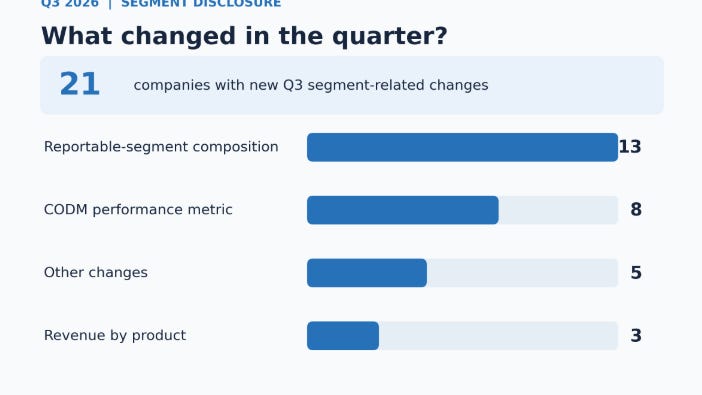
In the current sample, we identified 21 companies with 29 new Q3 segment-related changes. A single filing may disclose more than one change, so number of changes may exceed the number of companies.
The changes fall into the following categories:
Changes in composition of reportable segments. In 13 cases, companies modified the composition of reportable segments by adding, eliminating, or combining segments, or by moving businesses and revenue streams between segments.
Changes in CODM performance metric. In 8 cases, companies changed the measure used to assess segment performance or changed how they calculated the existing measure.
Other changes. In 5 cases, companies revised expense or asset allocations or changed within-segment presentations.
Changes in presentation of revenue by product. In 3 cases, companies changed how they disaggregated product revenue.
Changes in composition of reportable segments. In 13 cases, companies modified the composition of reportable segments by adding, eliminating, or combining segments, or by moving businesses and revenue streams between segments.
Changes in CODM performance metric. In 8 cases, companies changed the measure used to assess segment performance or changed how they calculated the existing measure.
Other changes. In 5 cases, companies revised expense or asset allocations or changed within-segment presentations.
Changes in presentation of revenue by product. In 3 cases, companies changed how they disaggregated product revenue.
Microsoft: more Azure revenue detail, but no standalone segment classification
Microsoft is the clearest example of the distinction between product disclosure and reportable-segment disclosure. The company separately disclosed Azure revenue for the first time and recast historical product revenue, giving investors a clearer view of Azure’s scale and growth. But Microsoft did not make Azure a separate reportable segment. Instead, it reduced its reportable segments from three to two — Agents and Infra, and Devices and Consumer — and included Azure within Agents and Infra alongside Microsoft 365 Cloud, productivity and server licensing, industry solutions, and frontier and support services. Investors therefore gained a new revenue figure for Azure but still cannot separately evaluate its costs, profitability or capital spending.
We counted Microsoft as a new Q3 disclosure because the change appeared in the September 30, 2026, 10-Q. However, we discussed this change earlier because Microsoft announced it in an 8-K before filing the 10-Q — arguably an unusual step for a segment-presentation change that gave the announcement additional prominence and suggests Microsoft viewed the new Azure disclosure as important to investors.
3M: changing what counts as segment profit
3M changed its measure of performance evaluated by CODM in stages during 2026:
In Q1, it moved manufactured-PFAS activity out of Transportation and Electronics and respirator-mask/asbestos litigation costs out of Safety and Industrial.
In Q2, it moved acquisition-related costs out of the business segments.
In Q3, it moved acquired-intangible amortization to Corporate as well. The segments themselves remained the same, but their reported operating income now excludes costs previously assigned to them.
In Q1, it moved manufactured-PFAS activity out of Transportation and Electronics and respirator-mask/asbestos litigation costs out of Safety and Industrial.
In Q2, it moved acquisition-related costs out of the business segments.
In Q3, it moved acquired-intangible amortization to Corporate as well. The segments themselves remained the same, but their reported operating income now excludes costs previously assigned to them.
The amounts are material. In Q3 2026, Corporate included $64 million of amortization and acquisition-related costs, including $41 million of acquired-intangible amortization, plus $46 million of net litigation and PFAS-exit costs. Comparing the original Q3 2025 filing with the recast figures in Q3 2026 filing shows the combined effect of the 2026 presentation changes on that prior quarter: reportable-segment operating income rose $41 million, from $1.527 billion to $1.568 billion, with $38 million of the increase in Safety and Industrial. Corporate declined by the same $41 million; consolidated operating income was unchanged. That comparison captures all the intervening changes, not just the Q3 amortization change.
3M’s changes in the presentation of the performance metric follow a broader change in how 3M reports its non-GAAP metrics. Beginning in Q3 2026, 3M also began excluding acquired-intangible amortization from its non-GAAP results — a new adjustment distinct from the acquisition-related costs it had begun excluding in Q2 — and recast prior-period reconciliations on that basis:
“In the third quarter of 2026, 3M changed its non-GAAP reporting to include amortization of acquired intangible assets as a special item.”
“In the third quarter of 2026, 3M changed its non-GAAP reporting to include amortization of acquired intangible assets as a special item.”
Together, amortization and acquisition-related costs added $0.20 to adjusted EPS for Q3 2026—about 7.6% of the $2.63 GAAP EPS figure. Other adjustments moved in the opposite direction, so final adjusted EPS was $2.50.
3M disclosed the change and recast prior periods, preserving year-over-year comparability on the new basis. Investors should still pay attention to what the new measure excludes: moving costs to Corporate makes the business segments appear more profitable, while excluding those costs from non-GAAP results raises the adjusted company-wide measure.
Under ASC 280, companies have long reported a measure of segment profit or loss used by the chief operating decision maker (CODM). The newer ASU 2023-07 requirements make that measure more informative by requiring disclosure of significant segment expenses and an explanation of how the CODM uses the reported measure. That makes changes to the measure itself worth watching.
As we discussed in our earlier piece, 3M changed the asset measure it reports for each segment in 2025. The previous measure attributed receivables, inventories, property and equipment, goodwill, intangibles and certain other assets to the businesses. The new measure — based on the segment-asset information regularly provided to the CODM — includes only inventory. On that basis, the recast 2024 amount reported as business segment assets was about $3.5 billion, compared with $19.9 billion under the previous measure.
Note that in 2026, 3M changed a different CODM measure, segment operating income, several times. The changes in 2025 and 2026 changes affect different measures, but the direction is similar: the new reported measures attribute fewer assets and costs to individual segments, with the remaining assets included in the reconciliation to consolidated assets and the excluded costs reported in Corporate.
Strategy (Ticker: MSTR): when a treasury activity becomes a segment
Note: although Strategy’s segment change occurred in Q2 and is not included in our Q3 count, we discuss it here because it was disclosed only one quarter earlier and concerns a company whose bitcoin holdings and financing model attract close investor scrutiny. The new segment presentation offers a timely opportunity to examine what has changed and what investors can learn from it.
Until the second quarter of 2026, Strategy reported only one reportable segment, Software Business. Its bitcoin treasury activities, which generate most of Strategy’s profits and losses, instead appeared in a non-operating “Corporate & Other” category. However, in its Q2 filing, Strategy made Bitcoin a separate reportable segment alongside Software and recast the comparative periods:
Beginning with the second quarter of 2026, we have realigned our financial reporting to present our operations as two reportable segments: our Software segment and our Bitcoin segment. In prior periods, we reported a single reportable operating segment, our Software segment (previously referred to as the “Software Business”), and presented the bitcoin-related activities now comprising our Bitcoin segment within a non-operating “Corporate & Other” category. We made this change to provide users of our financial statements with greater visibility into the activities of our software business distinct from our bitcoin treasury operations. See Note 13, Segment Information, to the Consolidated Financial Statements included in Part I, Item 1 of this Quarterly Report for additional information regarding our reportable segments. The discussion that follows presents a consolidated overview of our results of operations, liquidity, and capital resources, followed by a separate discussion of the results of each of our reportable segments.
Beginning with the second quarter of 2026, we have realigned our financial reporting to present our operations as two reportable segments: our Software segment and our Bitcoin segment. In prior periods, we reported a single reportable operating segment, our Software segment (previously referred to as the “Software Business”), and presented the bitcoin-related activities now comprising our Bitcoin segment within a non-operating “Corporate & Other” category. We made this change to provide users of our financial statements with greater visibility into the activities of our software business distinct from our bitcoin treasury operations. See Note 13, Segment Information, to the Consolidated Financial Statements included in Part I, Item 1 of this Quarterly Report for additional information regarding our reportable segments. The discussion that follows presents a consolidated overview of our results of operations, liquidity, and capital resources, followed by a separate discussion of the results of each of our reportable segments.
So, what changed between Q1 and Q2 2026, and what can investors learn from this change about Strategy’s business and liquidity?
Strategy describes itself as a “Bitcoin Treasury Company.” It raises capital by issuing stock and debt to buy bitcoin, which it holds as its primary treasury asset. What distinguishes Strategy from companies formed solely to hold bitcoin is its original enterprise software business, which still generates revenue and cash to support ongoing operations. In a May 2023 CNBC interview, Michael Saylor called it a “cash cow” and said Strategy used its cash to pay debt interest and buy more bitcoin.
Saylor’s “cash cow” description did not mean the software business could fund Strategy’s obligations on its own indefinitely. The company had said as early as 2023 that it did not expect software-generated cash to cover its long-term obligations. By June 30, 2026, bitcoin had fallen from $87,515 at year-end 2025 to $58,714. Jonathan Weil argued in a WSJ piece that Strategy’s ability to issue shares to buy bitcoin becomes less attractive when those shares trade at a discount to its bitcoin holdings. While Strategy does not disclose cash flow by segment, its consolidated operations generated only $9.9 million in cash in the first half of 2026, including interest earned on its dollar reserve — far below its $1.76 billion annualized preferred-dividend and debt-interest obligations.
Our concerns about that model predated the 2026 price decline. In a two-part analysis published in 2025, Deep Quarry and The Dig questioned whether Strategy could keep raising debt and equity to buy and hold bitcoin indefinitely. What would happen if bitcoin’s price fell sharply or investors became less willing to finance new purchases? Its software business generated cash, but that didn’t necessarily mean it could support the growing financial obligations tied to the bitcoin strategy.
On June 29, 2026, Strategy introduced its Digital Credit Capital Framework. As part of it, the board authorized — but did not require — bitcoin sales to fund the USD Reserve, pay preferred dividends and interest, or repurchase securities:
BTC Monetization Program
The Company’s Board of Directors has authorized a BTC monetization program (the “BTC Monetization Program”) under which the Company may sell bitcoin from time to time for three primary purposes:
• to generate up to $1.25 billion of additional proceeds to fund the USD Reserve;
• to additionally fund preferred stock dividends and interest expense as they become payable, or to replenish the USD Reserve after such payments, when management determines that it is more advantageous than issuing class A common stock or other capital markets transactions; and
• to additionally fund repurchases of Digital Credit Securities or class A common stock, including related taxes, fees, and transaction expenses, under the repurchase programs described above.
BTC Monetization Program
The Company’s Board of Directors has authorized a BTC monetization program (the “BTC Monetization Program”) under which the Company may sell bitcoin from time to time for three primary purposes:
• to generate up to $1.25 billion of additional proceeds to fund the USD Reserve;
• to additionally fund preferred stock dividends and interest expense as they become payable, or to replenish the USD Reserve after such payments, when management determines that it is more advantageous than issuing class A common stock or other capital markets transactions; and
• to additionally fund repurchases of Digital Credit Securities or class A common stock, including related taxes, fees, and transaction expenses, under the repurchase programs described above.
Bitcoin’s June decline did not persist through Q3: its price rose from $58,714 at June 30 to $83,552 at September 30. At quarter-end, Strategy reported $4.88 billion in its USD Reserve and another $0.92 billion in USD Cash. Together, those funds represented approximately 43 months of its then-expected preferred dividends and debt interest, which totaled $1.59 billion annually, according to Strategy’s Q3 disclosure:
As of September 30, 2026 and October 25, 2026, our current expected annual Preferred Stock dividend payments and Convertible Note interest expense were approximately $1.59 billion and $1.51 billion, respectively, and our USD Assets represented approximately 43 months and 40 months, respectively, of such expected payments. The foregoing expected annual dividend payments assume declaration in full of Preferred Stock dividends and, in the case of STRC Stock, a dividend rate of 12.00% per annum.
As of September 30, 2026 and October 25, 2026, our current expected annual Preferred Stock dividend payments and Convertible Note interest expense were approximately $1.59 billion and $1.51 billion, respectively, and our USD Assets represented approximately 43 months and 40 months, respectively, of such expected payments. The foregoing expected annual dividend payments assume declaration in full of Preferred Stock dividends and, in the case of STRC Stock, a dividend rate of 12.00% per annum.
That brings us back to the new Bitcoin segment. Strategy said in its Q2 10-Q that separating Bitcoin from Software would give investors greater visibility into the two activities. But visibility alone does not establish that an activity is an operating segment under GAAP.
According to KPMG’s ASC 280 handbook, to be classified as an operating segment, an economic activity:
Must be a component that engages in business activities from which it may recognize revenue and incur expenses;
Must be a component whose results the CODM regularly reviews to assess performance and allocate resources; and
Must be a component whose discrete financial information is available.
Must be a component that engages in business activities from which it may recognize revenue and incur expenses;
Must be a component whose results the CODM regularly reviews to assess performance and allocate resources; and
Must be a component whose discrete financial information is available.
Based on Strategy’s segment disclosure, CODM separately reviews results of bitcoin operations, which implies that discrete information is available. But what about the first criterion, the ability to generate revenue and incur expenses?
Strategy says that the primary function of the bitcoin segment is to buy and hold bitcoin as a treasury asset and perform several liquidity-related functions:
The Bitcoin segment encompasses the Company’s bitcoin treasury operations, through which the Company executes its bitcoin acquisition, capital markets, and capital management strategies. The segment’s principal activities consist of acquiring and holding bitcoin as the Company’s primary treasury reserve asset; issuing class A common stock and preferred securities through ATMs to fund bitcoin purchases; and maintaining a U.S. dollar reserve (the “USD Reserve”) to support Preferred Stock dividends and interest expense on the Company’s outstanding indebtedness.
The Bitcoin segment encompasses the Company’s bitcoin treasury operations, through which the Company executes its bitcoin acquisition, capital markets, and capital management strategies. The segment’s principal activities consist of acquiring and holding bitcoin as the Company’s primary treasury reserve asset; issuing class A common stock and preferred securities through ATMs to fund bitcoin purchases; and maintaining a U.S. dollar reserve (the “USD Reserve”) to support Preferred Stock dividends and interest expense on the Company’s outstanding indebtedness.
KPMG guidance explains that the treasury function could, under certain circumstances, qualify as an operating segment — for instance, if it incurs interest income:
A treasury function that recognizes interest income is an example of a functional department that could be an operating segment. [280-10-50-1, 55-4]
A treasury function that recognizes interest income is an example of a functional department that could be an operating segment. [280-10-50-1, 55-4]
Strategy describes the Bitcoin segment as acquiring and holding bitcoin, issuing stock and preferred securities to fund purchases, and maintaining a dollar reserve to meet financial obligations. Holding bitcoin produces fair-value gains or losses as its price changes; selling it can realize gains or losses and provide cash. But gains and losses are not revenue, and Strategy reported no revenue for the Bitcoin segment in Q2 or Q3 2026.
Strategy held bitcoin long before Q2 2026, when its treasury activities were still presented in Corporate & Other. What changed? Is interest earned on the USD Reserve sufficient to make the treasury activity an operating segment under the ASC 280 criteria discussed by KPMG? If not, does the new segment reflect plans to expand into bitcoin-related activities that may generate revenue? Strategy’s filing does not answer those questions.
For questions and data inquiries, please contact [email protected].
Investment, Tax and Legal Disclaimer: This article is for informational purposes only and does not constitute investment, tax or legal advice. The content contained herein is not to be relied upon as the basis for any investment or other decision. Nothing herein should be construed as a solicitation, recommendation, endorsement, or offer to buy or sell any particular security, product, or service. The author has not taken into account the specific investment objectives, financial situation, or particular needs of any specific person who may read this material. Investing involves inherent risks, and there can be no guarantee that any investment or company mentioned will be suitable or profitable for any investor’s investment portfolio. Readers are strongly advised to conduct their own thorough research and consult with a qualified and licensed financial professional and legal counsel before making any investment decisions. Past performance is not indicative of future results.