
Bitcoin's maximum supply is capped at 21 million BTC. To date, approximately 20 million bitcoins have been mined. However, some of these coins have been permanently lost due to lost private keys or inaccessible crypto wallets.
Bitcoin's limited supply and the permanent loss of some BTC affect the amount of cryptocurrency available on the market. Let's explore how many bitcoins have already been issued, how many remain to be mined, and why some existing bitcoins are no longer accessible.
The article covers the following subjects:
- Major Takeaways
- How Many Bitcoins Are There Right Now?
- Why Is Bitcoin's Supply Capped at 21 Million?
- How New Bitcoins Are Created
- Bitcoin Halving and the Supply Schedule
- How Much Bitcoin Is Left to Mine?
- How Many Bitcoins Are Lost Forever?
- What Bitcoin's Fixed Supply Means for Traders
- Conclusion
- FAQs
Major Takeaways
Bitcoin's maximum supply is 21 million BTC. Bitcoin's creator built this limit into the protocol when the cryptocurrency launched.
Approximately 20.09 million bitcoins have been mined so far. However, some of the issued coins have been permanently lost and are no longer accessible to their owners.
Fewer than 930,000 bitcoins remain to be mined. The last bitcoin is expected to be mined around 2140.
According to various estimates, owners have lost access to between 1.57 million and 7.5 million bitcoins. This wide range reflects how difficult it is to confirm the permanent loss of coins: a long period without transactions does not necessarily mean that their owners have lost access to them.
The current block reward is 3.125 BTC. The next Bitcoin halving is expected in 2028, at block height 1,050,000.
Who owns the most bitcoins? The largest Bitcoin holdings are believed to belong to Satoshi Nakamoto. An estimated 1.096 million BTC are attributed to Nakamoto, spread across 22,000 addresses. Most of these coins have not moved since they were mined.
Some estimates suggest that around 825,000 people own at least one bitcoin. This represents approximately 0.01% of the world's population, although the exact number of owners cannot be determined.
Bitcoin has a limited supply that cannot exceed its predetermined cap, while some coins have been permanently lost. Unlike BTC, the supply of fiat currencies can be increased by central banks as part of their monetary policy.
How Many Bitcoins Are There Right Now?
To determine how many bitcoins currently exist, we need to look at the total number of coins issued. To date, approximately 20.09 million BTC have been mined. This figure is reported as the circulating supply, even though some of these coins may no longer be accessible to their owners.
Bitcoin's maximum supply is capped at 21 million BTC, while its circulating supply increases as new blocks are mined. However, blockchain data cannot reveal whether owners still have access to their assets. In addition, some coins are technically unspendable because of how certain transactions were created.

As a result, lost bitcoins are generally still included in circulating supply statistics. This means the reported Bitcoin supply does not reflect the exact amount of BTC owners can access and spend.
If estimated losses are excluded, the number of existing bitcoins that remain accessible would be significantly lower. Based on 20.09 million BTC mined, the estimated amount would range from 12.6 million to 18.5 million coins. However, this range is only an estimate: a long period without transactions does not prove the permanent loss of cryptocurrency.
Why Is Bitcoin's Supply Capped at 21 Million?
Bitcoin's maximum supply is capped at 21 million BTC. Although this supply limit was not explicitly stated in the Bitcoin white paper, it can be mathematically derived from two rules built into the cryptocurrency's protocol:
Block reward. Initially, Bitcoin miners received 50 BTC for each new block they mined.
Halving. The block reward is cut in half every 210,000 blocks, approximately once every four years.
Block reward. Initially, Bitcoin miners received 50 BTC for each new block they mined.
Halving. The block reward is cut in half every 210,000 blocks, approximately once every four years.
As a result, the rate of new Bitcoin issuance gradually decreases. Adding up all Bitcoin block rewards over successive periods gives the following formula:
210,000 × (50 + 25 + 12.5 + 6.25 + 3.125 + 1.5625 + …) = 21,000,000 BTC
This formula shows the theoretical maximum supply. In practice, block rewards are rounded down to whole satoshis, the smallest units of Bitcoin. Therefore, the total number of bitcoins issued will be slightly below 21 million BTC.
Thus, Bitcoin's supply limit is determined by its protocol rules rather than decisions made by individual participants. Technically, these rules can be changed, but adopting new rules would require broad consensus among Bitcoin network participants.
What Happens When All 21 Million Bitcoins Are Mined?
The last bitcoin is expected to be mined around 2140. However, the end of Bitcoin issuance will not stop the network from operating. Transactions will continue to be processed, and new blocks will continue to be created as usual.
Once Bitcoin issuance ends, miners will no longer receive block subsidies in newly created BTC. Their only source of revenue will be transaction fees users pay to have their transactions included in blocks.
The main uncertainty is whether transaction fee revenue will be sufficient to secure the Bitcoin network. Currently, transaction fees generally account for a small share of miners' revenue, although this share can increase significantly during periods of high network activity. In the long term, Bitcoin's sustainability will depend on demand for transactions, transaction fees, and the economic incentives of network participants.
How New Bitcoins Are Created
Bitcoin mining is the process through which new bitcoins enter circulation and transactions are confirmed and recorded in a distributed ledger. The blockchain stores the history of all transactions, while miners compete to add the next block. To do so, they use computing power to find a cryptographic hash that meets specific requirements. The first miner to find a valid hash proposes a new block to other nodes on the network. Once the block is verified and accepted, the miner receives a reward.

In the Bitcoin blockchain, this process involves several steps:
Users create Bitcoin transactions and broadcast them to the network.
Miners select unconfirmed transactions and assemble them into a block.
They compete to find a hash that meets the required conditions.
The miner who finds a valid solution proposes the next block for inclusion in the Bitcoin blockchain and receives a mining reward once the network accepts it.
The reward consists of two components: a block subsidy paid in newly created BTC and transaction fees.
To maintain a steady rate of new coin issuance, mining difficulty is adjusted every 2,016 blocks. If the network's total mining power increases, mining difficulty rises. If computing power decreases, difficulty falls. This mechanism keeps the average block time close to 10 minutes.
Mining rewards encourage miners to contribute computing resources to secure the Bitcoin network. Thus, Bitcoin mining serves three purposes: issuing new BTC, confirming transactions, and securing the blockchain.
Bitcoin Halving and the Supply Schedule
Bitcoin halving is a protocol-defined event that cuts miners' block rewards in half. This event occurs every 210,000 blocks and gradually slows the issuance of new coins. The first halving occurred in 2012, and the most recent one was in April 2024, when the block reward fell from 6.25 to 3.125 BTC.
The table below shows Bitcoin's issuance schedule, illustrating how block rewards change after each halving.
Epoch
Blocks
Block reward
Period
1
0–209,999
50 BTC
2009–2012
2
210,000–419,999
25 BTC
2012–2016
3
420,000–629,999
12.5 BTC
2016–2020
4
630,000–839,999
6.25 BTC
2020–2024
5
840,000–1,049,999
3.125 BTC
2024–2028
6
1,050,000–1,259,999
1.5625 BTC
2028–2032
The next Bitcoin halving is expected in April 2028, when the network reaches block 1,050,000. After that, the block reward will fall to 1.5625 BTC, while daily issuance will decrease from approximately 450 to 225 BTC.
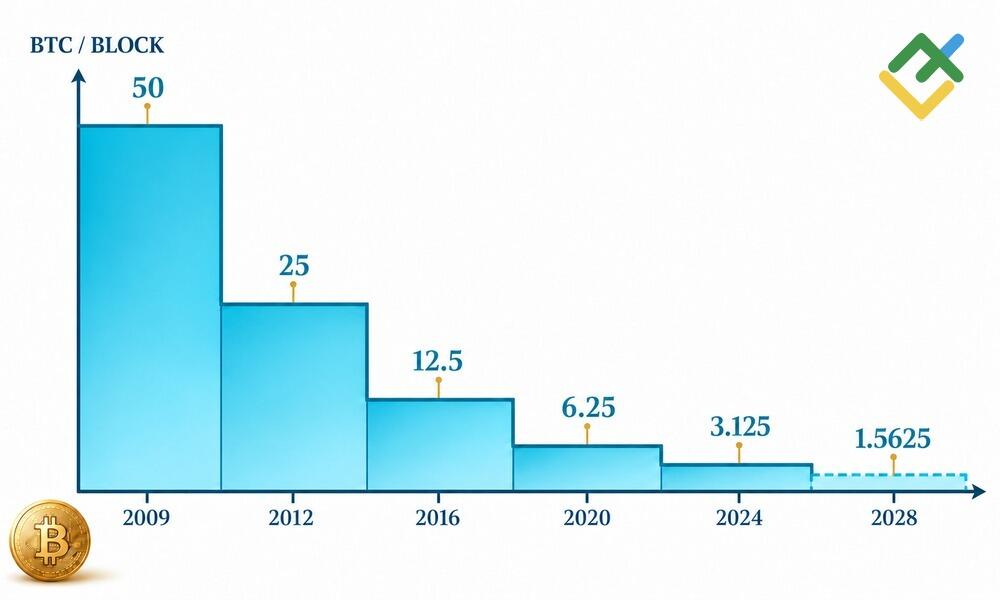
Bitcoin's issuance schedule shows how its supply growth gradually slows over time. The limited supply makes BTC scarce: unlike fiat currencies, whose issuance is regulated by central banks, Bitcoin cannot be issued beyond its maximum supply without changing the protocol rules.
How Much Bitcoin Is Left to Mine?
Fewer than 930,000 bitcoins remain to be mined before the maximum supply is reached. Because block rewards are regularly reduced, mining the remaining coins will take more than a century.
Currently, approximately 450 BTC are mined per day on average. At this rate, the remaining coins could be mined in approximately 5.6 years. However, after the 2028 halving, daily issuance will fall to 225 BTC and continue to decline thereafter. As a result, the last bitcoin is expected to be mined around 2140.
The table below shows how daily BTC issuance will gradually decrease.
Year
Daily issuance
2026
~450 BTC
2028
~225 BTC
2032
~112 BTC
2036
~56 BTC
The remaining new BTC will gradually enter circulation, and the issuance rate will continue to decline after each halving. The last bitcoin will not be issued as a single payment. Instead, the final stage of issuance will consist of numerous small block rewards spread over several decades.
How Many Bitcoins Are Lost Forever?
Lost bitcoins remain recorded on the blockchain, even if their owners can no longer access or spend them. Losing a private key, forgetting a password, or losing a device that stores a Bitcoin wallet can result in permanent loss of funds. However, blockchain data cannot reveal whether an owner has actually lost access to their cryptocurrency.
Estimates depend on which coins researchers classify as lost. Some count only confirmed cases of permanent loss of access, while others include BTC that have remained inactive for years. However, a long period without transactions does not necessarily mean that funds have been lost: the owner may simply be holding the cryptocurrency.
The table below presents estimates of lost bitcoins based on different methodologies.
Source
Estimated losses
Definition
River
1.57 million BTC
Only permanent losses in self-custody
Ledger
2.3–3.7 million BTC
Permanent losses
Unchained Capital
3–3.8 million BTC
Permanent losses
CryptoQuant
3.56 million BTC
Permanent losses
CoinDesk
Up to 5.6 million BTC
Coins that have not moved for over 10 years
Alphractal
7.47 million BTC (37.2%)
Broad definition, including dormant coins
Differences in estimates stem from how researchers define the permanent loss of cryptocurrency. A long period without transactions does not prove that the owner has lost access to their funds: assets can remain in cold storage for years.

A loss is permanent when the private key is lost, and professional recovery services cannot restore the owner's access to the funds. For example, if the device holding the only copy of a private key is damaged, the owner may lose access to their funds entirely. However, if coins stored in a hardware wallet have not moved for years, that doesn't mean they are inaccessible.
A notable example is the bitcoins attributed to Satoshi Nakamoto. According to Arkham's estimates, Bitcoin's creator holds approximately 1.096 million BTC that have remained unmoved since they were mined. It is unknown whether Satoshi still has access to these funds. If the private keys have been lost, this could represent one of the largest permanent losses in cryptocurrency history. Otherwise, these assets represent one of the largest long-term BTC holdings, although it would be technically incorrect to describe them as a single cold wallet.
What Bitcoin's Fixed Supply Means for Traders
Bitcoin's limited supply affects price movements, but price direction depends on supply and demand. When analyzing the market, traders also consider BTC dominance, which measures Bitcoin's share of the total cryptocurrency market capitalization.
Key factors to watch include:
Reduced supply of new coins. Each halving slows the issuance of new BTC, gradually limiting supply growth. If demand remains stable or grows, this could support Bitcoin's price, but it does not guarantee an increase.
Growing importance of transaction fees. After each halving, the block reward decreases, making transaction fees increasingly important to miners' revenue. Their share depends on user activity and Bitcoin network congestion. Traders should monitor these indicators, as they help assess demand for transactions.
Impact of institutional demand. Spot Bitcoin ETFs give investors exposure to the cryptocurrency through exchange-traded products. Capital inflows into these funds may lead to Bitcoin purchases and increase market demand. With limited supply, this may create conditions for price growth, while capital outflows could have the opposite effect.
Reduced available supply due to lost coins. According to River, approximately 1.57 million BTC have been permanently lost, while Alphractal's broader methodology estimates up to 7.5 million BTC, including dormant coins. Based on 20.09 million BTC mined, an estimated 12.6–18.5 million coins remain potentially accessible. However, to understand how many bitcoins are actually available for trading, consider not only lost coins but also holders' willingness to sell their assets.

Risks and Counterarguments
Bitcoin's limited supply does not eliminate risks for investors and traders. When assessing Bitcoin's prospects, it is important to consider factors that could put pressure on its price and affect the network's stability:
Scarcity does not guarantee price growth. Even with a limited supply, falling demand can drive the price down. Therefore, Bitcoin price forecasts should consider not only its issuance rules but also overall market conditions.
Estimates of lost coins may be overstated. Long periods of inactivity do not mean that owners have lost access to their funds. If dormant wallets become active again, the amount of Bitcoin available for sale could increase.
Miners' revenue depends on transaction fees. After the final halving, the Bitcoin network will continue to operate, but block rewards will consist entirely of transaction fees. If this revenue is insufficient to cover miners' costs, the network's total computing power could decline, potentially weakening Bitcoin's security.
Conclusion
Bitcoin's maximum supply tells us exactly how many bitcoins can exist. Of the 21 million BTC allowed by the protocol, more than 20 million have already been mined, while the remaining coins will continue to be issued until the end of the next century.
Bitcoin's limited supply sets it apart from fiat currencies, whose issuance is regulated by central banks. Unlike traditional currencies, Bitcoin cannot be issued beyond its maximum supply without changing the protocol rules. This supply limit is maintained by participants in the Bitcoin network.
For traders, the balance between demand and available supply is particularly important. The Bitcoin Rainbow Chart helps assess BTC's current price against historical price ranges but does not guarantee accurate forecasts.
Even with limited issuance, cryptocurrency prices can fall due to market and regulatory factors. Therefore, investors should consider not only how many bitcoins remain in circulation but also the potential risks before buying.
FAQs
According to Arkham, Satoshi Nakamoto owns approximately 1.096 million BTC spread across 22,000 addresses. Most of these coins have remained unmoved since the early years of the Bitcoin network. The exact amount Bitcoin's creator holds is unknown.
According to River, approximately 825,000 people own at least one whole bitcoin. This represents roughly 0.01% of the world's population. However, the exact number of owners is impossible to determine because one person can control multiple cryptocurrency addresses.
Fewer than 930,000 bitcoins remain to be mined. Because of regular reductions in block rewards, the issuance rate will gradually decline, with the last bitcoin expected to be mined around 2140.
After the final halving, no new BTC will be issued, and miners will earn revenue exclusively from transaction fees. The Bitcoin network will continue to process transactions, but mining rewards will no longer include newly created coins.
Technically, the maximum supply can be increased, but doing so would require changes to the protocol rules and broad consensus among network participants. Nodes operating under the existing rules would reject any additional coins, potentially causing a blockchain split.
Price chart of BTCUSD in real time mode
The content of this article reflects the author’s opinion and does not necessarily reflect the official position of LiteFinance broker. The material published on this page is provided for informational purposes only and should not be considered as the provision of investment advice for the purposes of Directive 2014/65/EU.
According to copyright law, this article is considered intellectual property, which includes a prohibition on copying and distributing it without consent.