Which topics should we dive deeper into?
Select what genuinely interests you. Your picks feed directly into our editorial planning.
Crypto news that's actually worth your time.
Weekly. 60 seconds. Carefully curated by our editors: no hype, no promo flood, no spam.
There are two ways to buy an NFT with euros. Either you first convert your money into the right cryptocurrency at a crypto exchange via SEPA transfer and then buy the NFT on a marketplace with your own wallet. Or you pay directly on the marketplace by card, Apple Pay or PayPal, and a payment service such as MoonPay handles the conversion in the background. The second route is more convenient but noticeably more expensive for small amounts: for an NFT costing around €86, the card's payment fee alone comes to €3.99, or 4.6 percent.
Which option suits you depends on three things: which blockchain the NFT you want sits on, how much you want to spend, and whether you will need the cryptocurrency afterwards for further purchases. Which platforms are still trading in 2026 and what they charge is shown in our comparison of NFT marketplaces. This guide walks step by step from your current account to the completed purchase and recalculates the fees with real figures from November 14, 2026.
What a non-fungible token is, technically and legally
An NFT, short for non-fungible token, is a token on a blockchain that represents exactly one item and therefore cannot be swapped one for one against another. One euro is worth the same as any other euro, but an NFT carries its own identifier within its collection. As a rule, the blockchain only stores the record of who owns this identifier and a reference to the content, meaning the image, video or data set.
This implies a limit that surprises many newcomers. Buying an NFT means acquiring the token and with it control over that record. Copyright in the artwork does not automatically pass to you unless the artist expressly grants it in their terms. An NFT therefore works more like a digital title deed with a built-in trading route than like the work itself.
What collectors use NFTs for today
The best-known categories are digital art, trading cards, in-game items, domain names and virtual land in metaverse worlds. There are also tickets and memberships, where the NFT unlocks access. For the purchase itself the category matters less. What counts is the blockchain on which the NFT collection was issued, because it determines which cryptocurrency you need.
Where can I buy NFTs? The NFT marketplaces still open in 2026
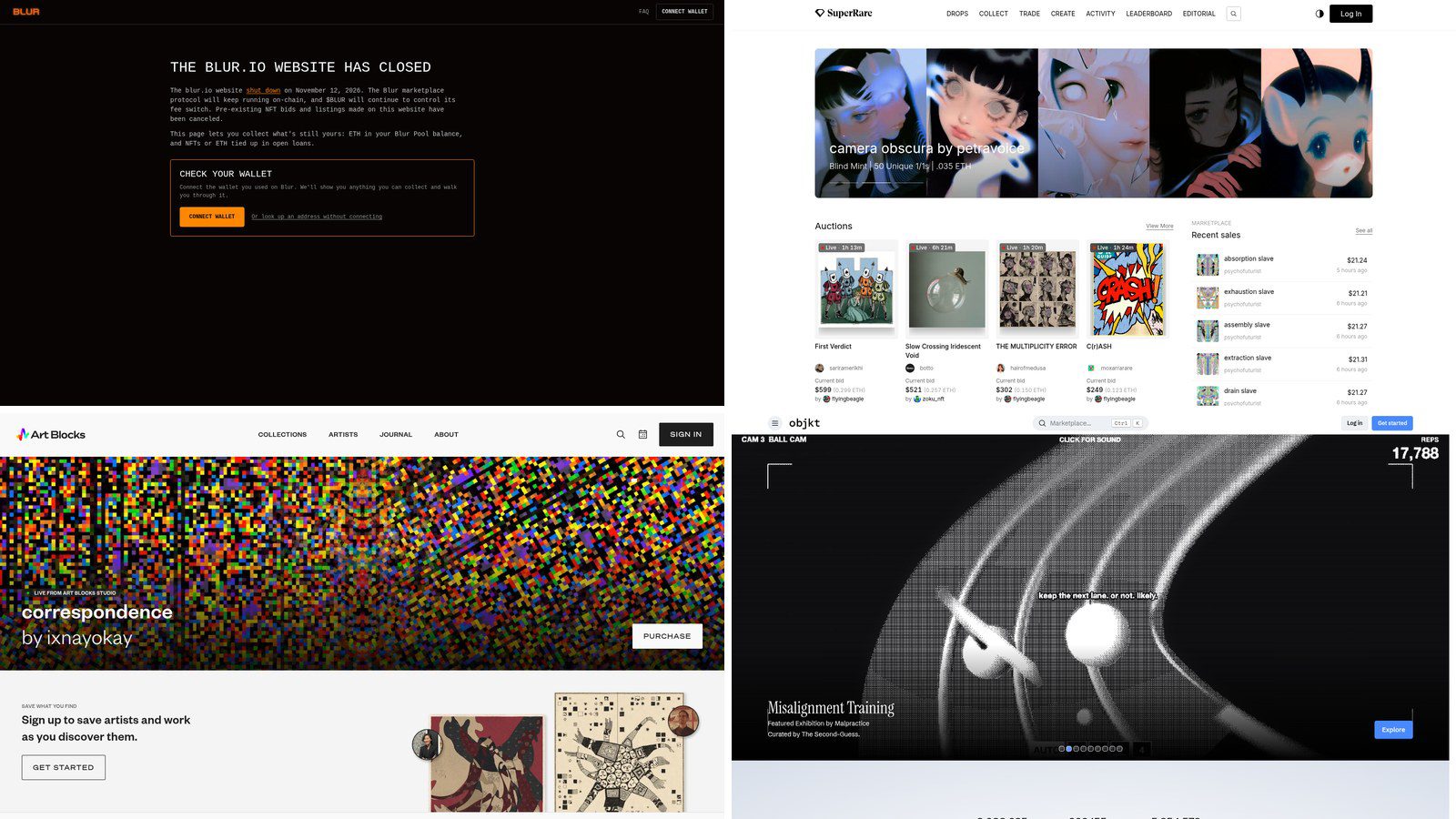
The number of trading venues shrank considerably in 2026. Binance closed its NFT section on July 3, 2026, Nifty Gateway did so in April, and Magic Eden now only trades Solana NFTs. Details of these closures are in our overview Three fewer NFT marketplaces. Still open are, among others, OpenSea for Ethereum and several other blockchains, Magic Eden and Tensor for Solana, as well as Rarible and SuperRare, with SuperRare focusing on selected artworks.
An NFT marketplace is not a custodian. You connect your own crypto wallet, the marketplace displays what it holds and handles buying and selling via smart contracts, meaning programs on the blockchain that automatically execute the exchange of a token for payment. If a marketplace closes, the shop window disappears, not your NFT. What a purchase on OpenSea looks like in detail is covered in our guide to OpenSea.
Ethereum or Solana: the blockchain determines the cryptocurrency
Many well-known collections run on the Ethereum blockchain. Their prices are quoted in ETH, the cryptocurrency of Ethereum, and payment is also made in ETH or in WETH, the wrapped form used for bids. On Solana, trading is in SOL. On Saturday morning, November 14, ether cost around €1,716 and one Solana coin around €68. There are also NFTs on Polygon, Base and other networks that are technically related to Ethereum and work with the same wallet.
So check where the NFT lives before spending your first euro. On the NFT collection's page, every marketplace shows the blockchain and the contract address. If you buy ETH although the piece you want sits on Solana, you pay fees a second time for the detour.
Which crypto wallet you need to buy NFTs
For Ethereum NFTs, any wallet that can connect to the main marketplaces will do; for Solana NFTs, you need a wallet that supports Solana. A software wallet in your browser or on your smartphone is enough to start with. If you hold larger amounts, pair it with a hardware wallet that has you confirm every signature on its own display. The one essential is that you secure the recovery phrase yourself. Without it, the NFT is gone if you lose your device, and no marketplace can retrieve it.
From current account to crypto wallet: the route via a crypto exchange with SEPA
In most cases the cheapest route runs through a crypto exchange. You transfer euros by SEPA to your exchange account, buy ETH or SOL there and send the coins to your own wallet. Only then do you move on to the marketplace.
Authorisation matters at this step. Since the end of the transition period, exchanges serving customers in the EU have needed a licence under the EU's Markets in Crypto-Assets regulation, MiCA. Kraken, for example, received it from the Central Bank of Ireland on June 25, 2025, and Coinbase from the Luxembourg regulator CSSF in June 2025. An overview of licensed providers is available in our comparison of regulated crypto exchanges. The licence protects you when exchanging euros into crypto, not when you later buy the NFT.
Costs on the exchange side
Kraken's fee schedule lists a trading fee of 1 percent for instant buys, or up to $2 instead of the percentage fee for small purchases. On top comes a spread, the gap between the market price and the price you receive. This gap is built into the displayed price. Fees are lower through the professional interface with an order book, but you then have to place buy orders yourself. Every exchange charges its own fee for withdrawals to your wallet, which varies by coin and network and is shown before you confirm.
One detail saves money: always send the coins over the network on which the NFT sits. ETH on the Ethereum mainnet and ETH on Base are the same currency but not the same network. If you withdraw to the wrong one, you then have to move the coins via a bridge and pay again.
Card payment, Apple Pay and PayPal: buying an NFT via MoonPay
In its own help pages, OpenSea presents buying by credit card as the simplest route. MoonPay handles the conversion: the service converts your euros into cryptocurrency, and the NFT lands directly in your wallet. According to OpenSea, a processing fee for the card and the blockchain's gas fee apply.
The level of the processing fee is set out in MoonPay Europe's pricing disclosure: up to 4.5 percent for cards and alternative payment methods, up to 4.5 percent for PayPal and up to 1 percent for bank transfers. Below a certain threshold, a minimum fee of €3.99 applies. If you reach MoonPay through a partner such as a marketplace, that partner's own markup may be added. Supported methods in the EU include Visa, Mastercard, Maestro, Apple Pay, Google Pay, PayPal, Revolut and SEPA transfers.
Whether the convenience is worth it depends on the size of the purchase. For a single small purchase you save yourself an exchange account, identity verification and withdrawal. If you plan to buy several NFTs, you pay the surcharge again each time.
NFT fees in a worked example: an NFT for 0.05 ETH costs up to €90
Suppose the NFT you want is listed on OpenSea for 0.05 ETH. At the ether price of November 14, that equals €85.82. The calculation for both routes looks like this:
In this example the card route costs €4.10 above the purchase price, the exchange route just under one euro plus the withdrawal fee. Neither calculation includes the spread that is built into the price of instant buys. At €1,000 the picture would be different: no minimum fee applies there, and the card costs up to €45, the bank transfer via MoonPay up to €10.
On Solana, network costs are almost negligible. According to the Solana documentation, the base fee is 5,000 lamports per signature, or 0.000005 SOL. At the price of November 14, that is around 0.03 cents, and an optional priority fee may be added. A Solana NFT for 1 SOL therefore costs around €68.36 plus the fees on the way from euros to SOL.
Gas fee, marketplace fee and creator earnings when buying NFTs
Three items appear in every NFT purchase. The gas fee is the price of the computing power the network spends on your transaction. The money goes to the blockchain's validators, not to the marketplace. A single purchase via the OpenSea protocol used mostly between 165,000 and 200,000 gas units overnight into November 14, around 190,000 on average. At the median gas price of these purchases, 0.35 gwei, that is around €0.11. The most expensive purchase that night paid 4.6 gwei, which at median consumption would be around €1.50. One gwei is a billionth of an ETH.
On OpenSea, the marketplace fee is paid by the seller. According to OpenSea's fees page, it is typically 1 percent and already included in the displayed price. The same applies to creator earnings, the share the artist receives on every resale. Depending on the collection they are mandatory or optional, and with optional earnings the seller decides whether to pay them. The final price for buyers does not change as a result, but your proceeds do if you later sell the NFT yourself.
If a transaction fails, for instance because another buyer was faster, no marketplace fee is charged. The gas already consumed, however, is gone, on Ethereum and on Solana alike.
MiCA and NFTs: what the EU rulebook covers and what it leaves out
The EU's MiCA regulation excludes crypto-assets that are unique and not fungible with other crypto-assets; that is set out in Article 2(3). Classic NFTs therefore fall outside supervision, and marketplaces need no MiCA licence for pure NFT trading. Recitals 10 and 11 do draw a line, however: fractions of an NFT are not considered unique, and with large series the supervisor may assume fungibility. For you as a buyer, this means there is neither a prospectus nor a complaints body behind an ordinary NFT.
How paying for an NFT with ETH or SOL, and the NFT itself, are taxed depends on the country you live in. Note the date, the euro price and the transaction ID of every purchase; tools that log such trades automatically are listed in our comparison of crypto tax software.
Risks when buying NFTs: fake collections, approvals and total loss
The biggest practical risk is copies. Anyone can take an image and issue it as a new collection. Before buying, compare the contract address with the one on the project's official site and look for the marketplace's verification badge, which is, however, only a plausibility check.
The second risk lies in the wallet. When you connect to a marketplace, you are not asking permission for a single purchase; many flows require an approval that allows a contract to move tokens out of your wallet. Only confirm signatures whose content you understand, and revoke old approvals regularly. Fake marketplace pages and messages promising free NFTs target exactly this step.
The third risk is the price. NFTs have no cash flow and no intrinsic value; their price arises from demand alone. It can therefore fall sharply within a short time, and thinly traded pieces sometimes find no buyer at all. A total loss is possible. Only buy what you would keep even without reselling it.
Buying an NFT: a bank transfer beats the card by several percentage points
- Identify the blockchain and choose a marketplace: Check whether the NFT you want sits on Ethereum, Solana or a related network, and choose a venue that lists it. Fees and blockchains of the open platforms are in our comparison of NFT marketplaces.
- Convert euros cheaply: From your second purchase onwards, or from a few hundred euros, an account at an exchange with a MiCA licence and SEPA deposits pays off. You can compare fees and payment methods in our overview of the best crypto exchanges.
- Secure your wallet: Keep the recovery phrase offline and confirm larger purchases on a separate device. Suitable models are listed in our hardware wallet comparison.
(As of November 14, 2026. This article is not investment advice. Prices and fee structures change; check the terms with the provider before you buy.)
Frequently asked questions about buying NFTs
You buy NFTs on NFT marketplaces such as OpenSea for Ethereum or Magic Eden and Tensor for Solana, which remain open in 2026. Binance closed its NFT section on July 3, 2026, and Nifty Gateway in April 2026.
Yes, OpenSea offers card purchases through the payment service MoonPay, which converts euros into crypto in the background. MoonPay Europe lists a fee of up to 4.5 percent and at least €3.99 for this, plus the blockchain's gas fee.
For an NFT priced at 0.05 ETH, around €85.82 on November 14, 2026, the card route via MoonPay costs about €4.10 extra. The route via a crypto exchange with a 1 percent trading fee comes to just under one euro plus the withdrawal fee and spread.
NFTs generate no cash flow, their price is driven purely by demand, and thinly traded pieces sometimes find no buyer at all. A total loss is possible, so NFTs suit mainly collectors who would keep a piece even without reselling it.
Partner links: some links on this page are partner links. If you become a customer through one of them, we may earn a commission at no extra cost to you. Selection, ratings and ranking are decided independently by our editorial team. Ethics and Independence · Ownership and Funding
Transparency note: This article was produced with the assistance of artificial intelligence and reviewed by our editorial team before publication. All figures and claims were checked against the primary sources linked in the text. The feature image was generated with AI.
For later? Save this article and find it again in your profile.
Related articles
- Bitget Futures Trading: Your First Trade, Leverage and Risk
- Buy Bitcoin with Paysafecard: the €50 limit and why exchanges rarely take the code
- Buying IOTA with PayPal: Bitpanda and Bitvavo list the coin, Kraken and Coinbase do not
- Bybit Card: 0.9 percent on crypto payments and 2 percent at cash machines above €100
- Buying XRP with PayPal: PayPal itself does not sell XRP in Germany
Which topics should we dive deeper into?
Select what genuinely interests you. Your picks feed directly into our editorial planning.
Crypto news that's actually worth your time.
Weekly. 60 seconds. Carefully curated by our editors: no hype, no promo flood, no spam.
November 7, 2026 10:59 PM
Will Bitcoin Go Back Up? Three Scenarios to Year-End: $70,000, $80,000 or $100,000
Bitcoin (BTC) is 40% below its record, ETFs are bleeding cash and the Fed may hike. What happened since early November, which levels decide between $70,000, $80,000 and $100,000, and what price history says about the 53 days to New Year's Eve.
November 7, 2026 1:18 PM
Bitrefill review: buying gift cards with crypto when the rate holds for 30 minutes
On Bitrefill you pay for gift cards for Amazon.de, Rewe and more than 8,000 other products with Bitcoin, Lightning or stablecoins, even without an account. What a purchase really costs, which limits apply and why every gift card counts as a disposal for German tax purposes.
November 5, 2026 8:27 AM
How to use Etherscan: reading transactions, gas fees and smart contracts with real examples
Etherscan shows every movement on the Ethereum blockchain, free of charge and without sign-up. This guide uses real examples to explain how to read transactions, fees, tokens and smart contracts, and how to protect yourself from address poisoning.
November 4, 2026 12:00 AM
Trump, Iran and the MOAB: What Moves the Oil Price and Gold Price After the Midterms
Trump's pause on Iran ended with the vote. What is on record about the mother of all bombs, why gold has fallen on most big oil days, and where oil and gold can be traded.
November 3, 2026 10:36 PM
Anthropic Stock: How to Buy, IPO Date and Pre-IPO via XTB
Anthropic plans to list on Nasdaq under the ticker ANT. When you can buy the stock, what the pre-IPO CFD at XTB is, how the offers in Europe and the UK work and what the prospectus says.
November 1, 2026 7:21 AM
How to Buy USDT in the EU: 7 Platforms Checked, What Still Works
Since ESMA's opinion of 8 October 2026, Tether's stablecoin is disappearing from exchanges in the EU. We checked seven platforms, measured spreads and network fees, and show which routes and alternatives remain on 1 November 2026.
November 1, 2026 3:30 AM
Buying Pepe: 22.5 million PEPE for 100 euros, and the fee decides the rest
Bitvavo, Kraken and Bitpanda list Pepe with a MiCA licence. At midday on Wednesday the order books were 14 cents apart, the fees by more than a euro.
October 31, 2026 6:29 PM
Buying Kaspa: three exchanges trade KAS against the euro, with fees between 0.15 and 1.49 percent
Bitvavo, Kraken and Bitpanda list Kaspa with MiCA authorisation. €100 bought around 3,121 KAS at midday on Wednesday, and the fee ranged from 15 cents as a maker to €1.49 for an instant buy.
October 29, 2026 9:08 PM
Best Crypto to Buy Now: 5 Coins to Watch in November 2026
The best crypto to buy now, updated every month: five coins for November 2026 with price, catalyst and main risk, how we pick them and how last month's list performed.
October 29, 2026 3:37 AM
Buying Hedera: five euro pairs, and the fee that sets your quantity
Analysis: HBAR stands at 0.067658 euros and therefore 39 percent below the level of a month ago, and it is exactly in weeks like this that the question of the buying route comes up most. Documented is what five venues quoted for a euro pair overnight; our assessment of it follows further down.
October 27, 2026 6:48 PM
Buy BNB in Germany: three exchanges with a MiCA licence, and the fee that decides
At midday on Tuesday, 100 euros bought 0.150875 BNB at Kraken and 0.150820 at Bitvavo. Once the fee is counted Bitvavo is ahead, and on withdrawal the right network is what matters.
October 27, 2026 3:47 PM
Buy Chainlink in Germany: five licensed exchanges, fees that differ tenfold
Across the three order books measured, 100 euros bought around 9.82 LINK at Tuesday midday, with prices three cents apart. What decides it is the route: a fee of 0.15 to 1.875 percent.
October 19, 2026 7:16 PM
Only 1.59 percent of Shiba Inu trading runs in euros: SHIB vs Bitcoin in the order book
A proprietary analysis of the hundred largest SHIB trading pairs on October 19, 2026 shows the euro carrying 1.59 percent of turnover and the Turkish lira 6.54 percent. Between the cheapest and the most expensive euro pair, the bid-ask spread differs 30-fold on the same day.
October 13, 2026 4:45 PM
NFT prices in October 2026: Bored Apes 97 percent below record, CryptoPunks hold up best
A Bored Ape costs less than it has in years, Pudgy Penguins lost almost three quarters in a year, and Blur is closing. The prices of the eight best-known NFT collections compared, the reasons for the decline, and what matters when buying at a low price.
October 13, 2026 4:37 PM
Blur closes on November 12: what matters now for NFT holders
The once largest NFT marketplace on Ethereum switches off its website on November 12, 2026, and the Blend lending product will then arrange no new loans. Outstanding loans, open bids and old approvals all need a decision before that.
October 12, 2026 10:27 AM
Is Bitcoin Still a Good Investment in October 2026?
Spot ETFs have changed who sets the Bitcoin price, and the easy repricing is behind us. What still supports BTC, what could break it, and how much belongs in a portfolio today.
October 12, 2026 1:32 AM
Three NFT marketplaces fewer: what matters when buying now
Binance has ended NFT trading, Nifty Gateway is closed and Magic Eden trades only on Solana. Which NFT marketplaces are open in 2026, what a purchase costs and why MiCA does not protect you there.
October 11, 2026 4:28 AM
Coinbase Card Without a Transaction Fee: What Investors Need to Know About Conversion and the Holding Period
Coinbase charges no transaction fee for paying with the card. It gets expensive in two places that appear on no receipt: the conversion of the balance and the holding period.
October 6, 2026 4:32 AM
Bitcoin for a gift card: what paying with crypto means for your holding period
Paying for a gift card with Bitcoin is a sale for tax purposes. What counts as the disposal proceeds, when the twelve-month holding period bites, and the four records the tax office expects.
October 4, 2026 4:24 PM
Bitcoin by credit card: the surcharge runs up to 9.94 euros per 100 euros
Anyone buying Bitcoin with a credit card pays two fees instead of one: the trading venue's, and their own bank's, which often settles the purchase like a cash withdrawal. On 100 euros of card spending up to 9.94 euros add up, while the SEPA transfer costs nothing at the same providers.
September 22, 2026 4:33 PM
Three of the 25 Largest Coins Have No Euro Pair: How to Check Your Buying Route Before the Order
Our own survey of five trading venues active in the EU, taken on September 22, 2026, shows that three of the 25 largest cryptocurrencies have no euro pair there at all, and four more only one. What that means for your next order and what the detours cost.
September 22, 2026 1:27 AM
Bitcoin ATM in Germany: Fees, BaFin Authorisation and Tax
Bitcoin ATMs stand in kiosks and shopping arcades, and buying there costs a multiple of the online route. What BaFin demands of the operator, at what amount your ID becomes due, and how you evidence the purchase for tax.
September 21, 2026 4:13 AM
How to Buy XRP in Germany: Exchange, Destination Tag and Tax
Buying XRP works through a crypto exchange with MiCA authorisation, through a broker, or through an ETP in your securities account. This guide shows what matters on fees, the destination tag, custody and the German holding period.
September 6, 2026 10:12 PM
MoonPay Fees: Up to 4.5 Percent, a Partner Margin on Top, and a Markup You Never See as a Fee
MoonPay is the buy button built into many crypto wallets. The European price list names four layers of cost, and only three of them show up as line items. What the provider is allowed to do, and what it expressly is not.
June 9, 2026 11:00 PM
How to buy SpaceX shares? All options for investors explained
Learn how to buy SpaceX stock. Discover the benefits of Kraken stock products, as well as Revolut for a potential investment.
June 8, 2026 3:42 PM
How to buy SpaceX shares? All options for investors explained
Learn how to buy SpaceX stock. Discover the benefits of Kraken stock products, as well as Revolut for a potential investment.
More from CryptoTicker