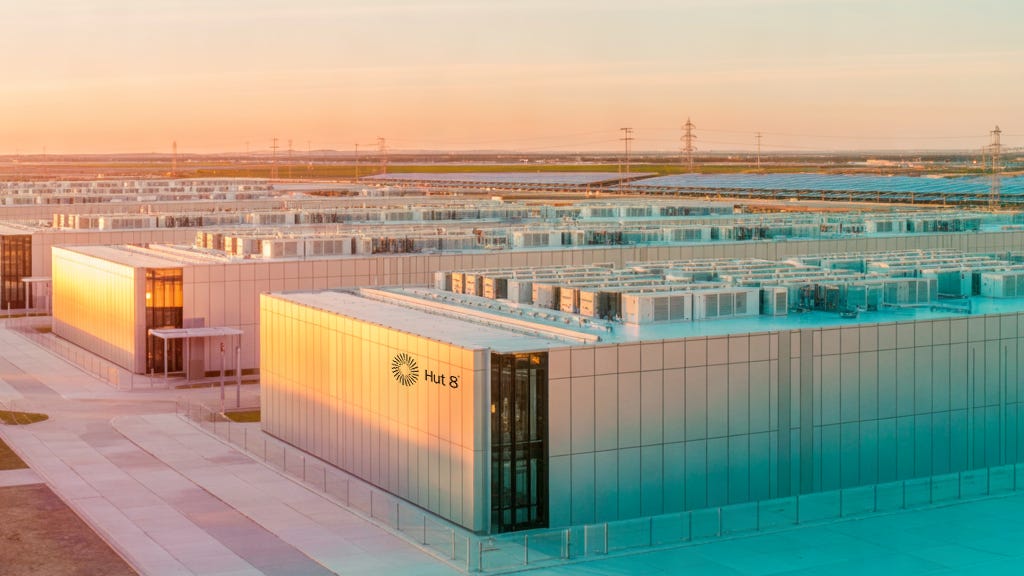
Two financed campuses, $7.5B of non-recourse bonds and a Google-backed lease at River Bend. Why rent starting in Q2 2027, not a $413.8M Bitcoin gain, will decide what shareholders earn.
Welcome to Global Data Center Hub. Join investors, operators, and innovators reading to stay ahead of the latest trends in the data center sector in developed and emerging markets globally.
The AI build-out is short of power, and the companies that hold power are not always the ones with the strongest balance sheets.
Former Bitcoin miners own something hyperscalers want: land with grid connections already in place.
The hard part has been turning that power into leases that lenders will fund.
Many converters have announced megawatts. Far fewer have signed investment-grade tenants and raised project debt against them.
Hut 8 has. It now holds 949 MW of contracted IT capacity across three projects, two of them financed with $7.5 billion of project bonds that do not reach the parent company.
That moves the company to a different test. A lease becomes rent when the building is delivered, and rent becomes shareholder cash when the debt is paid.
Until then, the income statement still reports a mining business whose profit moves with the price of Bitcoin.
The third quarter is best read as a company between those two stages.
The Hard Part Is Done: Leases Lenders Will Fund
The lease book is specific and well backed.
River Bend has 330 MW of utility power supporting 245 MW of leased IT load. The tenant is Fluidstack, on a 15-year lease with a financial backstop from Google.
That backstop is what made the project financeable at scale: lenders are underwriting Google-supported rent, not a mining company’s balance sheet.
Beacon Point has two phases of 500 MW of utility power and 352 MW of IT load each, leased to an unnamed tenant with a high investment-grade rating.
Phase 1 targets Q3 2027 and Phase 2 targets Q2 2028. During the quarter, management extended the Phase 2 lease from 15 to 17 years, which gives lenders a longer stream of rent to lend against.
Hut 8 puts a headline base-term value of $26.6 billion on the three leases. That figure predates the Phase 2 extension and should be read as disclosed, not updated.
Two distinctions keep the numbers honest. The 1,330 MW of utility power is not 1,330 MW of rentable space; the 949 MW of IT load is what tenants pay for.
And the 7,859 MW pipeline is mostly early stage: 1,330 MW is under construction, 3,180 MW under exclusivity and 3,300 MW under diligence.
The pipeline is option value. The three signed projects are the business.
Construction is under way, with Vertiv and Jacobs named in delivery roles at River Bend. The River Bend target of Q2 2027 is unchanged from the original lease announcement.
The next step is turning that date into accepted data halls.
The Income Statement Is Still a Mining Company
Hut 8 reported consolidated net income of $189.5 million, of which $131.1 million belonged to Hut 8 shareholders. GAAP diluted EPS was $0.98.
The driver was a $413.8 million gain on digital assets. Operating income of $318.2 million would have been a $95.6 million loss without it.
The gain reflects the real value of the Bitcoin Hut 8 holds, but it rises and falls with the market, so it says little about the AI business.
The cleaner measures moved in the right direction. Operating cash flow was $27.8 million, against negative $5.6 million in Q2 and $0.8 million a year earlier.
Adjusted EBITDA, which now excludes Bitcoin mark-to-market, rose to $33.0 million from a recast $30.5 million.
Revenue fell to $71.1 million, from $83.5 million a year earlier, and came in 6.2% below the $75.8 million consensus reported by Perplexity Finance.
Part of the drop reflects deliberate portfolio changes: Far North was sold in February and Traditional Cloud during Q3.
Compute, mainly the consolidated American Bitcoin business, produced 96.3% of revenue, and its margin before depreciation fell from 68.5% to 59.0% as direct costs rose 27.2%.
Costs are being built ahead of rent. General and administrative expense was $99.6 million, including $64.7 million of stock compensation. Without stock pay it was $34.8 million, up 78.2% from a year earlier.
Free cash flow, after cash spent on property and equipment, was negative $455.7 million. That is what a company looks like when it is building three campuses at once.
The question is not whether those costs are high today, but whether rent arrives on time to carry them.
A Structure Built to Protect the Parent
Hut 8 financed River Bend and Beacon Point Phase 1 with $7.5 billion of non-recourse project bonds, $3.25 billion and $4.25 billion respectively.
Lenders can claim the projects, not the parent. If one campus runs into trouble, the rest of the company is walled off from that debt.
The structure has a visible consequence on the balance sheet. At quarter end, Hut 8 held $3.556 billions of restricted cash and $2.839 billions of restricted investments, about $6.4 billion set aside for the projects, against $156.9 millions of unrestricted cash.
Loans, notes and other financial liabilities totaled $7.632 billion. The money to build is in place. It is just held where the lenders can see it.
For corporate needs, Hut 8 has an undrawn $1.07 billion secured revolver. That gives it room to move, though drawing it would add corporate-level debt.
The bonds are also fully amortizing, which means rent pays down principal from the start.
Hut 8’s own illustrative financing models, which are dated and are not current guidance, show River Bend producing $373 million of net operating income in 2028 and $107 million of cash after interest and principal.
Beacon Point Phase 1 shows $561 million of net operating income in 2030 and $217 million after debt service. That is conservative credit.
It front-loads repayment, and it means the cash that reaches shareholders in the early years is a fraction of headline rent, growing as the debt shrinks.
Phase 2 is the piece still open. Its financing was being arranged at the print. The longer lease should help.
What the Selloff Does and Does Not Say
Shares closed at $63.75 before the release and $48.94 on earnings day, a 23.2% fall. By November 10 they had recovered 16.0% to $56.77, still 10.9% below the pre-release close, according to Perplexity Finance.
The available sources do not separate how much of that move came from the revenue miss, the open Phase 2 financing, rising overhead or the wider market. Neither the drop nor the partial rebound settles what the leases are worth.
On competitive position, Hut 8 has shown what the converter model needs most.
Signed, financed, investment-grade leases are scarce, and the Google backstop at River Bend is clear evidence that hyperscaler credit can make a third-party developer bankable.
For the rest of the cohort, the benchmark is now the financing and delivery structure, not announced megawatts.
The risk sits in the bridge to 2027: rising overhead, an unfinanced third phase and a mining business with falling margins carrying the company until rent begins.
Credit Moves Down the Chain, and Delivery Risk Moves With It
The wider pattern is now clear. Hyperscalers need energized capacity faster than they can build it, and they are lending their credit to developers who already hold power.
Google’s backstop at River Bend is that trade written into a contract.
This moves risk rather than removing it. The tenant’s credit covers default.
It does not cover a late substation, a failed acceptance test or a debt market that tightens before Phase 2 closes.
Those risks stay with the developer, and project debt turns delivery dates into credit dates.
So the question for every converter has changed. It is no longer whether power can be leased.
Hut 8 has answered that. It is whether facilities get delivered and their debt paid while enough cash per share is left over to reward the equity.
What Resolves Next
First, River Bend acceptance in Q2 2027. Accepted data halls and rent commencement would be the first hard proof that the model works at Hut 8.
Second, Phase 2 financing terms. The cost, the repayment profile and any sponsor funding requirement will set what that phase is worth to shareholders.
Third, cash per share. After quarter end, Hut 8 reported $250 million of repurchases funded by Bitcoin sales and raised its authorization to $1.0 billion.
That turns some of the Bitcoin gain into a lower share count. Whether it adds value depends on stock compensation and share issuance staying below it.
For investors, the measure is cash per share after debt service. For operators, it is acceptance on schedule.
For policymakers, hyperscaler credit is now financing grid-connected sites through third parties, which places more of the delivery risk on developers and on the grid itself.
The Bottom Line
Hut 8 has done what most converters have only announced: signed investment-grade leases and financed them without putting the parent on the hook.
The quarter’s reported profit came from Bitcoin, and the income statement will keep reflecting mining until 2027.
What decides the equity from here is execution: delivering River Bend on time, closing Phase 2 on good terms, and showing how much rent reaches shareholders once the bonds are paid.