Summary
- Injective said at Korea Fintech Week 2026 that it presented a roadmap for building on-chain capital markets and linking digital money with tokenized assets.
- It also presented real-world use cases, including a trade receivables tokenization proof of concept with POSCO International and LG CNS, and Pentive’s transfer of more than $1.5 billion in mortgage loan records.
- Injective said it plans to explore cooperation with domestic financial institutions ahead of the 2027 launch of the tokenized securities regime, building on the Nasdaq listing of the INJ ETF (INJC) and its SEC transfer agent registration.
Forecast Trend Report by Period
Digital financial infrastructure firm Injective outlined a plan for building on-chain capital markets at Korea Fintech Week 2026, linking asset issuance, trading and settlement through blockchain.
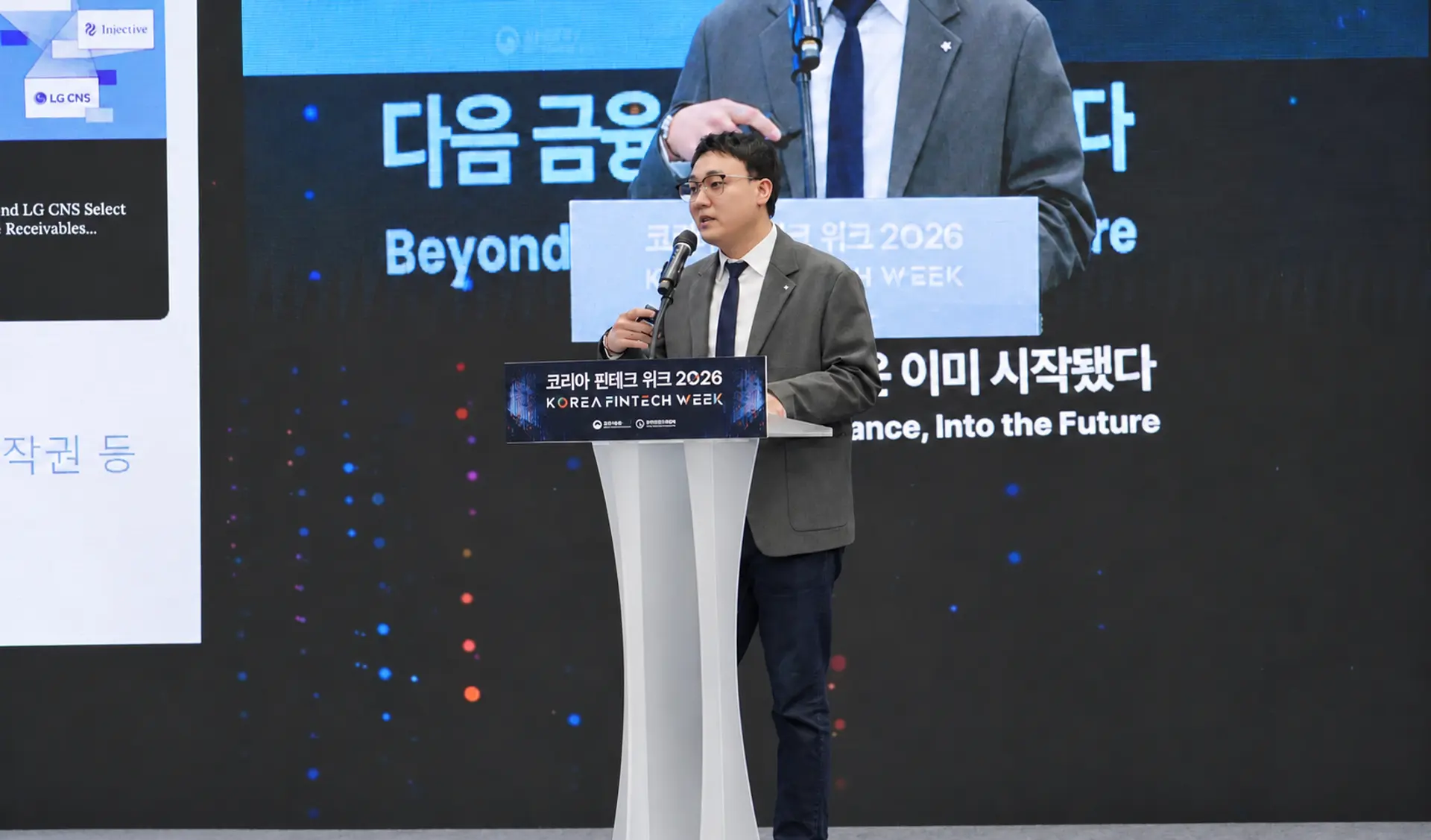
Andrew Kang, Injective’s head of business development for Asia-Pacific, spoke at LG CNS’s “Programmable Economy” session at Korea Fintech Week 2026, held from Nov. 25 to Nov. 27 at the aT Center in Seoul’s Yangjae district. His presentation, titled “On-Chain Capital Markets: The Next Step in Financial Infrastructure,” laid out domestic and overseas use cases and potential areas of cooperation with financial institutions.
At the center of the presentation was the link between digital money and tokenized assets. The framework uses stablecoins and deposit tokens as payment and settlement tools while handling asset issuance, trading and ownership management in a single environment. “If digital money is finance’s cash, on-chain capital markets are the venue where that cash moves,” Kang said.
As a domestic case study, Kang introduced a trade receivables tokenization pilot by POSCO International and LG CNS. The companies completed a proof of concept this year using the Injective network. POSCO International provided real trade transaction data and a validation environment, while LG CNS handled system design and technical verification.
Overseas, Pentive, a company listed on NYSE American, is migrating mortgage loan records to Injective. As of Injective’s Nov. 19 announcement, the transferred records represented more than $1.5 billion in loans. Pentive plans to migrate more than $10 billion in legacy loan records over the longer term.
Injective also highlighted its links to traditional finance. On Nov. 5, Canary Capital’s Canary Staked INJ ETF (INJC) was listed on Nasdaq. Earlier, in August, Injective Institutional Services registered with the US Securities and Exchange Commission as a transfer agent. A transfer agent maintains official ownership records for securities and processes changes to those records.
Injective plans to explore ways South Korean financial institutions can use asset tokenization technology ahead of the country’s tokenized securities regime in February 2027. In the US, Kang said, real financial operations are already moving on-chain, from ETFs and securities ownership management to mortgage records. Tokenization is no longer a pilot project, he added, but the next stage of financial infrastructure.
YM Lee