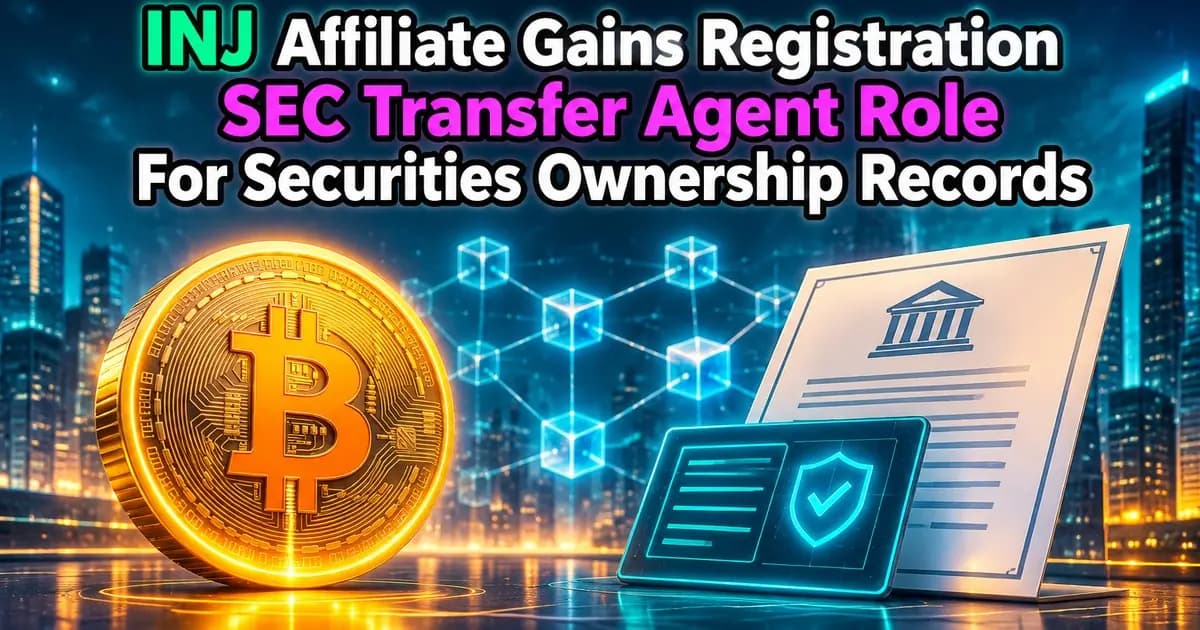
Injective’s SEC transfer-agent registration, held through its affiliate Injective Institutional Services, LLC, marks a new regulated role for the network’s tokenization infrastructure. The Defiant reported the status on November 17, 2026, naming the affiliate as the entity listed in SEC filings.
The registration gives the affiliate a regulated role in securities ownership recordkeeping, and that role now sits next to Injective’s tokenization tools. It does not amount to SEC approval of the blockchain or its assets.
Injective went further in a public announcement, calling itself “the first layer-1 blockchain to officially obtain a transfer agent registration with the SEC.” That claim is the company’s own. The registered entity is Injective Institutional Services, LLC, so the phrase really describes the affiliate’s milestone under the network’s name.
- 🟠What Injective's SEC Transfer-Agent Registration Means for Securities Recordkeeping
- 🟢Injective Mint Supplies the Issuance Controls
- 📖Injective's Tokenization Work Includes Funds and Trade Finance
- 📌Why Official Ownership Records Matter for Injective Securities
- ✨Injective's Filing and Registration Coverage Follow Separate Milestones
- ✨Injective Also Completed a European White-Paper Notification
- 🟢Injective Products Retain Their Own Securities Requirements
- 🟣What Comes Next for Injective's Transfer-Agent Function
- ❓FAQ
What Injective’s SEC Transfer-Agent Registration Means for Securities Recordkeeping
Which entity holds the transfer-agent role?
Injective Institutional Services is the affiliate named in the registration reporting. It handles official ownership records and securities transfers, which puts a regulated administrative function beside the network’s infrastructure.
A KCEX account, credited to CoinCentral, says the affiliate can maintain authoritative securities ownership records and process transfers under the federal transfer-agent framework. Those records show who the legal owners are and how holdings move between registered holders.
What ownership-related work does the role involve?
Transfer agents do more than process transfers. They also support distributions, redemptions, issuance records and other securities administration. The affiliate’s work therefore reaches past logging a transaction, into the ownership register and the obligations tied to each security.
For tokenized products built on the network, that work can run alongside onchain settlement. The arrangement places ownership recordkeeping inside an entity linked to the underlying infrastructure.
Injective Mint Supplies the Issuance Controls
How do Injective, the affiliate and Mint fit together?
Injective provides the blockchain. Injective Institutional Services can back official ownership and transfer records, and Injective Mint gives institutions tools to create and run tokenized assets.
Together, these pieces span issuance, administration, recordkeeping, settlement and asset management. An issuer can create an asset and set rules for how it moves between holders in one place.
Which restrictions can issuers apply through Mint?
Mint handles transfer restrictions, administrative permissions, jurisdiction rules and wallet controls through a single interface. It also covers minting, redemption, address restrictions and transfer pauses.
Those tools let issuers enforce restrictions at the protocol level. The product’s legal structure and compliance requirements still decide how they get used.
Injective’s Tokenization Work Includes Funds and Trade Finance
Which institutional activity preceded the registration coverage?
According to CoinCentral, Injective has widened its tokenization work since 2025, spanning institutional funds, equities, private markets and enterprise finance. Laser Digital earlier tokenized its Laser Carry Fund through Libre, alongside other institutional investment products.
The network has also supported secondary trading, lending and portfolio margining for selected tokenized assets. That activity forms the institutional backdrop for the affiliate’s recordkeeping role.
The push later moved into private-company markets and enterprise trade finance. The account places that shift after the fund work, with the network moving from fund products to private-company assets and commercial receivables.
What did the POSCO International and LG CNS pilot cover?
POSCO International and LG CNS picked Injective for a trade-receivables pilot covering international commercial transactions. The project handled issuance, transfers, administration and settlement of receivables created through real-world trade.
It pushed the network’s tokenization into enterprise finance. The focus was commercial receivables, alongside its work in funds and other financial assets.
Why Official Ownership Records Matter for Injective Securities
Where does the recordkeeping function connect with blockchain settlement?
Tokenized securities run into a persistent problem. Assets move onchain while separate databases keep the legally recognized ownership records, so platforms have to reconcile blockchain transactions against that regulated information.
An affiliated transfer agent fills that gap by running the securities-recordkeeping function next to settlement. That is the practical role Injective is adding to its tokenization offering.
Coverage of the July filing also described enforceable ownership rights as part of the transfer-agent function. Injective’s stated goal was for onchain ownership records to carry the same legal weight as traditional transfer-agent filings, alongside the operational gains it outlined.
What benefit did Injective describe when it applied?
When it applied, Injective argued that moving ownership recordkeeping onto blockchain infrastructure would add transparency without giving up regulatory compliance. It presented the filing as a step toward a regulated path for issuing securities onchain.
The company also paired compliant ownership records with sub-second settlement, arguing that the combination could make issuance and trading in the US more efficient.
Injective’s Filing and Registration Coverage Follow Separate Milestones
Injective filed Form TA-1 on July 16, 2026, Crypto Briefing reported. Its account repeated an Injective announcement that called the filing a step toward regulated onchain securities infrastructure.
The announcement called the filing “a major step towards becoming a leading blockchain with a regulated pathway to issue securities onchain.” A companion message stressed the US angle: “This advances RWA market infrastructure in the New Internet Economy, right here in the US.” Both lines went out with the July 16 application announcement.
By August 20, a KCEX-carried article described the registration as effective. Coverage on November 17 later named Injective Institutional Services as the registered affiliate in SEC filings.
Injective Also Completed a European White-Paper Notification
Alongside the US transfer-agent work, Injective finished the notification process for its INJ▲$7.26 MiCA white paper in Europe. The tokenization account counts that as another regulatory step for the network, beyond its US securities-recordkeeping push.
The two developments are separate. The European item covers the INJ white paper, while the US registration covers Injective Institutional Services and its securities-administration duties. Together they strengthen the network’s regulatory footing in major markets, though the European step is only a completed notification.
Injective Products Retain Their Own Securities Requirements
What requirements apply when ownership records use distributed ledgers?
CoinCentral’s account says SEC guidance lets registered transfer agents fold distributed ledgers into official shareholder record systems. Transfer agents still have to meet the applicable federal securities requirements when they use the technology.
For the affiliate, that means running the regulated ownership role alongside the network’s technical stack.
How is each tokenized asset’s regulatory treatment determined?
Every asset created through Injective Mint keeps its own legal structure, regulatory classification and compliance obligations. Issuers have to handle those product-specific duties when they create and administer securities.
Mint’s restrictions and admin controls help with that work. Whether they are enough depends on the rules that govern the specific asset.
What Comes Next for Injective’s Transfer-Agent Function
What operating role does registration enable?
The affiliate can keep ownership records and process securities transfers inside the federal transfer-agent framework, per the reference account. That puts regulated securities administration next to the network’s issuance and settlement tools.
What governs the use of that infrastructure?
Issuers now need to apply issuance, transfer and administration functions within each product’s legal limits. That covers regulatory classification, transfer restrictions and continuing securities compliance.
FAQ
When did Injective file its transfer-agent registration application?
The application went in on July 16, 2026, per Crypto Briefing. That day’s Injective announcement framed the filing as part of its push toward a regulated path for onchain securities.
Which SEC form did Injective submit?
Injective filed Form TA-1 for transfer-agent registration. The filing kicked off the application stage in July 2026, ahead of later coverage reporting registered status.
What administrative duties do transfer agents perform beyond recording ownership changes?
They also support distributions, redemptions and issuance records. That work covers ongoing securities administration, not just the register of legal owners.
Why can tokenized securities require reconciliation between blockchain transactions and legal ownership records?
A tokenized security can move onchain while its legal ownership register sits in a separate database. Reconciliation lines up those blockchain transfers with the regulated record of who owns what.
Which transfer and wallet controls does Injective Mint support?
Mint supports jurisdiction rules, wallet controls, address restrictions and transfer restrictions. Its admin functions include minting, redemption and pausing transfers when needed.
Which fund did Laser Digital previously tokenize through Libre?
Laser Digital tokenized its Laser Carry Fund through Libre. It was one of the institutional fund projects in Injective’s broader tokenization push.
What assets were involved in the POSCO International and LG CNS pilot?
The pilot covered trade receivables created by international commercial transactions. Its scope ran from issuing and transferring those receivables to administering and settling them on Injective’s infrastructure.
This article is for information only and is not financial advice.
Related Articles
Canton Coin Gets SEC Staff No-Action Relief for Programmatic Minting
The Canton Coin SEC no-action letter gives specified network participants narrow relief for...
US Senate Bans CBDC Until 2030 — Stablecoins Exempt From Ban
The measure passed as part of a housing bill. We break down what the US CBDC ban means for the...
Ripple National Trust Bank: Final OCC Approval, Custody and RLUSD Risks
Ripple OCC approval puts $2.5B in RLUSD reserves and institutional custody under federal oversight,...
Nvidia Joins 49 Companies Objecting to OKX Stock Tokenization Plan
The OKX tokenized stock marketplace faces 50 disclosed company objections, including Nvidia, as...
David Solomon Crypto Bill: Why Goldman Sachs CEO Says This Could Be Crypto’s Biggest Wall Street Breakthrough Yet
The David Solomon crypto bill endorsement is a sign that regulation is becoming Wall Street...
Coinbase Slams BIS Stablecoin Warnings as Too One-Sided
Coinbase slammed BIS for arguing that stablecoins fall short as money while judging them against a...