Synapse Founder’s New Startup Can’t Make Payroll After CEO Took $4.6M Loan For Luxury House, CNBC Reports
Hey all, Jason here.
It has been an absolutely crazy, fun, surreal five days in New York. Big thanks to the Bilt team for throwing an amazing event for the launch of their Neighborhood OS and for including me. And a thank you to the team from Knot and everyone who was able to make it out to our last minute dinner on Friday — always a pleasure to see people in real life.
I’m heading down to DC later today to attend and moderate a panel at the American Fintech Council Policy Summit and to attend FinRegLab’s AI Symposium. If you’re at either, I hope to catch up in person!
Celebrating fraud fighters during Fraud Week
Partner content: Plaid is proud to support ACFE’s International Fraud Awareness Week, November 15-21. And this year, we’re celebrating the people who do the work.
Fraud looks different in every industry, and so do the people who fight it. In our new Fraud Fighters eBook, leaders from Robinhood, Webull, NationsBenefits, and AppFolio share how they found their way into fraud prevention, what drives them, and how connected financial data helps them spot risk earlier.
Kontigo’s License Suspended, Cutting The Venezuelan Crypto App Off From Country’s Banking System
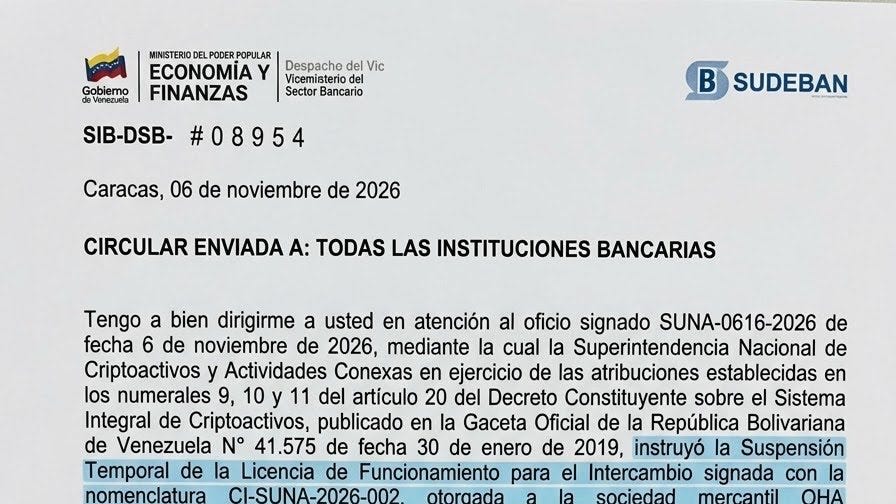
Y Combinator- and Coinbase-backed stablecoin banking app Kontigo had its license revoked by the Venezuelan crypto regulator SUNACRIP, according to a circular sent by the country’s bank regulator, SUDEBAN.
SUNACRIP “temporarily” suspended Kontigo’s license on November 6th. Subsequently, SUDEBAN instructed Venezuelan banks to cease any commercial relationships or operations with the company.
Numerous sources Fintech Business Weekly has spoken to said that multiple people associated with Kontigo had been “detained,” but, as of the time of publication, it hasn’t been possible to verify those claims.
As a result of the regulator’s order, Kontigo users are currently unable to deposit or withdraw funds through the Venezuelan banking system. Users can still withdraw funds held as USDC to external crypto wallets and exchanges via multiple blockchains.
Kontigo cofounder and CEO Jesus Castillo didn’t respond to an email sent on Monday, November 9th, asking to clarify the circumstances around the pause of withdrawals. Multiple attempts to reach Kontigo’s chief compliance officer, Jorge Luis Hidalgo, went unanswered.
The company posted a statement on X yesterday evening, reading in part (translated from Spanish):
“Kontigo, Inc. and its app continue to operate, and will continue to operate, normally, with its management team fully in charge of the company.
Our users’ funds remain in their wallets, are their exclusive property, and are under their control. Kontigo, Inc. does not hold custody of those funds and has no say over them and does not intervene in them.
In each country where the law requires it, Kontigo, Inc. operates through duly licensed commercial partners. In Venezuela, that partner is Oha Technology, C.A., a Venezuelan company with which Kontigo, Inc. has a contractual relationship.
Oha Technology, C.A.’s bolívar conversion and domestic payment rails operations are currently suspended on a temporary basis. We understand this stems from an ongoing administrative proceeding by its local regulator concerning transactions carried out outside the Kontigo ecosystem. That proceeding is not directed at Kontigo, Inc. or at its executives or shareholders.”
While the statement suggests Oha Technology, C.A. is a distinct entity that provides services to Kontigo, an archived version of Kontigo’s website refers to Oha as a “subsidiary and brand representative” of Kontigo.
It remains unclear why SUNACRIP suspended Kontigo’s license, but local reports claim as much as $50 million was embezzled from the company; Fintech Business Weekly has not been able to independently verify these claims.
Additional reporting also suggests an investigation into Kontigo extends to the company’s use of JPMorgan Chase, Stripe, and Bridge in its operations. Asked if they were aware of any investigation, a representative of JPMorgan Chase said he was not.
A representative for Stripe and Stripe-owned Bridge responded via email, writing, “We cannot comment on specific matters, but Stripe routinely cooperates with law enforcement.”
Kontigo and its bombastic cofounder and CEO attracted scrutiny for its claims of rapid growth and ability to offer JPMorgan Chase account credentials to Venezuelan consumers and businesses, as first reported by The Information in December 2025.
In January 2026, Fintech Business Weekly reported that Kontigo effectively functioned as an arm of the Venezuelan government for injecting dollar-denominated liquidity into the country’s economy from the illicit sale of Venezuelan oil, which primarily was sold to China.
An October 2025 New York Times story explained “Venezuela today sells the bulk of its oil to China, gets paid in crypto and then funnels some of those revenues back into the national economy.”
The article continued, saying, “This year [2025], the government started funneling part of its oil revenues into the economy through the two authorized crypto exchanges, which are allowed to trade bolívares at a weaker exchange rate.” (emphasis added)
The New York Times piece didn’t specify the exchanges, but a report from Transparencia Venezuela documented links between Kontigo and another licensed exchange, Crixto, and banks in the country.
Fintech Business Weekly also reported in January that Kontigo’s business model was, fundamentally, currency arbitrage: buying dollars at the official exchange rate, and selling them at the informal market rate.
As one Venezuelan national explained to Fintech Business Weekly at the time, the most profitable business in a country with currency and capital controls is buying dollars at the official rate and selling them at the informal market rate.
It remains murky how, exactly, Kontigo came to enjoy the privilege of being one of only two crypto exchanges officially licensed in the country. The company appears to have had ties to the Maduro regime, with local media outlets suggesting a relationship between the wife of Maduro’s son, Grysell Torres, and Kontigo.
Maduro’s son, Nicolás Ernesto Maduro Guerra, commonly known as “Nicolasito” or “The Prince,” was indicted in the United States alongside his father and mother on drug trafficking and narcoterrorism charges in January.
A representative for Kontigo declined to provide a comment for publication.
A representative for Coinbase declined to provide a comment for publication.
A representative for Y Combinator did not reply to questions and request for comment sent outside of normal business hours.
Synapse Founder’s New Startup Can’t Make Payroll After CEO Took $4.6M Loan For Luxury House, CNBC Reports
Sankaet Pathak’s new robotics company failed to pay its employees last month, CNBC reported yesterday. The situation has particularly angered staffers, as Pathak took a $4.6 million loan from the company to buy a luxury property in Sausalito, California.
It isn’t the first time Pathak extracted capital from one of his companies; Fintech Business Weekly reported that Pathak took loans totaling $320,000 from Synapse in the month’s preceding the company’s collapse into bankruptcy, which ultimately left thousands of customers unable to access as much as $95 million in deposits.
The matter remains unresolved, though the Consumer Financial Protection Bureau has allocated approximately $55.2 million to compensate Synapse victims.
Pathak’s new company, Foundation Robotics, is seeking to raise hundreds of millions in new funding at a $3 billion valuation, CNBC reported.
Foundation’s investors include Eric Trump and Tribe Capital. Tribe Capital’s CEO, Arjun Sethi, is titled as a cofounder of Foundation. Sethi is also the co-CEO of crypto exchange Kraken.
A spokesperson for Eric Trump told the Financial Times that he has “no involvement in Foundation’s management, operations, strategic decisions or commercial activities, including the solicitation, negotiation, procurement or execution of any government contracts.”
In 2024, when Foundation was soliciting investors, the company claimed to have a partnership with and was expecting an imminent investment from General Motors; the automaker denied having any relationship with or investment in the company.
Pathak has claimed Foundation has contracts with the U.S. Government, including a $24 million deal with the Pentagon. However, that contract was actually made with a company Foundation acquired, Boardwalk Robotics.
A review of government contracting data indicates that Foundation does not appear to have won any government business apart from what it acquired via Boardwalk; Boardwalk appears to have only been awarded a total of about $3.2 million in contracts with the Army, Air Force, and NASA.
IHMC, a Florida non-profit that Boardwalk was spun out from, was awarded a contract with the Navy worth up to $24.8 million, though less than $3 million has actually been obligated, according to a review of publicly available government contracting records.
Things To Know & Other Good Reads
Financial Stability Report (Federal Reserve Board of Governors)
Third-Party Risk Management: Proposed Guidance and Request for Comment; Extension of Comment Period (Office of the Comptroller of the Currency)
18 State Democratic Attorneys General Urge Congress to Reject H.R. 7866, Challenging Federal Interest-Rate Exportation by Out-of-State State Banks (Consumer Finance Monitor)
A Banker’s Guide to Anthropic: Why the IPO is a credit event (Net Interest)
The Hater’s Guide To Megaspeed (Ed Zitron)
The AI Visibility Tax: Pay to Appear, Pay Again to Measure (Fintech Snark Tank)
Can Revolut Dominate the U.S. Without Taking Risk? (Fintech Takes)
Hard Core (Conversions): Core conversions are painful. Three banks decided to do it anyway (Fintech Takes Banking)
Listen: Reciprocal Deposits, the 21st Century ROAD to Housing Act, and the Future of Banking (Consumer Finance Monitor)
Listen: The Blue Wave Hits Banking (Fintech Takes)
About Fintech Business Weekly
Looking to work with me in any of the following areas? Email me.
Buy my best-selling book, Banking as a Service: Opportunities, Challenges and Risks of New Banking Business Models, here
Vendor, partner & investment opportunity advice and due diligence
Fintech advising & consulting
Sponsoring this newsletter
News tip or story suggestion — reach me on Signal at mikulaja.01