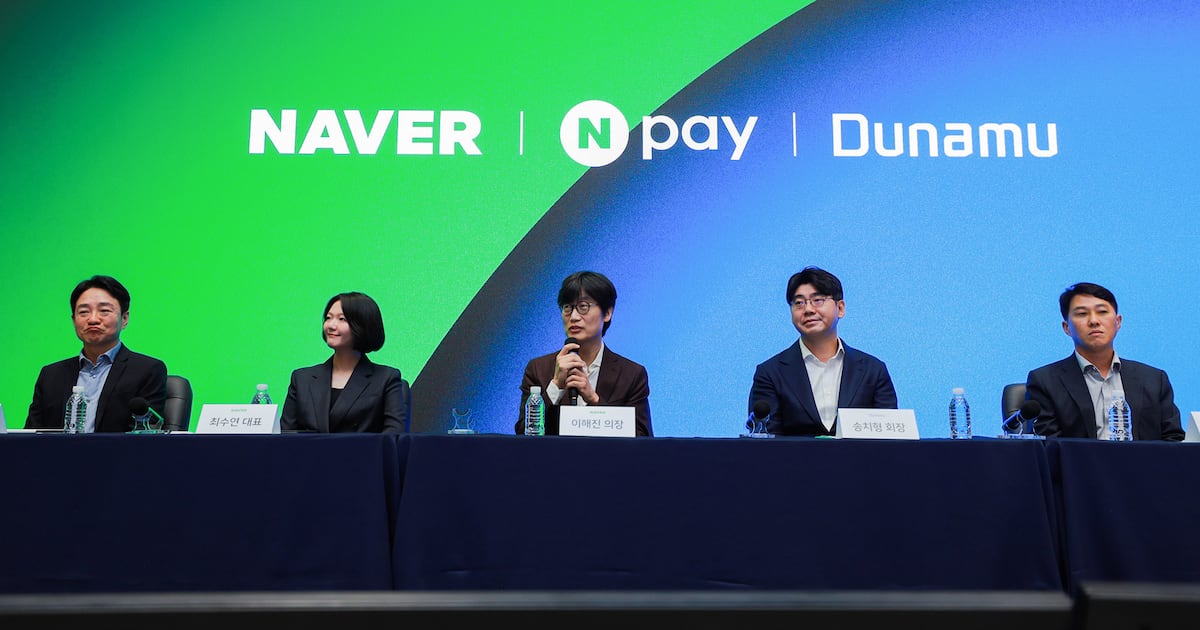
The Korea Fair Trade Commission said on the 10th that it sent a review report to the two companies stating that if Naver Financial, the No. 1 domestic simple-payment service, acquires Dunamu, operator of Upbit, the top virtual asset exchange, it could raise concerns about market monopoly. The review report is equivalent to a prosecutor's indictment; any final sanction will be confirmed by the commission's decision-making body, the plenary meeting.
Earlier, Naver Financial and Dunamu said in November last year that they would carry out a comprehensive stock exchange. The swap ratio is 2.54 shares of Naver Financial for each Dunamu share. Through this, Naver Financial would absorb 100% of Dunamu's equity. Naver and Dunamu plan to link Naver's artificial intelligence (AI), search, and commerce, and Naver Pay's payment and financial services, with Dunamu's virtual asset and Blockchain businesses to expand their digital finance operations.
◇ "Naver–Dunamu tie-up would affect as many as 10 markets"
The Korea Fair Trade Commission (FTC) assessed Naver Financial's acquisition of Dunamu as the most complex cross-industry merger it has reviewed to date, with the potential to affect the largest number of markets. Both companies hold No. 1 market shares in their respective sectors, and Naver operates across an exceptionally wide range of businesses.
FTC case officers concluded the merger could affect 10 markets: ▲ domestic online simple payments ▲ domestic digital-asset exchanges ▲ domestic online search portals ▲ domestic online advertising ▲ domestic online shopping ▲ domestic financial MyData services ▲ domestic brokerage of unlisted shares ▲ domestic listed-share investment platforms ▲ domestic online secondhand marketplaces ▲ domestic won-denominated stablecoin issuance.
Among them, even though digital-asset exchanges—where Dunamu leads the market—and domestic online simple payments and search portals—where Naver ranks No. 1—are unrelated industries, the Korea Fair Trade Commission (FTC) concluded there are concerns about restricting competition. At a media briefing, Jeon Seong-bok, director general of the FTC's Corporate Mergers Review Bureau, said, "If there are concerns that the deal would hinder potential competition or exclude rivals in related markets through bundling, we see restrictive effects on competition."
For example, if the two companies roll out a product that offers benefits for using Naver Pay when trading virtual assets on Upbit, it could harm competition from other virtual-asset exchanges or simple-payment providers.
◇ FTC also analyzed the stablecoin market Naver has yet to enter
In reviewing the merger, the Korea Fair Trade Commission (FTC) also examined potential restraints on competition in the market for issuing won-denominated stablecoins, which Naver has not yet actively entered. With Dunamu holding the top share among digital-asset exchanges, the FTC determined that if Naver were to issue a won stablecoin, a single company would control both issuance and distribution, raising competition concerns.
In line with the FTC's view, Naver Financial and Dunamu submitted remedies to address the competition concerns. At an upcoming plenary meeting, the Korea Fair Trade Commission (FTC) will review whether to approve the merger, taking the remedies into account.