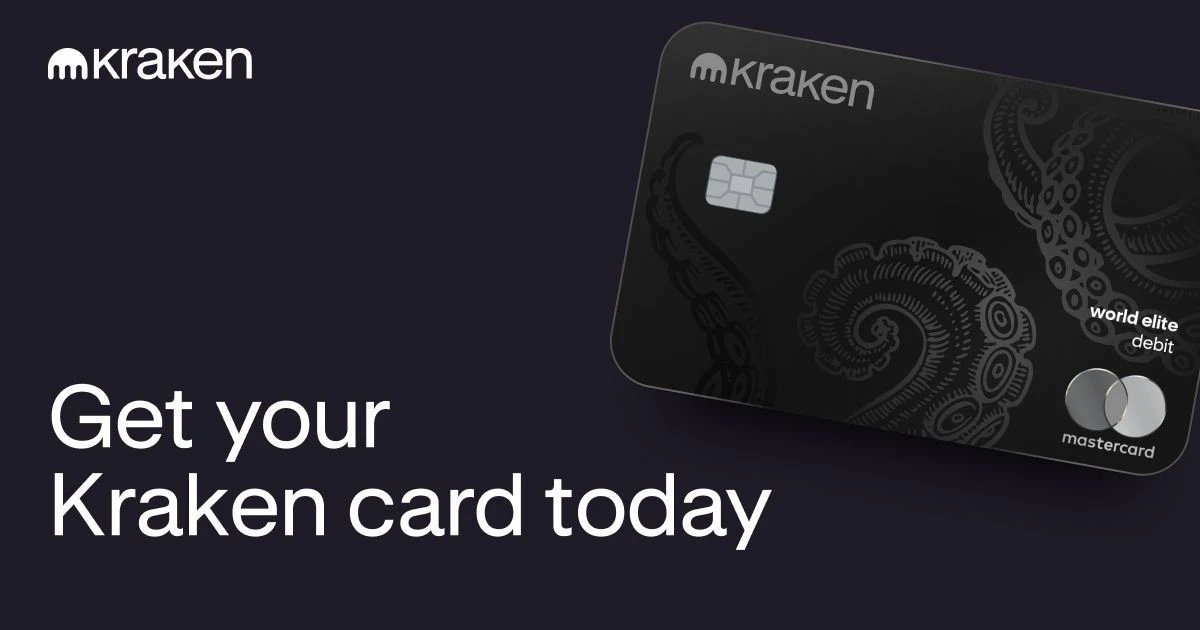
Kraken's parent company Payward has opened a U.S. waitlist for two Visa credit cards that return as much as 4% of spending in dollars or bitcoin, pushing the exchange group further into consumer lending as trading revenue stays below year-earlier levels.
The Krak Credit Card and a companion secured card were announced Tuesday. Both run on Visa's network, with First Electronic Bank as issuer and fintech firm Cardless handling program management, technology and servicing. Applications are not yet being accepted, and the company said cards are expected to begin shipping in early 2027, though a summary in its announcement put the timeline at late 2026.
Cashback is paid into a customer's Krak account in either U.S. dollars or bitcoin rather than as points. The rate scales with the assets a customer keeps on the platform:
Note: The 3%, 3.5% and 4% tiers apply only to the first $10,000 of eligible purchases each month; spending above that earns 2%. Cashback is paid in dollars unless the cardholder opts for bitcoin, and the terms warn that bitcoin rewards may lose value.
Both cards require a Krakpass subscription, priced at $6.99 a month or $75.48 a year. Members also earn 4% annual percentage yield on eligible USDC and USDG stablecoin balances, versus 3% for non-members, and pay no trading fees on up to $3,000 of monthly volume, though spreads still apply. Membership is free for customers receiving more than $3,000 in qualifying monthly direct deposits.
The secured version is aimed at people building or rebuilding credit, including those whose assets are held mainly in crypto. Customers pledge between $350 and $5,000 in USDC, and the deposit sets their credit limit. Unlike a conventional secured card, the pledged stablecoin keeps earning up to 4% APY through an auto-earn arrangement; the yield is variable and does not raise the credit limit or the locked collateral. The card will report activity to TransUnion, Experian and Equifax, and the company cautions that responsible use may help credit-building but does not guarantee a higher score.
Kraken said Krak account balances are not protected by FDIC or SIPC insurance, leaving customers exposed to stablecoin, platform and product-specific risk.
Eligibility is limited to U.S. residents aged 18 or older with an account in good standing and an active Krakpass membership. Neither card will be offered in Indiana, Maine, Massachusetts or New York; the secured card is also unavailable in Washington, D.C. Payward has not disclosed annual percentage rates or full fee schedules, and joining the waitlist does not guarantee approval.
The move extends a consumer business that already includes debit cards, salary deposits and yield-bearing accounts. Kraken introduced a U.S. Visa debit card in August 2026 and says its global debit-card business has passed 200,000 cardholders, alongside a Mastercard debit offering in the U.K. and Europe.
Tying rewards to balances gives Payward an incentive to keep customer funds on its platform, and the economics rest as much on revenue from retained assets and subscriptions as on card spending. The company has not disclosed projected card revenue, lending volumes, acquisition costs or expected profitability, nor how lending economics will be split among partners.
The launch follows a Nov. 13 financial update in which Payward reported $60 million of third-quarter adjusted EBITDA, down 66% from a year earlier but up from $23 million in the prior quarter. Total platform margin was $487 million, including $234 million from transaction-based activities, $128 million from asset-based activities and $125 million from access-based services. Asset- and access-based operations together contributed 52% of platform margin, up from 46% a year earlier.
For investors, the cards offer a way to monetize existing customer relationships while trading activity lags. Whether they lift profitability will hinge on adoption, financing costs, reward expenses and what Payward keeps after payments to its banking and technology partners.
Once added, BigGo Finance appears first in Google Search Top Stories, so you get the broadest, most up-to-the-minute, and most comprehensive global financial news first.


