Last Week’s New Yorker, week of November 16
“‘I know what I want to do with my money for enjoyment purposes today. I’m going to go bet on Ping-Pong from the Czech Republic.’”
“‘I know what I want to do with my money for enjoyment purposes today. I’m going to go bet on Ping-Pong from the Czech Republic.’”
“The Under” (The Sporting Scene) - Nick Berardini games the system. To begin with, I recommend you read this barnburner in the print edition; the online version’s assortment of random photos and infographics doesn’t add a thing. Berardini is not merely a basketball fan; he warmed the bench at Mizzou, and he brings a fan’s eye to sports that helps this piece on gambling avoid alarmism. That’s not to say it soft-pedals the insanities of the sports-betting world. Berardini begins with a profile of Jontay Porter, one that’s compelling but fairly standard – his brother’s stardom (“…it was sometimes hard to be one of the top players in the country but just the second best in his family”), his fixation on money (he bought a car with early bitcoin profits). His gambling addiction rapidly turns into a circles-of-hell nightmare, and Berardini gets a remarkably revealing picture of the economics of FanDuel from Frank Cardenas, the guy whose job was to keep Jontay and others like him betting – box seats filled with “young men glued to their phones, placing bets”; the role of live “prop bets” in turning football into a hyper-addictive “multiline slot machine”. In its last third, the piece shifts from using Jontay’s story to illuminate this public-health crisis (ten per cent of thirteen-to-seventeen-year-olds in the U.S. would qualify “as high-risk problem gamblers”) to recounting the part of his story that is pretty much unique – his decision to fake an eye injury as part of a startlingly obvious scheme to rig a bet. Everyone involved comes across as both very sad and a bit stupid; this extends to Cardenas (“He was trying to quit gambling, but he said, ‘I don’t know who I am without it’”) and even Awawdeh, the con man who extorted Porter. (“He told me that it was partially his own gambling debts that had led him to get involved in the scams. …’You got Charles Barkley and Shaq talking about their prop bets. Bro, there’s little kids watching these games. This is the society they fuckin’ built.’”) Will our society be able to grasp the danger of gambling addiction, or do these corporations have their hooks in too deep? Well, the new issue of this magazine has a Kalshi ad. I’m putting everything on blackpill.
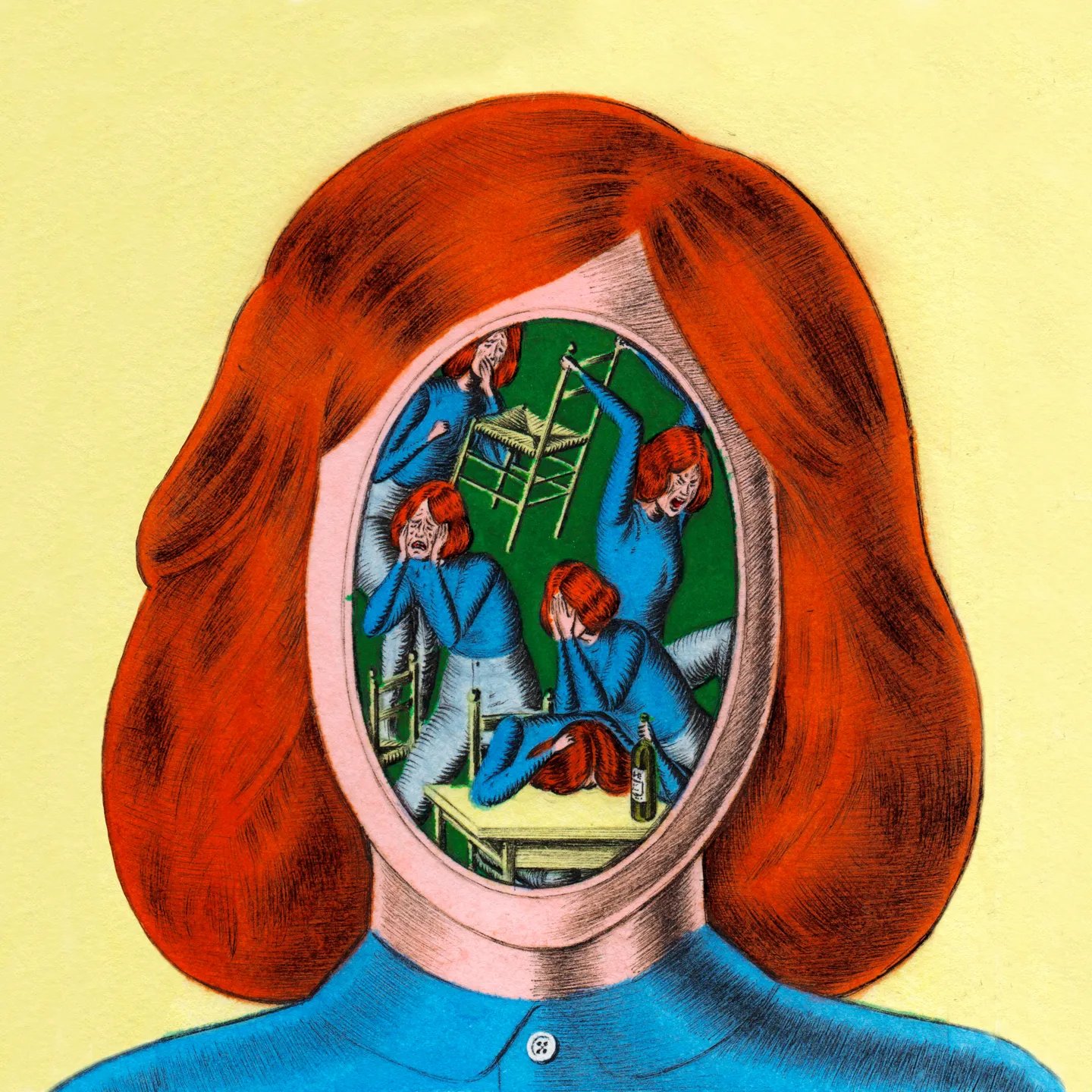
“Unnatural Selection” (Books) - Louis Menand catches feels. The Darwin anecdote (he “must, at some point, have asked himself, I got naturally selected for this?”) is pertinent enough and genuinely funny. Behavioral economics is a silly area of study built on sandy foundations and, as Menand points out, ‘just-so stories’; Menand mostly addresses the correlatory bullshit while also picking bits of wisdom – and telling a series of jokes that, while broad, have more hits than misses. (“Did our Stone Age ancestors lie awake wondering whether they had remembered to put out the fire pit?”) It’s surprising that he barely addresses mindfulness, which seems like the obvious extension of the ideas that our emotional system must be “prone to false alarms” – “Anxiety, for example, makes us more alert to threats, which can make us perceive more threats, which heightens our anxiety” – and that perhaps “some states we classify as symptoms of mental disorders are responses to a world that’s genuinely frightening or depressing.” Of course, even if this is true, anxiety and misery don’t necessarily help – which is largely the Zen-derived “lesson” of talk therapy; sorry for the spoilers. Accepting that we won’t get the answers allows us to decide to be present and at peace. To make a long-face story short.
“Burn Rate” (The Control of Nature) - Eric Klinenberg puts in a Good Karen word. Klinenberg on preparations for ongoing disaster is not quite as riveting as Klinenberg on preparations for impending disaster; there’s a bit too much setup needed – descriptions of burnt-up neighborhoods that are gripping enough but very similar to the magazine’s extensive coverage of such things elsewhere; insurance-company evils; fire testing. Skip ahead to the section beginning “In late September”, which is where Klinenberg names his focus: a community planned and built explicitly to be fire-resistant and attract reasonable insurance rates. Along with financial incentives, a new kind of H.O.A. intrusiveness is needed, not merely to antisocially ensure aesthetic standards but to prosocially keep a community safe – hence spawning the wonderful term “Good Karen”. As usual, what makes Klinenberg’s pieces so special is his attentiveness to the details of a design; even things like the differences between cow- and goat-based shrub grazing come in for attention. But he’s not afraid to raise the bigger questions, like what, at the end of it all, we owe our neighbors. We’re all in this kitchen together; time to take the heat.
“If You Know You Know” (Pop Music) - Kelefa Sanneh finally gets 2 on. The new Tinashe album is very good, and if this is somehow less than a review of that album, to which it devotes four cover-blurb-y words (“a riotously good time”) Sanneh walks us through the singer’s arc with reasonable facility. He also shouts out a JADE song that’s been one of my recent favorites since it first came out and which I hadn’t realized was finally catching on in the States, and recommends a Mexican pop artist whose work strikes me as totally ordinary, but is at least genuinely new to me. It remains deeply annoying that every pop music review in the magazine has to turn into a broad-brush thesis on the nature of pop stardom, but at least Tinashe deserves the nice big illustration.
“Are You Crying Yet?” (Annals of Music) - Jane Bua wants no Nature of Daylight, kid. Bua’s premiere full-length piece in the magazine is startlingly skeptical; I can’t remember the last time a figure in the arts (as opposed to politics) has gotten profiled in such a borderline nasty fashion. Richter sounds haunted by the ubiquity of that sappy cue, which really isn’t that bad on its own but has been repeated until it’s become a signifier for empty pathos. I’m unsurprised he tried to argue Chloé Zhao out of using it at the end of Hamnet. Bua is correct that the rest of Richter’s work is fairly ordinary, and that its popularity stems from its filling a lowest-common-denominator void in ambient music with more anonymity and less Zen authenticity than Eno. It does make one wonder why she decided to write about him, though; Richter is likable enough to make the character assassination seem unwarranted, and the piece peters out before it can really find a thesis. If many articles in the magazine are interesting without being fun, this one manages to be fun without ever quite becoming interesting. In that sense, it, too, is ambient.
🗣️ “Rawther” (Dept. of Milestones) - David Kamp puts a few feathers in Hilary Knight’s cap. Legend!
🗣️ “Area Man Bets” (Political Econ) - Charles Bethea knows a fool and his money are soon partisan. Pairs well, for obvious reasons, with the Berardini piece, even if Bethea can appear blithe in comparison. But the schadenfreude of this schmuck losing money betting on red is too good to resist.
“All Together Now” (The Theatre) - Emily Nussbaum finds, out of many, wonder. It’s somewhat obvious how to assess a weeper – uh, did you weep? Was there the proverbial dry eye in the house? – and Nussbaum has a bit of trouble making The Heart sound not merely blunt-force effective in this regard but actually appealing: sure, it’s “generous, open to feeling as a source of wisdom”, but is it a good time? I do love her description of EDM’s “exhilarating artificiality” matching the hospital environment, though. The second half of the review is a grab bag on a theme; I Became We is in some sense too small to need a full review, but it is so obviously idiosyncratic that centering the review on its idiosyncrasy does it something of a disservice. Nussbaum is clearer on how she felt than what she thought, but the show has enough intellectual nuance to benefit from a critic willing to explore both.
“Family Values” (The Current Cinema) - Richard Brody stacks Paper Tiger. Brody remains hilariously bad at plot synopsis; he spends more than half this article on the movie’s goings-on, but the rapid introduction of Irwin and Scott and Ben and Hester and Iris and Gary, all in a row, left me reeling; he also tries to intertwine the plot of Gray’s previous movie, which makes things worse. It’s only the final two paragraphs that look anything like a review, and I do appreciate Brody’s focus on form there, and on Gray’s “lapidary images—spare, taut, and precise” and “quietly dazzling repertory of shadows and reflections, fragmented glimpses, truncated vistas, and blocked perspectives”. On the other hand, watching this film about silence on mute, as Brody expresses a desire to, seems more redundant than revelatory. If you can’t hear a thing, how can anything go unsaid?
“See and Be Seen” (Books) - Merve Emre hails the Berger king. Emre, handed an iffy Tom Overton biography of a troublesome figure that she nonetheless admires, is needlessly determined to ding Overton for minor faults even as she eventually addresses major ones. Emre struggles to get the facts of this “random, repetitive, uneven, and blurred” biography straight, and she spends a long time recounting the history of Berger’s “many flirtations and infidelities”, which are “difficult to follow” both in Overton’s book and in her summary, yet she also says Overton “represses sexuality as a momentous force” in Berger’s work, even to the point of basically suggesting Overton is horny for him. It’s a worthy provocation, but it throws the piece off-balance; as Emre goes into a very long analysis of Berger’s novel “G.”, it’s hard not to think: Wait, go back, what were you just saying before that? She’s rightly disgusted by Overton dismissing Berger’s philandering (“It is not the biographer’s job to wipe [the subject] clean”) but, again, has to pivot away from this point to bring this rather ungainly review to a close. She’s seeing, but disbelieving.
“The Next Left” (American Chronicles) - Jill Lepore acts antisocialist. A shockingly bad-faith argument from Lepore, who sneakily conflates the “day off in a world without capitalism” that the DSA platform proposes – one where, to use their language, “You work as much as you are able and no more than needed” – and the every day of an “A.I. future” that “Elon Musk and Sam Altman like to talk about, a world of abundance in a planned economy in which poverty has been eliminated and wage labor curtailed.” Is Lepore genuinely blind to the difference between “curtailing” work altogether and letting people take a day off to go see a movie, or is she just determined to tie the left to the most reactionary A.I. boosters, regardless of all common sense? It’s hardly worth talking about the rest of the piece, which is flawed in a more intelligible way – Lepore is so bone-deep a reformist that she has trouble imagining how reformists and revolutionaries could possibly coexist and share power in an organization. Sorry for her, it’s already happening.
Letters:
Nope!
second