Luxor Technology has confirmed an unauthorized redirection of bitcoin mining hashrate through its Commander platform, ending speculation surrounding an alleged attack involving thousands of mining machines. The company says the incident was contained within two hours, and affected customers will receive full compensation.
Key Takeaways
- Luxor confirmed that just over a dozen client accounts were affected by unauthorized hashrate redirection through its Commander platform.
- CEO Nick Hansen attributed the compromise to a “sophisticated AI-enabled vector,” although the company has not publicly detailed the mechanism.
- Luxor says it patched the vulnerability within two hours, prevented data exfiltration and will compensate affected customers for lost mining revenue.
Luxor Breaks Silence on Bitcoin Mining Security Breach
What initially appeared to be an unverified bitcoin mining hijack has developed into a confirmed security incident, with Luxor Technology acknowledging that attackers redirected mining equipment through its Commander management platform.
In an official statement issued Sunday, Nov. 15, 2026, Luxor disclosed that internal monitoring systems detected unauthorized modifications to mining pool configurations, prompting an immediate engineering response. The team wrote:
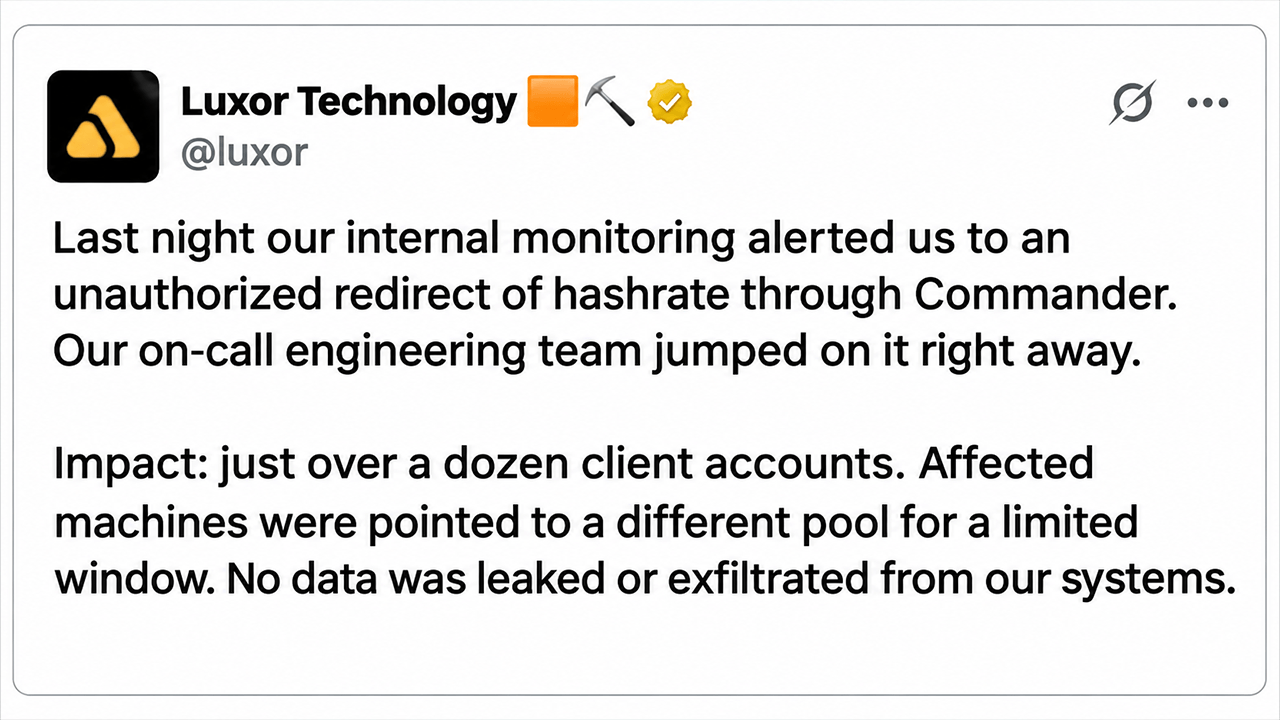
“Last night our internal monitoring alerted us to an unauthorized redirect of hashrate through Commander. Our on-call engineering team jumped on it right away.”
“Last night our internal monitoring alerted us to an unauthorized redirect of hashrate through Commander. Our on-call engineering team jumped on it right away.”
According to Luxor, just over a dozen customer accounts were affected, with mining machines temporarily redirected to another pool. The company maintains that no information was stolen from its systems.
“Impact: just over a dozen client accounts. Affected machines were pointed to a different pool for a limited window. No data was leaked or exfiltrated from our systems,” the team disclosed on X.
Luxor explained that its engineers patched Commander within two hours and began restoring affected equipment to its original configurations. The company also committed to reimbursing every affected customer for the computational power diverted during the incident. “Compensation: every affected client will be paid in full for the redirected hashrate, as if it had mined normally,” Luxor added.
The company further emphasized that the compromise was confined to Commander, with its mining pool and LuxOS firmware remaining unaffected.
CEO Nick Hansen Attributes Compromise to Sophisticated AI-Enabled Attack
Luxor CEO Nick Hansen subsequently offered a more personal account of the incident, acknowledging the operational disruption and identifying what he described as an artificial intelligence-assisted intrusion.
“The last 12 hours have been pretty rough,” Hansen wrote. He said the compromise began around 6 p.m. Pacific time Saturday, Nov. 14, affecting a subset of Commander customers. The CEO continued:
“Around 6:00p PDT yesterday, a subset of Commander customers were compromised, through a sophisticated AI-enabled vector.”
“Around 6:00p PDT yesterday, a subset of Commander customers were compromised, through a sophisticated AI-enabled vector.”
Although Hansen attributed the intrusion to an AI-enabled method, Luxor has not yet published technical findings establishing precisely how the attackers gained access or manipulated mining configurations.
Hansen detailed that engineers identified and patched the issue before undertaking the more laborious process of restoring affected machines. He also apologized to customers and reiterated that Luxor would cover their losses. He said:
“I apologize. You trust us with your fleet, and we need to be better.”
“I apologize. You trust us with your fleet, and we need to be better.”
The executive also remarked that affected customers would receive additional information by email, while Luxor promised a comprehensive post-mortem examining the incident.
OCEAN Mining Data Reveals Unusual Hashrate Activity
Before Luxor’s confirmation, reports circulating late Saturday suggested approximately 64,000 mining machines, representing an estimated 13 exahash per second (EH/s), had been redirected toward the Ocean mining pool. Those figures remain independently unverified, and Luxor’s disclosure of just over a dozen compromised accounts does not establish the total number of affected machines.
Ocean, a noncustodial Bitcoin mining pool launched in 2023 with financial backing from Jack Dorsey, allows miners to receive payments directly through block coinbase transactions. Its public dashboard showed unusual mining activity around the reported incident, while a suspected destination address accumulated an estimated 0.65761026 BTC in mining rewards.
Mempool.space developer Mononaut observed:
“Oof, about 0.657 BTC of shares earned from stolen hash, per ocean’s dashboard”
“Oof, about 0.657 BTC of shares earned from stolen hash, per ocean’s dashboard”
However, estimated rewards do not constitute completed payments. Available blockchain records showed no confirmed incoming transactions to the suspected address, suggesting the operator had not collected bitcoin from the redirected mining activity.
CoreX Hosting, which initially publicized the suspected attack, subsequently reported that the unauthorized hashrate had declined to approximately 100 petahash per second (PH/s).
Luxor’s confirmation resolves the central question of whether unauthorized redirection occurred, but important details remain unsettled. The precise number of affected machines, total computational power diverted, and technical mechanics of the alleged AI-assisted compromise await further disclosure.
For mining operators, the incident illustrates how unauthorized changes to fleet configurations can jeopardize revenue without requiring attackers to seize cryptocurrency directly. Luxor’s compensation pledge addresses the immediate financial consequences, but its forthcoming investigation will face a more consequential question: how attackers obtained sufficient control to redirect industrial mining equipment in the first place.
Bitcoin Falls, DTCC Chooses Solana for Tokenization Expansion, and More – Weekly Recap
This week’s stories centered on market stress, corporate investing, hardware-wallet security, tokenization and prediction markets. Bitcoin fell below $68,000 as…
Bitcoin Falls, DTCC Chooses Solana for Tokenization Expansion, and More – Weekly Recap
This week’s stories centered on market stress, corporate investing, hardware-wallet security, tokenization and prediction markets. Bitcoin fell below $68,000 as…
Bitcoin Falls, DTCC Chooses Solana for Tokenization Expansion, and More – Weekly Recap
This week’s stories centered on market stress, corporate investing, hardware-wallet security, tokenization and prediction markets. Bitcoin fell below $68,000 as…
About the author
WRITTEN BYJamie RedmanNews Lead
Jamie Redman is the News Lead at Bitcoin.com News and a financial technology journalist based in Massachusetts.