Ethereum's next big upgrade, Glamsterdam, could slip as far as May 2027 if developers rewrite the gas-pricing rules at its center to stop them breaking existing smart contracts, discussions at Thursday's All Core Developers call showed. The call ended with no decision, and under the current specifications the fork could still reach mainnet as early as mid-January 2027.
- Developers are split over whether to keep Glamsterdam's gas-repricing specifications or revise them to cut compatibility risk, and the 19 November All Core Developers call closed without a decision.
- Assessments presented to that call put the number of potentially affected contracts at up to 15,000, an upper bound, against roughly 90 million contracts deployed on Ethereum.
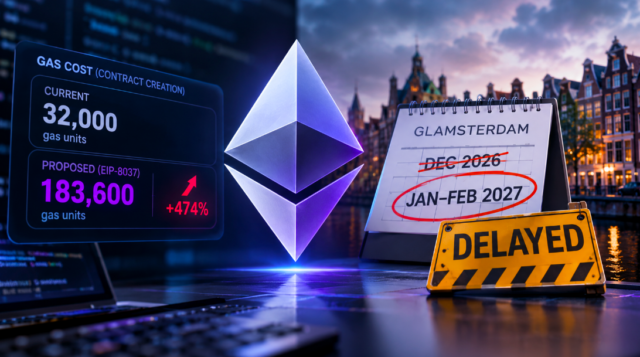
- If the specifications stay as they are, mainnet activation could come as early as mid-January 2027; adopting changes could push it to April or May 2027.
A Timeline With Three Endings
Under the current specifications, Glamsterdam's mainnet activation could come as early as mid-January 2027. Leave the decision until January and it slips to late February or early March. Adopt specification changes to protect affected contracts and it moves again, into April or May. That spread is why one question took up the meeting: keep the specs, or change them.
Developers were split. Some wanted to hold the specifications and the January date; others wanted to revise them to lower the chance of breaking contracts that are already deployed. The awkward part is that a change meant to protect one set of contracts can break another, so a revision is not automatically the safer path.
What EIP-8037 and EIP-8038 Actually Change
The compatibility worries center on two gas-repricing proposals. EIP-8037, "State Creation Gas Cost Increase", aims to hold back state growth and unblock scaling. It introduces a variable called CPSB, the cost per state byte, set by targeting average state growth of 120 GiB a year at a reference block gas limit of 150 million gas units. The proposal was created on 1 October 2025 and carries a last call deadline of 1 November 2026.
EIP-8038, "State-Access Gas Cost Update", raises the cost of state-access operations so they reflect a state far larger than it was when those prices were last set. It was created on 3 October 2025, requires EIP-8037, and shares the same 1 November 2026 last call deadline. Its authors are Maria Silva, Wei Han Ng and Ansgar Dietrichs.
The numbers are small but load-bearing. A cold account access rises from 2,600 gas to 3,000 gas, up 15%. The write surcharge on value-transferring CALL opcodes, SELFDESTRUCT, contract creation and transactions rises from 6,700 gas to 9,000 gas, up 34%. The surcharge on a storage write that changes a slot's value rises from 2,800 gas to 10,000 gas, up 257%. EIP-2929, in the Berlin fork of March 2021, last moved these costs, and Ethereum's state has grown a lot since.
Developers tied the repricing to raising the block gas limit from 60 million to roughly 200 million, arguing it would sharply cut costs for most users while keeping state growth in check. Contract creation would climb from 32,000 gas to 183,600 gas.
Why a Gas Change Can Break a Contract
In October, security firm ChainSecurity warned that the proposed gas-pricing changes could disrupt existing smart contracts and expose them to exploitation. The warning had an effect: developers postponed the Hoodi testnet fork that had been scheduled for 26 October, a delay we covered at the time.
The concern is granular. Researchers identified 13 real-world examples of potentially affected contracts in October, and a November investigation looked at eight smart contract invariants the upgrade could disrupt. An invariant is a property a contract assumes will always hold, and shifting gas costs can break it without a single line of the contract's own code changing.
That is also why the fix is awkward. A revision broad enough to protect the known examples may touch contracts nobody has examined yet, which is the risk developers weighed against the January date.
EIP-8151 and Hegotá's Quantum Detour
The same meeting looked past Glamsterdam to Ethereum's next planned fork, Hegotá, which could see its scope reduced as the network tries to speed up its move to post-quantum cryptography. EIP-8151, created on 9 February 2026, is designed to protect accounts migrating to post-quantum security. It requires EIP-3607, EIP-7702 and EIP-8038.
A preliminary review found that a potentially large number of existing smart contracts could be affected, which complicates fitting the proposal into Hegotá on time. Ethereum's wider post-quantum work has already been pulled forward.
No decision was reached on Hegotá's scope either, with client teams expected to submit their positions ahead of further discussions in two weeks.
The January Decision Point
Developers said at the call that the Ethereum Foundation, ChainSecurity and Dedaub had between them contacted at least 50 affected companies. Three projects were classed as high impact, with fixes completed or expected by mid-December, while medium-impact projects reported timelines stretching to 10 January. Those dates land just before the decision point that sets the fork's schedule.
For anyone tracking this from outside, the tell is narrow. If client teams converge on the current specifications, mid-January 2027 stays in play. If they adopt changes, the upgrade moves to the April to May 2027 window, and Hegotá's scope is settled after client teams file their positions in the next two weeks.