Summary
- Rep. Min Byung-duk said limiting won stablecoin issuance mainly to banks would reduce its usefulness.
- He said any participant that meets safeguards such as 100% reserve assets, guaranteed redemption rights, and anti-money laundering requirements should be allowed to compete on services.
- He said the Digital Asset Basic Act should be passed before Jan. 18, 2027, so stablecoins can be developed into a new growth engine and payments infrastructure.
Forecast Trend Report by Period
"The debate should focus on where stablecoins will be used and how they will circulate, but in South Korea it is still fixated on who gets to issue them."
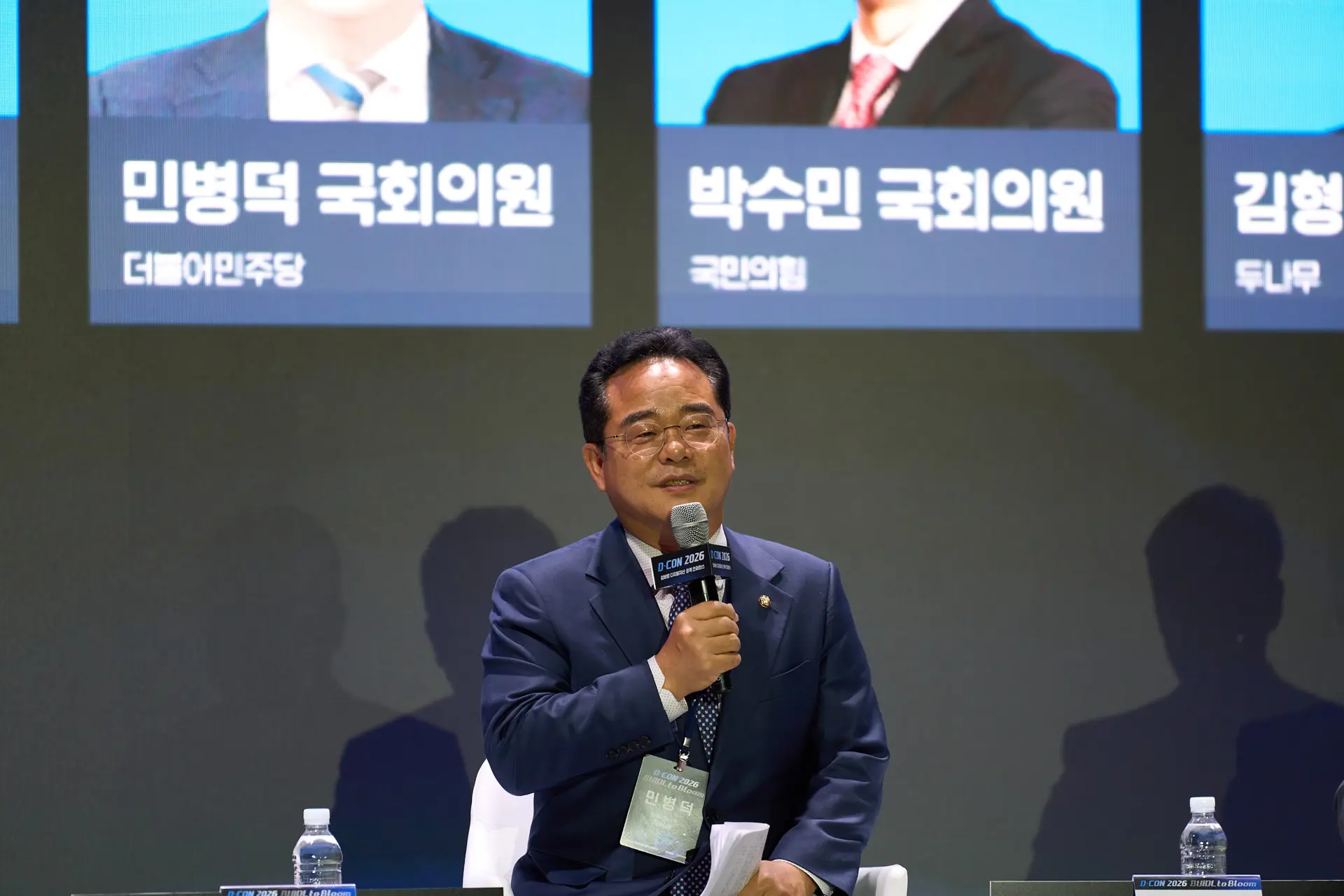
Min Byung-duk, a lawmaker from the Democratic Party of Korea, criticized efforts to limit won stablecoin issuance mainly to banks during a special dialogue at D-CON 2026 held at Fairmont Ambassador Seoul in Yeouido on Nov. 10.
He said South Korea should not create a stablecoin that no one uses simply because bank-issued tokens are seen as safer, and stressed that policymakers should first focus on use cases and distribution.
Compete on Services, Not a Bank Monopoly
Min argued that market participation should be determined by safeguards such as reserve assets and redemption systems, not by an issuer's industry.
"What matters is whether there are 100% reserve assets and guaranteed redemption rights, who supervises the issuer, and whether anti-money laundering and know-your-customer requirements are met," he said. "Any entity that meets those standards should be allowed to participate so competition can emerge."
His point was that regulators should set standards for market participants and oversee compliance, rather than restricting issuers in advance.
He drew a line, however, at opposing bank participation itself. Instead, Min said, South Korea needs a competitive structure in which banks, fintech firms and crypto companies combine their respective strengths.
"Banks are strong in infrastructure, fintech firms in convenience, and crypto companies in technology and networks," he said. "If they form consortia based on those strengths and create different stablecoins, they can compete on services."
He added that the companies that prevail through service competition in South Korea should then expand globally.
Min cited Samsung Electronics smartphones, Hyundai Motor and Kia, and K-content as potential distribution channels for won stablecoins. By tapping the overseas customer bases and distribution networks those Korean companies already have, he said, issuers could target global markets from the outset.
"Blockchain is a technology for the world, so we should not narrow the market to South Korea," he said. "We need to use the strengths we already have, such as Samsung phones, Hyundai Motor and Kia, and K-content."
"Basic Law Must Be Passed by Jan. 18 Next Year"
Min said stablecoins would play a bigger role in an era when artificial intelligence agents carry out transactions. He argued that South Korea should build its own payment network by leveraging stablecoins' advantages in speed and cost.
"AI agents are not going to make payments with cards," he said. "Stablecoins can become the payments infrastructure of the digital era."
He also said the shift offers a chance to change a system in which fees are paid to foreign payment networks such as Visa and Mastercard.
"The question is whether we will keep paying fees to payment networks built abroad, or live by collecting fees through a payment network built by South Korea," Min said. "Alongside semiconductors and shipbuilding, this could become a new growth engine."
To make that possible, he urged lawmakers to pass the Digital Asset Basic Act during the current regular National Assembly session, or at the latest before Jan. 18, 2027. He said domestic companies need conditions that allow them to compete as the US moves to institutionalize stablecoins.
"Criticism that the government is trying to collect taxes before even establishing a basic law helped underscore how urgent this legislation is," he said. "Dollar stablecoins are advancing, and we cannot keep telling domestic operators to wait."
He added that the basic law should not try to include every detailed rule.
"It is unrealistic to try to write into law every future development in a field that is changing rapidly in combination with AI," he said. "The basic law should set principles and guardrails, while leaving room for creative experimentation within them."
Doohyun Hwang