MoonPay Bank Charter: Will the OCC Approve Its Stablecoin Banking Bid?
Crypto payments company MoonPay has taken a big step toward becoming a regulated US bank.
The MoonPay bank charter application was filed with the Office of the Comptroller of the Currency (OCC) on November 17, 2026.
This article explains what MoonPay applied for, what the new bank would do, who would run it, and what happens next.
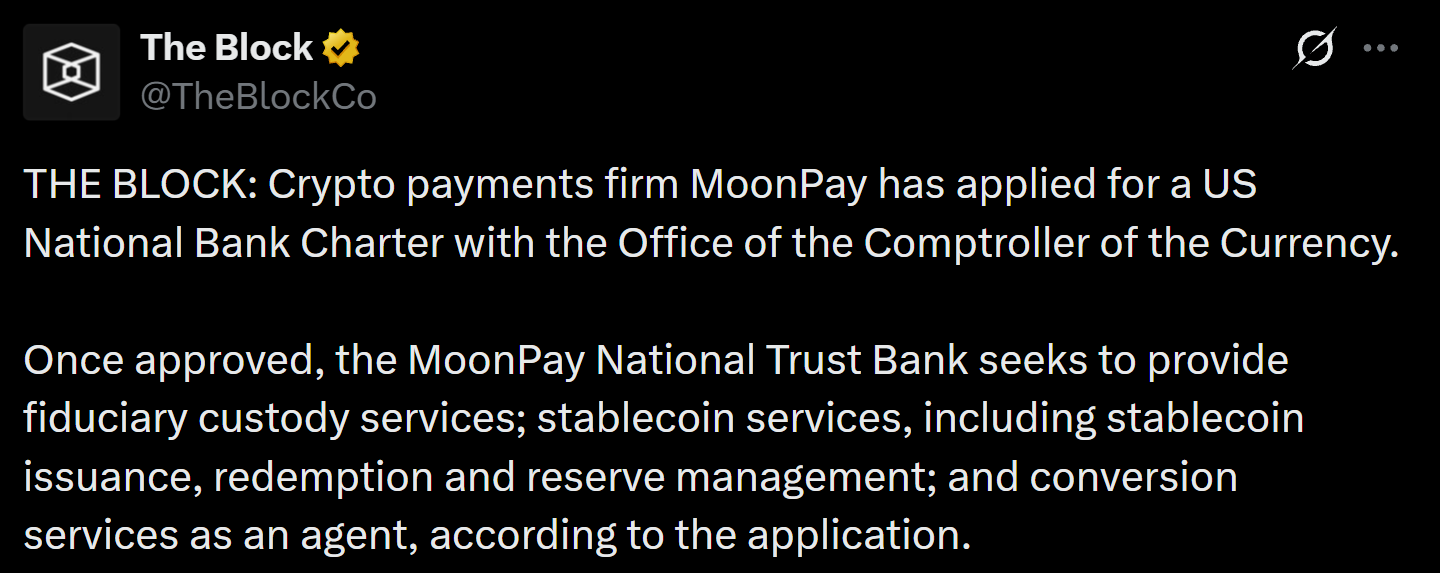
Source: The Block
What MoonPay Has Applied For
MoonPay announced that it has applied for a US national bank charter with the OCC.

Source: MoonPay Post
The OCC has also published the filing on its digital assets licensing applications page.
According to the public application document, MoonPay wants to set up a new bank called MoonPay National Trust Bank.
It describes it as a non-depository national bank. Its work would be limited to that of a trust company and related activities. A trust company looks after assets on behalf of others.
Three Services the Proposed Bank Would Offer
The application says that, once approved, the bank would provide three services:
Service
What it means in simple words
Fiduciary custody
Safely holding assets for clients, with a legal duty to act in their interest
Issuing stablecoins, redeeming them, and managing the reserves behind them
Conversion services as agent
Converting assets on behalf of clients
The application states that the bank wants to promote trust and transparency in stablecoin markets.
It also aims to provide strong technology for digital finance within a framework of regulatory compliance and safety.
MoonPay also asks for full fiduciary powers, which the application says its business plan establishes.
All products would be offered through electronic channels. The same document says the bank’s office will not be open to the public.
Ownership, Location and Leadership
The MoonPay bank charter plan is built around a single owner. The application says the bank will be wholly owned by MoonPay Inc, which will be its only shareholder.
It describes MoonPay as a Web3 technology and infrastructure group founded in May 2019.
The filing says MoonPay has more than 30 million customers in 180 countries and over 500 enterprise customers.
The main office would be at 407 Lincoln Road, Suite 6-K, Miami Beach, Florida.
The application says there are no plans for branches or an office move during the first years of the bank.
The board would have five members:
Ivan Soto-Wright (chair)
Victor Faramond
Michael Lempres (independent)
Caroline Butler (independent)
A fifth director, still to be decided
Ivan Soto-Wright (chair)
Victor Faramond
Michael Lempres (independent)
Caroline Butler (independent)
A fifth director, still to be decided
Senior executives named in the application are:
Ivan Soto-Wright as interim President and Chief Executive Officer
Anne Giviskos as Chief Financial Officer
Yujush Saksena as Chief Risk Officer
Victor Faramond as Chief Technology Officer
Laura Astrada as General Counsel
Chris Gregor as Chief Operating Officer and Head of Custody
Ivan Soto-Wright as interim President and Chief Executive Officer
Anne Giviskos as Chief Financial Officer
Yujush Saksena as Chief Risk Officer
Victor Faramond as Chief Technology Officer
Laura Astrada as General Counsel
Chris Gregor as Chief Operating Officer and Head of Custody
The bank would also have two board committees, each with at least three members and led by an independent director: an Audit and Fiduciary Committee, and a Board Risk and Compliance Committee.
Waivers, Start-Up Costs and Confidential Parts
The filing also lists some special requests and early costs:
Waiver requests: The bank asks for a waiver of the citizenship and director residency requirements under US banking law (12 U.S.C. § 72).
Permissibility: The applicants say they do not expect any problem with whether the plan is allowed under the National Bank Act and related rules.
Start-up costs: These include legal, consulting and application costs, technology integration and testing, smart contract audits, and pre-opening hires.
Banking partners: No correspondent bank arrangements have been finalized yet.
Confidential material: The business plan, financial projections and several other exhibits carry a confidential treatment request. Those details are not public.
What Happens Next: Public Comments and OCC Decision
The application includes a public notice that will be published in the Miami Herald.
It says people can send written comments to the OCC within 30 days after the notice is published.
The end date of the comment period will be posted in the OCC Weekly Bulletin.
Filing is not approval. The application itself states that approval is at the discretion of the federal banking agency.
It gives no decision date. Anyone following the MoonPay bank charter process should therefore watch the OCC’s official updates.
Conclusion
The MoonPay bank charter application shows a crypto company seeking to operate as a regulated national trust bank, with a focus on custody, stablecoin services and asset conversion.
The plan has named leaders, a Miami Beach office and a clear ownership structure.
The OCC has made the public portion of the filing available, but no approval has been granted. Readers should follow the OCC page for the next steps.
Disclaimer
This article is for educational and informational purposes only and is not financial or investment advice. Crypto assets are high risk, their prices can be very volatile, and you can lose some or all of your money. Always do your own research and consider speaking with a licensed financial advisor before making investment decisions.
About the Author Bablu Singh Nirwan
English Blog Writer at coingabbar.com
Bablu Singh Nirwan is a Content Writer with 6 months of experience covering blockchain, cryptocurrency, Web3, and digital finance. He specializes in researching emerging trends, simplifying complex topics, and creating SEO-optimized content. His work focuses on clarity, accuracy, and engaging insights that keep readers informed about the evolving crypto industry.
Frequently Asked Questions (FAQ)