On November 5, 2026, Morgan Stanley became one of the first major banks to tokenize U.S. equities and Treasuries through a new service from the Depository Trust & Clearing Corporation (DTCC). For businesses that rely on crypto banking — the seamless management of fiat and digital assets through crypto business accounts — the announcement is more than a headline. It signals that institutional-grade tokenization is moving from pilot to production, reshuffling how corporate treasuries, DAOs, and global startups will interact with capital markets. This analysis unpacks what happened, why it matters now, and what you should do about it.
Table of Contents
- What Just Happened: Morgan Stanley Tokenizes Securities via DTCC
- Why This Matters for Crypto Banking Right Now
- Crypto Banking 101: The Background You Need
- Concrete Implications for Your Business Banking in 2026
- What to Watch Next and Open Questions
- Key Questions About Tokenization and Crypto Banking
- Key Takeaways
What Just Happened: Morgan Stanley Tokenizes Securities via DTCC
The Announcement on November 5, 2026
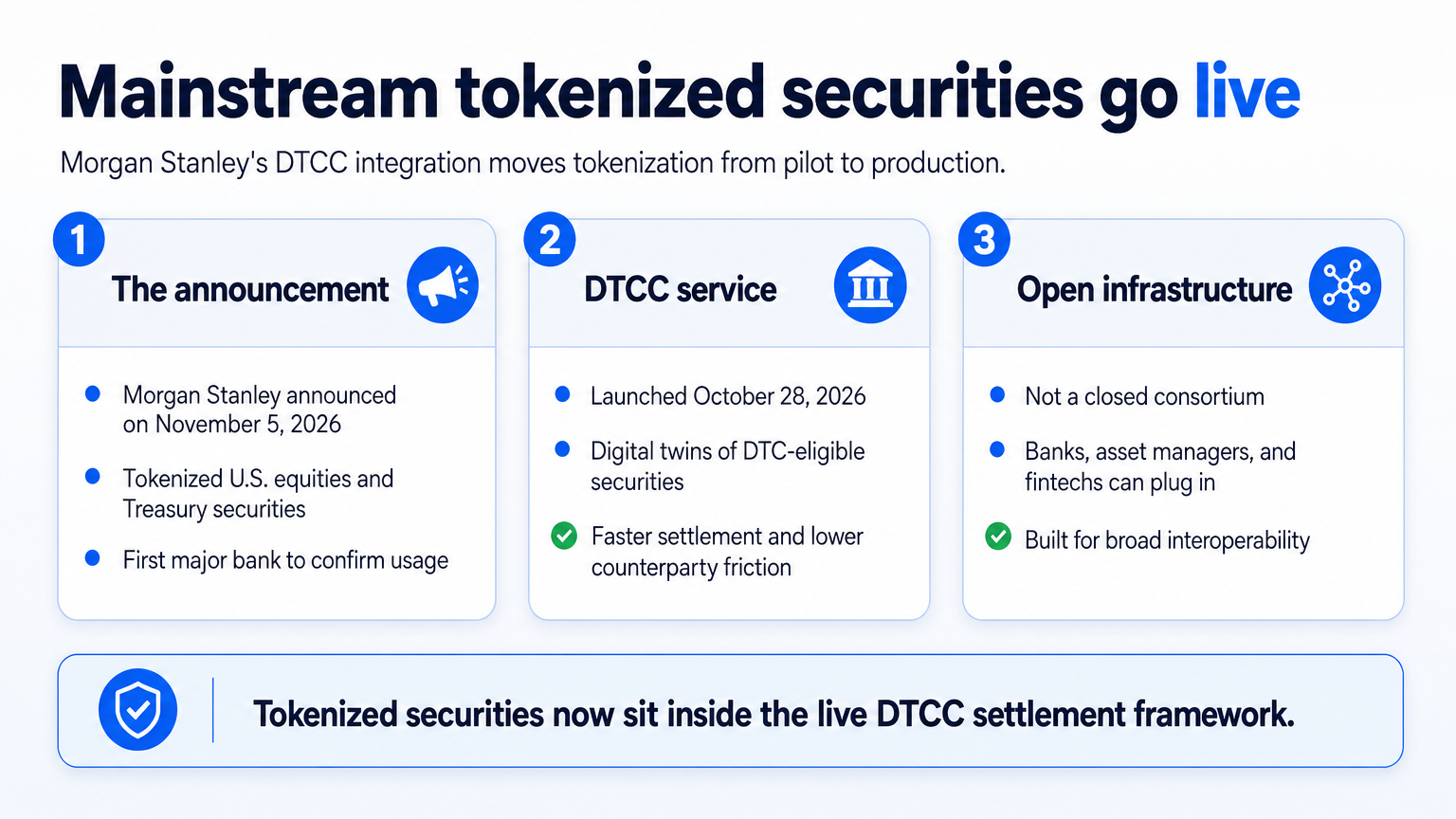
On Wednesday, November 5, Morgan Stanley disclosed on X that it had tokenized U.S. equities and Treasury securities using the DTCC Tokenization Service, which launched on October 28, 2026 (Yahoo Finance (Benzinga), November 5, 2026). Amy Oldenburg, Morgan Stanley’s head of digital assets strategy, stated that “hands-on integration of tokenized securities with established market infrastructure will inform how the firm builds its digital asset capabilities going forward.” The move converts traditional, DTCC-custodied assets into blockchain-based representations, designed to improve liquidity, collateral mobility, and capital efficiency.
DTCC’s New Tokenization Service Explained
The DTCC, which settles trillions in U.S. securities each day, launched a service that creates tokenized records of DTC-eligible securities — effectively digital twins of stocks and bonds that can be transferred, pledged, or settled on-chain. This is not a theoretical proof-of-concept. The service is live and operational, with Morgan Stanley acting as an early adopter. Tokenization here means an on-chain representation that is legally equivalent to the underlying security, maintained within the existing DTCC settlement framework. The immediate benefits include faster settlement cycles, reduced counterparty friction, and the ability to use these tokens as collateral in smart contract environments.
Who Else Is Involved?
While Morgan Stanley is the first to publicly confirm usage, The Block reported on November 4 that the DTCC service is open to a range of financial institutions. The structure is designed for broad interoperability, meaning additional banks, asset managers, and fintechs can plug in. This isn’t a closed consortium: it’s the core market infrastructure extending a bridge to blockchain rails.
Why This Matters for Crypto Banking Right Now
Crypto Banking Surpasses Retail Crypto
For years, crypto banking was associated with retail trading and high-yield accounts. That era is over. Institutional tokenization — with assets the scale of U.S. Treasuries — transforms crypto banking into a domain where businesses can hold, move, and use tokenized traditional assets alongside stablecoins and native cryptocurrencies. A crypto business account today must be able to handle not just USDC or Bitcoin, but also tokenized money market instruments and equities.
The Demise of the 'Two-System' World
Until now, most organizations ran two separate financial stacks: one for fiat and securities (prime brokers, traditional banks) and one for crypto (exchanges, on-chain custody). Morgan Stanley’s tokenization move, layered onto DTCC infrastructure, dissolves that boundary. A corporate treasury could post tokenized Treasuries as margin on a DeFi protocol without ever leaving the blockchain. Crypto banking providers that unify fiat, stablecoin, and now tokenized securities rails under one roof become essential operational tools.
Immediate Opportunity for Global Businesses and DAOs
Global businesses and DAOs that already use a crypto-fiat platform for multi-currency payments and treasury management can now envision holding yield-bearing, regulated assets on-chain. Instead of sweeping idle cash into traditional money market funds via manual bank wires, they could hold tokenized Treasuries directly in a compatible custody setup. This reduces cost, settlement lag, and geographic friction — a game-changer for organizations with distributed teams and crypto-native treasuries.
Crypto Banking 101: The Background You Need
What Is Crypto Banking?
Crypto banking refers to financial services that combine traditional banking functions (accounts, payments, custody) with cryptocurrency and digital asset capabilities. According to the SEC’s January 2026 statement on tokenized securities, such products must comply with federal securities laws when the underlying asset is a security. The FDIC separately clarified in 2025 the process for insured banks to engage in crypto-related activities, underscoring that the regulatory perimeter is expanding, not shrinking.
The Spectrum from Legacy Banks to Crypto-Native Platforms
On one end are traditional banks that have added crypto custody or trading via subsidiaries. On the other are fintech platforms that integrate fiat banking (through partner banks) with native on-chain asset support. The latter often serve Web3 startups and DAOs that need programmable, multi-signature wallets, automated payouts, and immediate conversion between fiat and crypto. OneSafe, for instance, provides a platform where businesses can hold multi-currency fiat accounts, send wires, and custody digital assets secured by Fireblocks custody — all through a single interface. That combination is what the tokenization era will demand.
Key Terms: Tokenization, Stablecoins, On-Chain Custody
- Tokenization: Creating a blockchain-based representation of a real-world asset that carries the same legal rights as the original. Tokenized securities are subject to securities regulations (Investor.gov).
- Stablecoins: Digital currencies pegged to fiat (like USDC) used for payments and settlement. They are not securities and serve as on-chain cash equivalents.
- On-chain custody: Safekeeping of digital assets using institutional-grade infrastructure such as Fireblocks, which provides multi-party computation (MPC) and policy controls.
Concrete Implications for Your Business Banking in 2026
Your Corporate Treasury Gains New Asset Classes
If your business holds significant fiat balances that earn zero or near-zero interest, tokenized Treasuries may soon be a viable alternative — accessible directly from your business crypto banking dashboard. Instead of opening a brokerage account and waiting T+2 for settlement, you could convert USDC to tokenized T-bills in minutes. The yield and regulatory clarity are improving as stablecoin regulation matures.
DAOs and Web3 Startups Get a Real On-Ramp to Traditional Markets
For DAOs, the ability to own tokenized securities is transformative. A Web3 treasury can now hold regulated, interest-bearing instruments without needing a legal entity to custody them through a traditional bank — provided the platform supports the token standard and integrates with the legal wrapper. DAO banking is no longer limited to holding ETH and stablecoins; it can diversify into stocks and bonds. This opens up treasury management strategies that were previously available only to corporations.
What to Look for in a Crypto Banking Platform Today
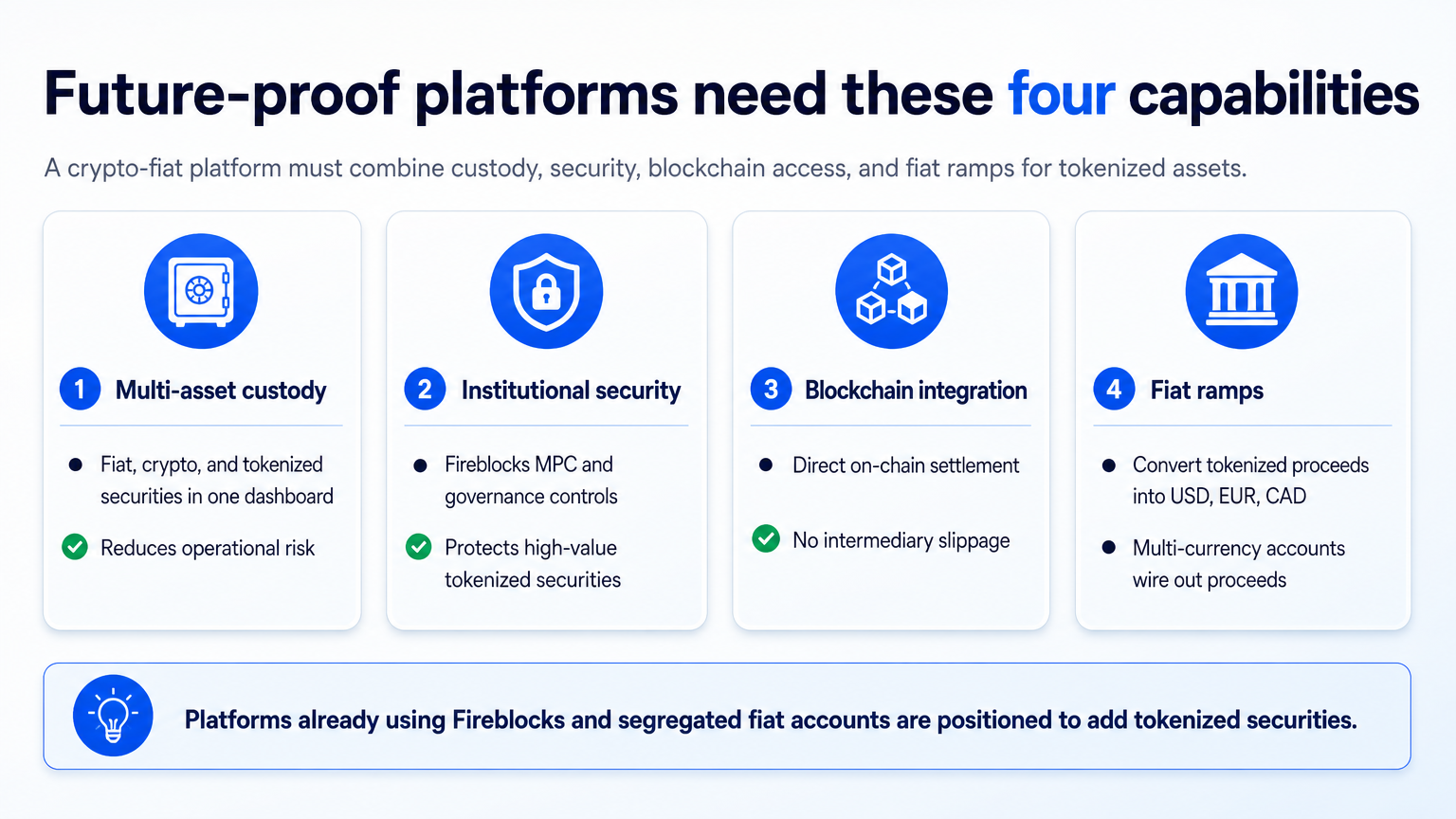
Not all platforms are ready for tokenized securities. A future-proof crypto-fiat platform should offer:
Platforms that already secure digital assets via Fireblocks and offer segregated fiat accounts are well-positioned to add tokenized securities support because the custody architecture is already robust.
The Fee and Speed Equation Will Shift
Traditional securities settlement takes two days and costs intermediaries fees. Tokenized securities can settle atomically, potentially reducing counterparty and operational costs. For businesses that frequently move between fiat, stablecoins, and now tokenized instruments, the blended cost of using a unified platform may drop significantly — especially if the provider offers free crypto deposits and competitive FX rates.
What to Watch Next and Open Questions
Regulatory Clarity on Tokenized Securities
The SEC’s January 2026 guidance made clear that tokenized securities are subject to the same disclosure and trading rules as traditional securities. The big question is how the agency will treat secondary market trading and fractional ownership when these tokens are used in DeFi protocols. Keep an eye on enforcement actions and no-action letters through early 2027.
Will Other Banks Follow Quickly?
Morgan Stanley is first, but JPMorgan, Goldman Sachs, and others have tested tokenization. The DTCC service is open, and competitive pressure is high. Expect announcements from at least two more global banks before the end of Q1 2027. The politics of stablecoin regulation suggest that banks will push to have these instruments recognized as high-quality liquid assets, which would accelerate adoption.
Can Crypto-Native Banks Offer Tokenized Securities?
Fintech platforms that partner with banks may be able to offer tokenized securities custody as part of a broader service. The key challenge is licensing: handling securities typically requires a broker-dealer or qualified custodian designation. Platforms that focus on fiat and crypto today may announce partnerships with licensed entities to add tokenized stocks and bonds to their dashboards. Watch for product announcements that explicitly mention DTCC compatibility.
The Stablecoin vs. Tokenized Deposit Debate
As stablecoins continue to dominate on-chain payments (Stripe expanded USDC payouts earlier this year), tokenized deposits — fiat cash represented on-chain — could compete with them for institutional settlement. If banks start issuing tokenized deposits for use in digital asset platforms, the distinction between a stablecoin and a bank liability may blur, bringing new compliance considerations for business crypto accounts.
Key Questions About Tokenization and Crypto Banking
What does Morgan Stanley's tokenization move mean for crypto banking?
It accelerates the convergence of traditional securities and blockchain-based finance, making crypto banking platforms essential for businesses that want to manage both in one place.
How do tokenized securities work?
A tokenized security is a blockchain-based digital representation of an underlying traditional security, such as a stock or bond, that retains the same legal rights and is typically custodied by a regulated entity like DTCC. It can be transferred peer-to-peer on a blockchain while still being reflected in the central securities depository.
What is the DTCC?
The Depository Trust & Clearing Corporation is the primary infrastructure provider for clearing, settlement, and custody of U.S. securities. It processes trillions in equity and fixed-income transactions daily. Its new Tokenization Service, launched October 28, 2026, creates tokenized versions of DTCC-eligible securities.
Why should businesses care about tokenized assets?
Tokenized assets offer near-instant settlement, 24/7 liquidity, and programmability. For businesses, this means faster access to capital, lower transaction costs, and the ability to use high-quality liquid assets as collateral in smart-contract-based lending or margin.
How will tokenization affect DAOs and Web3 startups?
DAOs and Web3 startups will gain access to regulated, yield-bearing instruments that can diversify on-chain treasuries without relying on traditional intermediaries. It also creates a bridge for these entities to participate in traditional financial markets while maintaining their crypto-native operations.
What should I look for in a crypto banking platform now?
Prioritize platforms that already combine multi-currency fiat accounts, digital asset custody (preferably through institutional-grade security like Fireblocks), and programmatic money movement. Ask whether they have a roadmap to support tokenized securities and what broker-dealer or custody partnerships they are building.
Key Takeaways
- Morgan Stanley’s tokenization of U.S. equities and Treasuries via DTCC on November 5, 2026 marks the operational launch of mainstream tokenized securities.
- Business crypto banking must now accommodate tokenized traditional assets alongside stablecoins and crypto, demanding unified platforms, not patchwork tools.
- DAOs and global startups can finally hold regulated, yield-bearing instruments on-chain, transforming treasury management.
- The capability checklist for a crypto banking platform now includes multi-asset custody, Fireblocks-grade security, and a clear path to handling tokenized securities.
- Regulatory frameworks are crystallizing, making this the moment to position your treasury infrastructure for the hybrid future of finance.
For daily illustrated SEO articles on developments like this, Joyrise plans, writes and publishes illustrated SEO articles to your Webflow blog every day.
Start building on a platform that already bridges fiat and crypto. Open a OneSafe account to manage your multi-currency treasury with institutional-grade custody and future-ready infrastructure.
Get started with Crypto in minutes!
Get started with Crypto effortlessly. OneSafe brings together your crypto and banking needs in one simple, powerful platform.