With the review of the business combination between Naver Financial and Dunamu moving into full swing, attention is focusing on the digital asset law set to be released this month. Even if the deal is approved, the future business structure could change depending on how the law sets out key regulations such as exchange governance, a won-backed stablecoin and a licensing system.
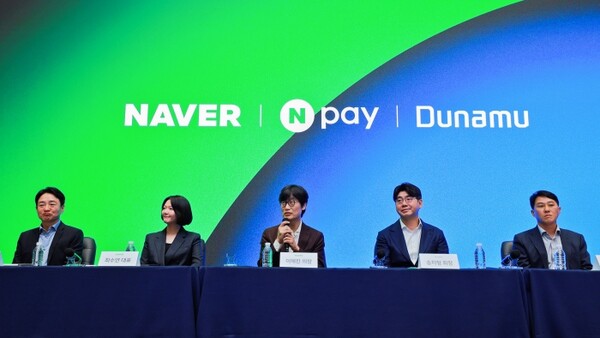
The Fair Trade Commission on Monday submitted an examiner’s report on the proposed merger between Naver Financial and Dunamu to its committee and began deliberation procedures.
The two companies are pursuing the combination through a comprehensive share swap under which Naver Financial acquires all of Dunamu’s shares. If the transaction is completed, Naver Financial will become Dunamu’s wholly owning parent and Dunamu will become a wholly owned subsidiary.
The scope the antitrust regulator is examining in this deal does not stop at Dunamu’s Upbit business.
The commission has defined 10 related markets, including online easy payments, digital asset exchanges, search portals, online advertising and shopping, financial mydata, and brokerage of unlisted shares. It also included in its review the market for issuing won-backed stablecoins, which has not yet been fully formed in South Korea.
In particular, the commission judged there could be a possibility of limiting competition in 4 combinations that could arise among issuing won-backed stablecoins, digital asset exchanges, easy payments and online shopping.
Jeon Seong-bok (전성복), director general of the commission’s Bureau of Business Combination Review, cited the fact that relevant bills have been introduced and that materials submitted by the two companies also focus on entering that market as the background to assessing potential limits on competition even in a market that has not yet formed.
That means the fact that Dunamu and Naver are reviewing won-backed stablecoins as a major business pillar going forward has emerged as a regulatory variable from the merger review stage.
Following the commission’s preliminary assessment, the companies have submitted remedies to address concerns about limiting competition. The commission will decide at a full panel meeting whether the remedies are appropriate and whether to approve the deal, aiming to complete deliberations within this year.
Even if the deal clears the antitrust hurdle, licensing and approval procedures by financial authorities remain. These include approval for a change of major shareholder for Naver Financial and acceptance of a report for a change of major shareholder for Dunamu.
The Financial Services Commission has previously said it would review safeguards in the digital asset law to prevent digital asset exchanges from undermining public interest and neutrality due to the influence of a specific company or shareholder.
One of the biggest variables is regulation of major shareholders of digital asset exchanges.
Financial authorities are in final-stage talks with a goal of releasing a government draft of the digital asset law this month. The bill is expected to include items not covered under the existing system, such as the issuance and distribution of stablecoins, requirements for digital asset operators, and exchange regulation.
Recently, options have been floated to limit ownership stakes held by major shareholders of exchanges to around 15 to 20 percent, similar to the level for alternative trading systems, and to give existing operators an implementation period of about 1 to 2 years. Another alternative that has been discussed is limiting voting rights above a certain level rather than forcing disposal of the shares themselves.
The specific cap and the method of application, however, have not yet been finalised. The commission has also previously said the cap on major shareholder stakes has not been decided.
For Dunamu, the regulation directly touches on governance after the combination with Naver Financial. If exchanges move to a licensing system and separate limits are introduced on ownership and voting rights for major shareholders, a key issue could be how to align the current structure, under which Naver Financial would hold 100 percent of Dunamu, with the new rules.
The stablecoin framework is also a key variable for business expansion.
In the government draft being discussed, a plan to first allow issuance of won-backed stablecoins by a bank-led consortium is being cited as the most likely option. Still, the issuer and specific equity requirements could change during discussions in the National Assembly.
Naver Financial has easy payments and financial services, while Dunamu has digital asset trading and blockchain technology, making stablecoins a field seen as demonstrating the combination’s synergies.
Naver has also set out plans to combine Naver’s AI and platform technologies with Naver Financial’s payment and financial capabilities and Dunamu’s blockchain and digital asset technologies through the business combination.
If a bank-centred issuance structure is finalised, however, the roles that Naver Financial and Dunamu can directly perform could change depending on how the system is designed.
The antitrust regulator also examined during its merger review the possibility that, if the companies issue their own stablecoin, they could lower transaction fees for a specific coin or restrict its use at rival exchanges.
Regulation of exchanges themselves is also expected to increase.
Financial authorities are reviewing a plan to shift digital asset exchanges, currently operated under a reporting system, to a licensing system and require sufficient capital, market-operating capability, and public interest and neutrality. The digital asset law discussions also include strengthening operator liability in the event of hacking or IT accidents and tightening requirements for the actual holding of users’ assets.
In the end, the combination of Dunamu and Naver is linked to multiple procedures, from the antitrust regulator’s merger deliberations to financial authorities’ licensing and approval and enactment of the digital asset law.
In particular, how regulation of major shareholders of exchanges and the stablecoin issuance structure are decided is expected to be a key variable dividing the governance of Naver Financial and Dunamu and the future scope of their digital finance business.