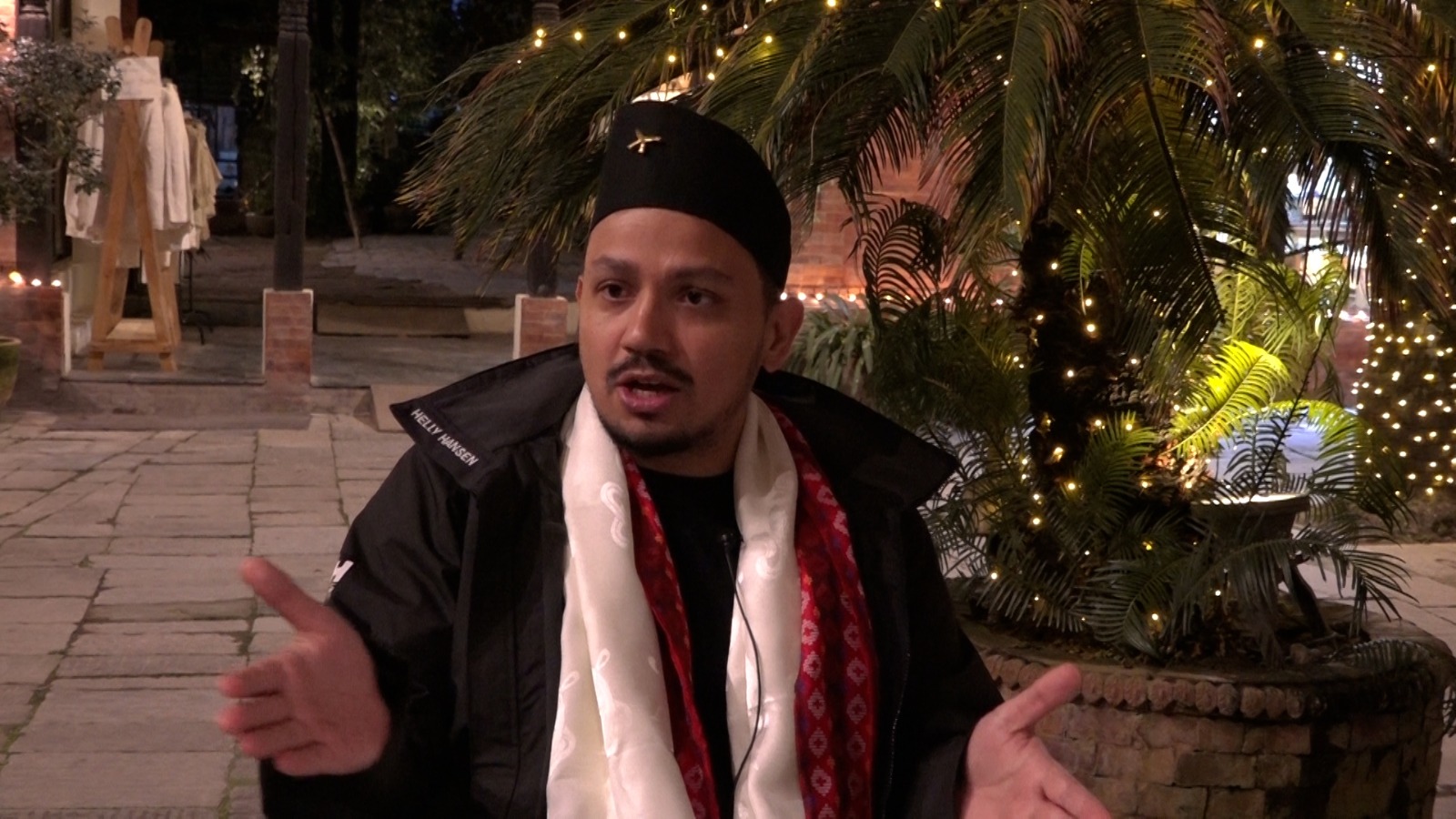
Sandeep Nailwal is one of the co-founders of the Polygon network and currently serves as executive chairman of Polygon Labs. He helps steer the long-term growth and sustainability of the Polygon ecosystem while overseeing the strategic priorities of Polygon Labs alongside CEO Marc Boiron.
His journey in blockchain began with Bitcoin in 2013, but his interest deepened after he developed his first Ethereum decentralised application (dApp). In late 2017, he joined Jaynti Kanani and Anurag Arjun to establish Matic Network, the precursor to Polygon, with the aim of scaling Ethereum. Mihailo Bjelic later joined the team in 2021 as they built Polygon.
A serial entrepreneur with an MBA from the National Institute of Industrial Engineering, Nailwal describes himself as “extremely humble, but madly ambitious”.
During his recent visit to Nepal, Nailwal spoke about potential investments in AI infrastructure and data centres, opportunities in cross-border payments, blockchain regulation and the country’s prospects in the global technology economy. In this conversation, he also discusses his plans for Nepal and why he believes Nepali entrepreneurs and engineers should think beyond domestic markets.
What is the main purpose of your visit to Nepal?
I was invited by my dear friend Paravesh Rijal, whom I have known for quite some time. He is a global leader doing great work in the US, a senior fintech executive from this region and an expert in Wall Street and banking who understands both traditional finance and cryptocurrency. He is also a global banking partner for us at Polygon.
I am involved in several technology initiatives focused on working with banks on payments and building data centres to support the expansion of AI. I was initially exploring opportunities in India, but Paravesh suggested that I look at Nepal as well.
What are your key takeaways from your meeting with the Finance Minister?
I was blown away after meeting the Finance Minister today. I am very impressed by his understanding of the industry and his determination to move quickly to put Nepal on the global map. That was very encouraging.
As a result, I plan to direct significant investments towards Nepal in the near future, primarily in AI infrastructure, data centres and payment systems in partnership with major banks. We aim to bring substantial foreign direct investment into the country, particularly alongside partners such as CRB Bank, which is a major global partner of ours.
With the massive expansion in data infrastructure taking place globally, there is a significant opportunity for countries like Nepal to establish themselves and attract investment.
The projects we are discussing could easily scale to hundreds of millions of dollars in foreign direct investment. That is our plan.
Could you also talk about cryptocurrency and stocks in Nepal?
Not really. Our primary focus is payments. We are not doing much on the purely cryptocurrency side. Instead, we are using stablecoin technology and our open Polygon Money Stack, in partnership with banks, to facilitate regulated payment businesses.
As for anything directly related to cryptocurrency, we respect the laws of the country and leave those policy decisions to the local government.
You were also involved in raising funds through a cryptocurrency-based campaign for Nepal’s disaster relief efforts. Could you provide an update?
We raised a total of $275,000. We had to execute the campaign in a manner that was fully compliant with international regulations, similar to what I did in India, where we raised millions of dollars.
We also ensured full compliance with Nepal’s local laws and regulations. We are glad to have raised approximately $275,000, which we are now in the process of repatriating to the Prime Minister’s Disaster Relief Fund.
Why does Nepal feel so close to you that you decided to organise this fundraising campaign?
I always jokingly say that I am probably one-fourth or one-sixth Nepali. I was born in Uttarakhand, and my maternal grandmother was born in Almora, just 50 kilometres from the Dharchula border. Before 1947, these areas were essentially part of the same community, with fluid boundaries and considerable cultural intermingling. I feel my maternal grandmother had strong Nepali roots, and I find it easy to relate to people here.
I am also deeply involved in spirituality. People associated with the Isha Foundation were working here, and I knew several individuals whose loved ones had been affected by the disaster. I felt a strong inner calling to step forward.
While I generally focus my charitable efforts on India, the disaster in Nepal felt very close to home. I felt compelled to help.
Does this mean you are also looking to invest in Nepal?
It initially started with donations, which we processed in a compliant manner with the assistance of CRB Bank to bring the funds into the country. Once we had accomplished that, broader conversations began.
Paravesh helped me understand how the current government, which came to power with a strong mandate, is positioned to drive growth. Having observed developments in India under Prime Minister Narendra Modi, I have seen how a strong public mandate can allow a government to push through major reforms more effectively.
My meeting with the Finance Minister reinforced my impression that there is a strong focus on economic reforms. Dozens of governance laws are being updated to create a more business-friendly environment.
This region has immense potential, particularly in AI, because Nepal has abundant green energy. As AI infrastructure expands globally, demand for green energy will increase, creating a huge opportunity for Nepal.
The opportunity for Nepal in AI, given its hydropower potential and geographical advantages, is enormous. Nepal should capitalise on the AI boom. Instead of simply producing electricity and selling it at commodity prices, the country can convert that energy into AI computing power and sell it globally over the internet.
That represents one of the biggest export opportunities for Nepal. After meeting government officials, I am confident that the government is actively promoting these efforts.
Over the next two to five years, the computing industry alone could contribute several percentage points to GDP and potentially increase total exports by 50 to 100 per cent, driving substantial economic growth.
Globally, most opposition to data centres centres on their reliance on non-renewable energy. However, when powered by renewable energy, data centres can become one of the most beneficial uses of electricity for local communities while generating numerous employment opportunities.
Jobs will not be created only in infrastructure development. Under our proposal, we also plan to provide computing capacity to Nepali entrepreneurs and companies at discounted rates. This could help incubate and scale local startups, creating technical employment opportunities within Nepal.
With AI, anyone can build applications for a global audience. I encourage entrepreneurs in both India and Nepal to focus on building products for international markets.
In fact, I recently met a team in Mumbai with a Nepali co-founder that is developing payment and remittance applications for Latin America from this region. Since modern applications are built on cloud infrastructure, combining AI, blockchain and stablecoin-based payment technologies allows local talent to serve global markets. The importance of this opportunity for Nepal cannot be overstated.
You mentioned plans to invest in Nepal. What is your timeline?
My initial plan was to explore investments, support local entrepreneurs and back startups over the next one to two years. However, after meeting the Finance Minister, who emphasised the need to move quickly, I feel compelled to accelerate our plans.
I am very impressed with him and extremely bullish on Nepal.
Given the strong mandate enjoyed by the Prime Minister and the Finance Minister, I have instructed my team to expedite our timeline and begin preliminary work immediately. We expect to finalise our framework with the government within four to six weeks and begin deployment within three months.
Will the initial deployment focus on data infrastructure?
Initially, the focus will be on AI computing infrastructure, followed by payment systems, central bank digital currencies (CBDCs) and banking collaborations. These are areas in which we already work with major financial institutions globally.
Given your involvement in payment systems, how do you view cross-border payment opportunities in South Asia, particularly in Nepal?
The cross-border payment market in Nepal is massive. If I am not mistaken, remittances account for around $16 billion annually.
Beyond the sheer scale of the opportunity, this money is earned through hard work by Nepalis living and working around the world. Currently, remittance fees cost them anywhere between 0.5 and 5 per cent.
With the regulated payment technology we are building in the US, we could facilitate money transfers into Nepal at a fraction of the current cost, perhaps one-third or one-fourth of existing rates.
Instead of paying these fees to intermediaries, those savings would go directly into people’s hands. That represents a huge opportunity. This is why I want to engage with local startups and entrepreneurs to explore how we can collaborate in this area.
Cryptocurrency is illegal in Nepal, but blockchain technology has several applications. What policy framework would you recommend for South Asian countries like Nepal to explore its use?
I think governments should start with tokenisation, including the tokenisation of government bonds, securities and even local currencies. They should allow these assets to integrate with the financial system and gradually understand how the technology works.
My recommendation is to begin with experimentation. Tokenisation is a standard use case that major US banks are currently testing, and the regulatory frameworks around it are relatively well defined. If governments want to explore blockchain applications, this would be a good starting point.
Do you believe cryptocurrency should be legalised in these countries?
I think many cryptocurrencies are highly speculative in nature. We always respect local laws and leave such policy decisions to governments. However, I support banning extremely speculative currencies in countries where people end up gambling on them.
It is painful to hear stories of people losing their savings to scams. So, I am generally aligned with that approach.
Governments should begin with tokenised assets and gradually expand their use as they build confidence in their ability to regulate the technology. The key is to experiment and learn.
What is your single most important piece of advice for a Nepali engineer who wants to build a global career while living in their home country?
My advice to Nepali entrepreneurs is that modern technology allows them to build products for a global audience while working from Nepal. Their mindset should focus not just on serving Nepali consumers but also on reaching users around the world.
For example, consider a company like Cal AI, which allows users to take a picture of their food and calculate its calorie content. There is no reason why a product like that cannot be developed in Nepal. When building a company, think globally and do not restrict yourself to the local market.
Second, I would say that the talent from this region is exceptionally strong. Look at leaders like my friend Paravesh from CRB, who has reached the highest levels of leadership in the US.
Today, remote work opportunities are abundant. Engineers should not limit themselves to applying to local companies. They should also target global companies that pay salaries in US dollars.
This shift transformed India’s technology landscape, as skilled engineers began earning global salaries while continuing to live in their home country.
If you are a capable engineer, global companies do not necessarily care whether you live in New York, Kathmandu or Delhi. They are willing to pay global salaries in dollars. My advice is to aim for those global opportunities.
React to this post
Hot Topics
Baral is an associate editor and the head of the business bureau.
Conversation
Related News
Air pollution reaches hazardous levels in Delhi after Diwali fireworks
Pregnant women should avoid firecrackers to prevent potential long-term health effects
Yuvraaj’s century helps Pokhara set Karnali a target of 218
Natural flower garlands gain popularity as Gulmi restricts artificial alternatives
55 arrested in gambling raids across six locations in Surkhet, Rs 1.25 million seized
‘Kabaddi 5’ box office earnings drop to Rs 16.3 million in a week
Most Read
Nepali Congress to provide warm clothes and mental health counselling to flood-hit communities
Who is Manoj KC, Nepal Police’s 34th IGP?
Nepal launches Visit Nepal campaign in partnership with TikTok
Misri looks forward to discussing key initiatives ahead of PM’s India visit, offers support for Bhotekoshi reconstruction
‘We do not need sympathy; climate finance is our right’
Subscribe to Onlinekhabar English to get notified of exclusive news stories.