NYDFS Crypto Advertising: What New York Firms Must Change by May 2027
New York’s financial regulator has issued new guidance on how licensed virtual currency companies must promote themselves.
The NYDFS crypto advertising guidance, announced on November 12, 2026, targets misleading claims, hidden costs, and unclear paid endorsements.
It also asks firms to set up formal review and governance processes. This article explains who must follow the rules, what they require and when the deadline.
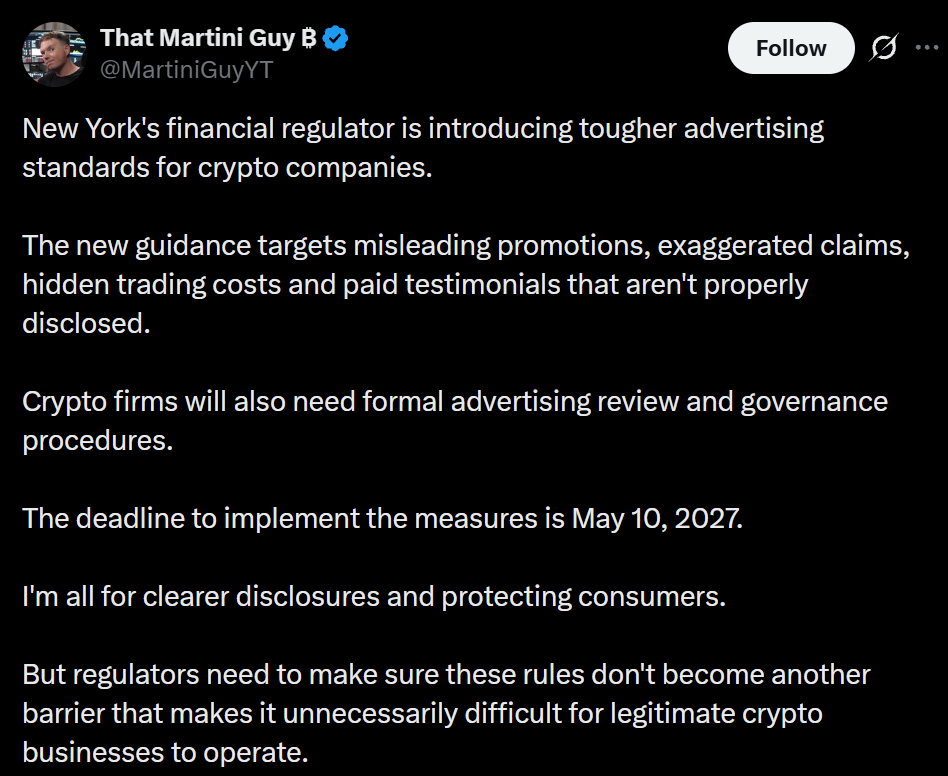
Source: Post on X
What Did New York’s Regulator Announce?
On November 12, 2026, Acting Superintendent Kaitlin Asrow issued the guidance through an official press release and a detailed industry letter.
She said it reinforces the department’s commitment to protecting New Yorkers and keeps marketing in this space clear, comprehensive, and accessible.
The rules apply to businesses licensed or chartered by the department, which the letter calls virtual currency entities:
Question
Answer
Who must follow it?
Companies licensed under 23 NYCRR Part 200 (known as BitLicensees) and limited purpose trust companies
What does it cover?
Any content that could reasonably be seen as promoting the firm’s virtual currency products, services or activities
Which formats count?
Social media, websites, blogs, audio and video, newsletters, presentations, brochures and customer-facing technology
The letter says labels do not matter. Content still counts if it is called “education” or a “fee comparison.”
What Content Is Not Allowed
Marketing must not make false, misleading, or deceptive statements, whether directly or by implication. Claims must be a fair portrayal and be evidence-based and verifiable.
The letter lists examples of content that internal review should catch:
Exaggerated or unsubstantiated claims the firm knows, or has reason to know, are false or misleading.
Statements that create a false impression of competitiveness, such as promoting “no-fee trading” while leaving out other costs like spreads or markups.
Misleading performance claims, such as leaving out time periods or showing results from only part of a portfolio.
False statements about regulatory status, including a person’s or company’s licensing.
In simple terms, a firm cannot advertise one low price while hiding other charges the customer pays.
Disclosure and Testimonial Rules
Disclosures must be clear and conspicuous. This part of NYDFS crypto advertising rules is the most detailed.
Under the letter, firms should make sure that:
Any mention of benefits comes with a balanced discussion of risk, and nothing reads as a promise of profit or protection from loss.
Customer testimonials carry a clear note that they may not reflect other customers’ experience.
Any payment for testimonials, direct or indirect, is clearly shown, including the nature and amount.
Disclosures are easy to see, considering size, color and contrast, and use plain language.
Risks are not buried, such as at the end of a podcast or behind a “click for more” button.
The licensed company providing the product is clearly named.
Governance and Review Requirements
Covered companies must keep written policies on marketing. The board of directors, or a designated board subcommittee, must review and approve them every year.
The policies should match the company’s size, customer base and business model.
According to the letter, effective policies generally include:
Clear roles and responsibilities for marketing work.
A formal review and approval process with a secondary review.
Monitoring for misuse of the company’s name, such as impersonation accounts and unauthorized promotions.
Records that support factual claims and show approvals.
Due diligence on third-party promoters, plus monitoring of their activity.
Procedures making sure anyone acting for the firm follows the policies and the law.
Extra care based on the audience, such as its size and sophistication.
Deadline and What Happens Next
The press release says companies are expected to update their policies by May 10, 2027, review them at least annually, and keep records for department review.
The industry letter says policies must be available for review effective May 12, 2027.
Because the two dates differ by two days, companies should plan around the earlier one. Both documents are linked above for checking.
That makes NYDFS crypto advertising compliance a supervised area. Through examinations and supervisory monitoring, the department says it will assess how licensees apply these policies and how well they work.
The guidance is not exhaustive, and the department may update it over time. It also does not limit any other law or regulation, and each business remains responsible for other state and federal requirements.
Conclusion
To sum up, NYDFS crypto advertising rules ask licensed firms to keep claims honest, disclose risks and costs clearly, and prove they have strong review systems in place.
The guidance applies only to businesses licensed or chartered in New York, and the deadline is in May 2027. Read the official letter for the full details.
Disclaimer
This article is for educational and informational purposes only and is not financial or investment advice. Crypto assets are high risk, their prices can be very volatile, and you can lose some or all of your money. Always do your own research and consider speaking with a licensed financial advisor before making investment decisions.
About the Author Bablu Singh Nirwan
English Blog Writer at coingabbar.com
Bablu Singh Nirwan is a Content Writer with 6 months of experience covering blockchain, cryptocurrency, Web3, and digital finance. He specializes in researching emerging trends, simplifying complex topics, and creating SEO-optimized content. His work focuses on clarity, accuracy, and engaging insights that keep readers informed about the evolving crypto industry.
Frequently Asked Questions (FAQ)