Oklo (NYSE: OKLO) signed a manufacturing partnership with U.S. Forged Rings on 6 November 2026, reserving domestic forging capacity for future Aurora reactor deployments, the company said.
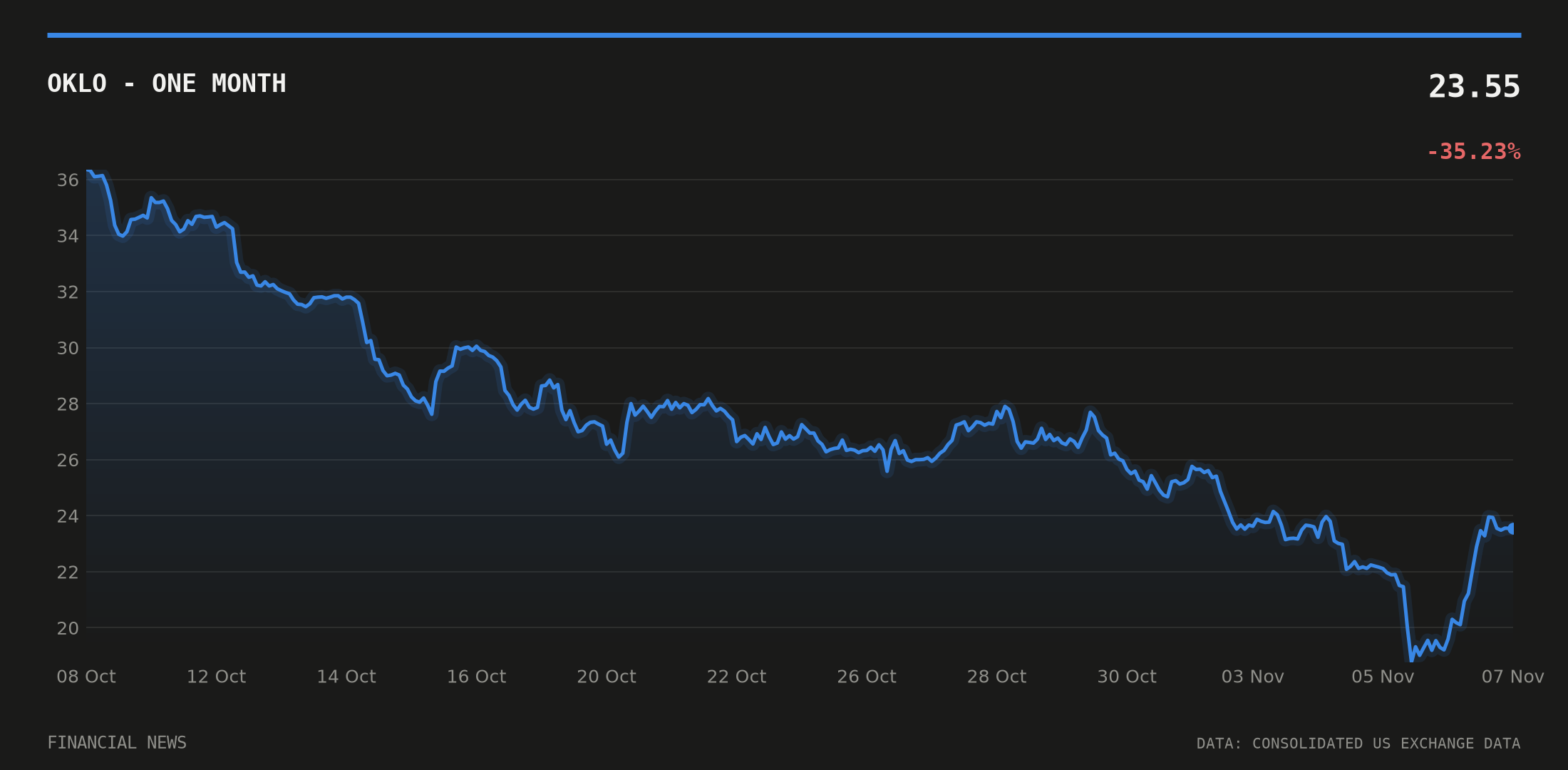
Shares jumped as much as 22.6% that day, from a prior close of $19.20 to a trade near $23.55, as MarketBeat reported. The move came alongside a third-quarter earnings update that beat Wall Street forecasts on both revenue and loss per share.
What the manufacturing partnership covers
The agreement with U.S. Forged Rings, Inc. (USFR) reserves capacity equivalent to 27 Aurora module-equivalents for deployments running from 2030 to 2035, according to Benzinga. The capacity sits at a planned USFR campus in Hertford County, North Carolina, according to the release.
Oklo frames the deal as addressing a bottleneck before it arrives: large forged reactor components are a known pinch point for any company trying to build multiple small modular reactors at scale, and the company has no Aurora unit generating revenue yet. Reserving forging slots years ahead of need is a bet that advanced nuclear demand will outpace US industrial capacity to supply it.
Earnings beat did the heavy lifting
Oklo’s third-quarter 10-Q, filed the same day, showed a GAAP net loss per share of $0.22, narrower than the $0.27 loss analysts had pencilled in, per SEC filings. Revenue came in at $1.86m, up from $1.21m in the second quarter and ahead of the roughly $1.02m consensus estimate.
The headline loss was still large in absolute terms: Oklo posted a net loss of $41.7m for the quarter, part of a pattern of losses that have widened most quarters since mid-2024, SEC filings show. The company held cash, cash equivalents and marketable debt securities of $3.13bn as of 30 September 2026, giving it ample runway against 2026 cash-outflow guidance of $120m-$150m, though the gap between that balance sheet and its commercial output remains wide.
Pre-revenue, but building
Oklo also disclosed the same day that its Groves-1 isotope test reactor in Texas had reached substantial construction completion after 229 days, at a construction cost of roughly $65m, Benzinga reported. Combined with the manufacturing partnership, the announcements gave investors two forward-looking signals of progress to set against a still-empty revenue line.
Trading volume on the day ran at 2.6 times the 20-day average, and the stock’s 20-day range widened to between $18.77 and $28.84. Shares remain down 17.75% over the preceding 20 trading days despite the jump, reflecting weeks of weakness that the earnings and partnership news only partly reversed. FINRA short-sale data show the daily short-volume ratio for OKLO falling from 0.605 on 4 November to 0.362 on 6 November, consistent with reduced short-side activity around the news.
Four Oklo insiders, including chief executive Jacob DeWitte and chief financial officer Caroline Cochran, filed Form 4 disclosures with the SEC in the days around the announcement, according to EDGAR records. The filings do not disclose transaction values in the available data.
The broader rate backdrop has been easing slightly, with the 10-year Treasury yield at 4.84% on 5 November, down from 4.90% previously, according to Federal Reserve data. Lower long-dated yields tend to help capital-intensive, pre-revenue growth names such as Oklo, which depend on cheap long-term financing to fund construction years before any Aurora unit earns a dollar.
Oklo has not given a date for when the USFR capacity reservation would convert into binding orders. Investors are likely to watch the company’s next regulatory updates and any further supply-chain agreements as it works toward its first commercial Aurora deployment.
This article is for information only and is not investment advice or a recommendation to buy or sell any asset. Markets move quickly; figures are correct as sourced at the time of writing. Always do your own research before making financial decisions.