OKX Europe Outage: What Really Happened on November 27?
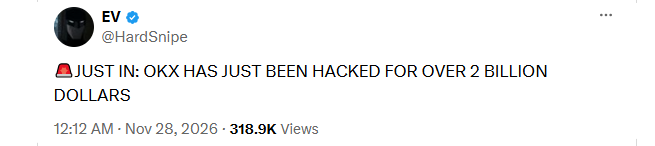
Within minutes of the OKX Europe outage on November 27, a $2 billion hack claim was spreading across social media. Was it a genuine breach at one of the industry's biggest platforms, or a technical glitch that only looked catastrophic? The question matters well beyond one afternoon, because 2026 has already produced some of the costliest exchange attacks on record.
Source: X Official Account
How the OKX Europe Outage Unfolded Between Mid-Afternoon and Evening
Users in the region began reporting trouble in mid-afternoon UTC. Logins failed, balances would not load, and API calls returned a "temporarily unavailable" message. A few traders also described glitches with open orders.
The OKX hack claims gained speed because failed logins and missing balances look exactly like the first signs of a real exchange breach. After the Binance and Bitget thefts, social media was already primed to assume the worst, so an unverified figure spread faster than any official update.
According to the CEO's official posts, the sequence ran as follows:
15:33 UTC: Erald Ghoos, head of OKX Europe, acknowledged the access problems and said the team was treating them as a priority.
About 16:35 UTC: He confirmed that customer assets were safe and that services were returning.
About 17:07 UTC: He announced full restoration and apologized for the inconvenience.
No technical root cause has been made public. The exchange has only described the event as a temporary service disruption.
No Evidence of a Breach as On-Chain Checks Show Reserves Holding Firm
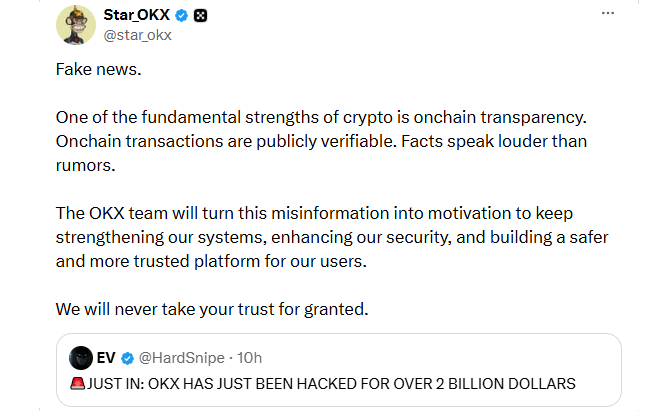
OKX founder Star Xu dismissed the $2 billion claim as fake news, pointing to the transparency of blockchain records, according to his response. Independent reviews of exchange wallets found no large withdrawals, sudden balance drops, or other patterns typical of theft. No blockchain forensics firm has reported a security incident tied to the downtime.
The false claim most likely grew out of the glitches themselves. Balances that failed to display looked, to some users, like balances that had vanished, and the story spread faster than official updates could catch it.
Binance Hack and Other 2026 Attacks Keep Exchanges on High Alert
Context explains the nervous reaction. This year has produced several of the largest exchange losses on record:
Binance, October 29: About $6.3–6.4 billion left hot wallets across multiple chains, the biggest crypto theft ever recorded. Investigators linked the attack to TraderTraitor, a group associated with North Korea's Lazarus network. Roughly half the stolen funds were frozen, and Binance said it covered user losses from its own resources.
Bitget, September 24, 2026: Attackers drained about $388 million from the exchange's hot and warm wallet infrastructure through a key and infrastructure compromise. It is the largest exchange theft of the year before Binance. Withdrawals were frozen, then reopened in phases from September 28, with Bitcoin first.
CoinDCX, October 2026: Roughly $16 million stolen from the exchange’s old deposit addresses left over from its July 2025 breach. CoinDCX said it covered the full amount from its own reserves. Combined with the $44 million lost in July 2025, the exchange has now lost roughly $60 million across two incidents.
Attackers have increasingly targeted staff, key management, and internal access rather than smart-contract flaws.
Why Trust in Crypto Exchanges Is Fragile and What Verification Looks Like
Against that backdrop, any downtime at a centralized exchange is quickly read as a security event. Xu has said publicly that no exchange is absolutely safe, and that internal controls are under review after the Binance attack.
OKX publishes proof-of-reserves data and has no widely reported exchange-level theft of customer funds in its history.
Anyone holding assets on a platform should rely on official channels, published reserve data, and independent on-chain analysis during an incident, not unverified posts.
The next test for OKX will be transparency. A published post-incident explanation of what failed on November 27 would do more to rebuild confidence than any reassurance posted mid-crisis.
Disclaimer: This article is for informational purposes only and does not constitute financial or investment advice. Crypto markets carry significant risk. Always do your own research before making any investment decisions.
About the Author Bhumika Baghel
English News Writer at coingabbar.com
Bhumika Baghel is a crypto journalist at Coin Gabbar with over 1.5 years of industry experience. She specializes in SEO-optimized content, market trend research, and fast-paced news reporting across cryptocurrency developments, along with regulatory updates, token presales, and emerging blockchain technologies. Maintaining an independent and unbiased editorial approach, Bhumi focuses on delivering clear, timely, and objective analysis.