On November 3, 2026, Walmart-backed OnePay was reported to be letting customers deposit stablecoins directly into a checking account and receive dollars. For a consumer fintech that's a convenient feature. For anyone running crypto banking operations across borders, it is a preview of the standard your treasury, payroll, and vendor payments will be measured against: on-chain money that lands as spendable fiat, in moments, without a manual conversion step in the middle.
Here's what changed, why it matters to a finance team rather than a shopper, and what to do about it this quarter.
Table of Contents
- What Just Happened: OnePay’s Stablecoin‑Checking Move
- Why This Matters for Crypto Banking
- The Background: From Crypto Banks to Embedded Stablecoin Rails
- What This Means for Your Business
- What Finance Leads Should Do Now
- What to Watch Next: Open Questions
- Quick Answers for Finance Teams
- Key Takeaways
What Just Happened: OnePay’s Stablecoin‑Checking Move
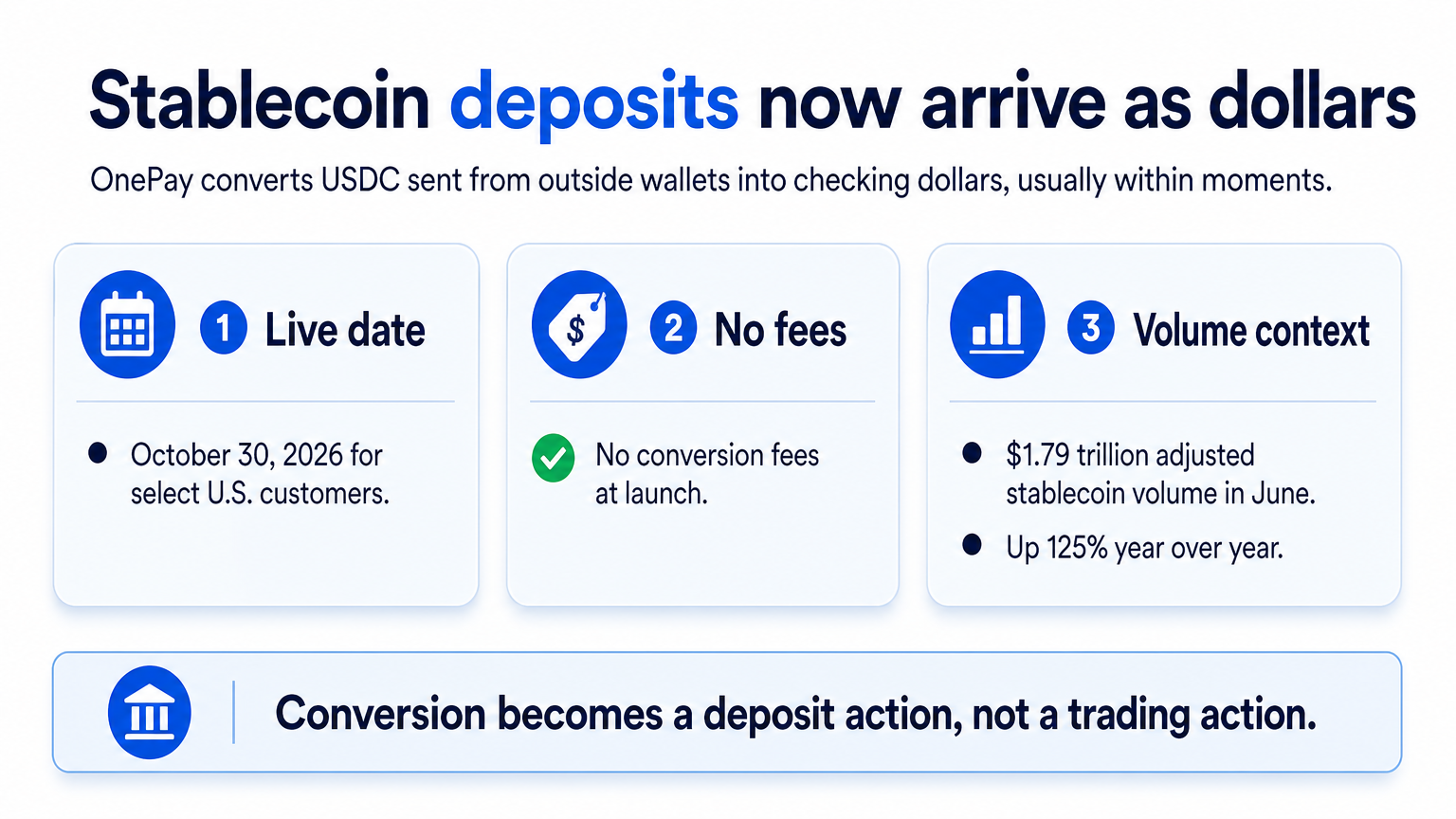
PYMNTS reported on November 3, 2026 that OnePay is letting customers deposit stablecoins straight into their checking accounts, where the money arrives as U.S. dollars. The report frames the move as putting a mainstream consumer app exactly where crypto earnings meet everyday spending.
The announcement and its terms (November 3, 2026)
Per OnePay's announcement as cited by PYMNTS, the capability opened on October 30, 2026 for select U.S. customers. A customer sends USDC from an outside wallet or exchange to a deposit address inside the OnePay app; OnePay converts the funds to dollars and credits them to OnePay Checking, usually within moments. There are no conversion fees at launch.
Stablecoin volume in context: $1.79 trillion in adjusted transactions (up 125% YoY)
OnePay cited industry figures showing roughly $1.79 trillion in adjusted stablecoin transaction volume in June, up 125% from a year earlier. Analysis: volume at that scale is no longer a crypto-trading artifact. It reflects settlement — remittances, vendor payments, treasury moves — which is precisely the flow that eventually has to touch a business bank account.
Why This Matters for Crypto Banking
Stablecoins break the crypto‑spending barrier
Until now the awkward step was always the same: hold USDC, then find a moment to sell it, wait for a bank transfer, and hope the rate held. OnePay's version deletes the sell order and the waiting period. The stablecoin-to-fiat conversion becomes a deposit, not a trade. That reframing is what makes stablecoin checking legible to people who will never open an exchange account.
Consumer adoption pulls business banking forward
Consumer habits set the expectation bar for business tools. Once a retail user can move USDC into a checking balance in moments for free, a founder invoicing a client in USDC will ask why their business crypto account takes two business days and a support ticket. Expect procurement pressure on settlement speed as a product feature, not a nice-to-have.
The convergence of checking and on‑chain liquidity
The strategic point is convergence: one balance that is both a deposit account and an on-chain position, with conversion handled at the edge. That is the architecture serious crypto business banking is converging on. It is also where a patchwork of a bank, an exchange, and a wallet starts to look expensive in headcount alone.
The Background: From Crypto Banks to Embedded Stablecoin Rails
What a crypto bank is – and why the definition is shifting
The term originally described exchange-adjacent institutions offering custody and trading alongside accounts, as NerdWallet's overview describes. The definition is drifting toward something simpler: an account with a fiat ledger on one side and an on-ramp on the other. OnePay's move is a data point for the second definition.
How stablecoins became the settlement layer businesses were missing
Cross-border payments still route through correspondent chains, each hop adding a fee, a cut-off time, and a reconciliation line. Stablecoins collapse that into a single transfer, and the remaining friction sits at the edges — moving value between the on-chain rail and the bank rail. That edge is where the correspondent banking problem now lives, and where the Federal Reserve's own researchers have examined what stablecoin growth could mean for deposits, credit, and intermediation.
The regulatory sandbox that made OnePay’s move possible
Not a literal sandbox — an accumulation of permissions. The FDIC's 2025 guidance clarified the process for banks to engage in crypto-related activities, and federal stablecoin legislation plus the OCC's implementing rule set the supervisory frame, as we covered in our read of what the OCC final rule changes. OnePay's USDC-to-dollar deposit sits inside that frame. It would have been a much harder product to launch in 2023.
What This Means for Your Business
Treasury management without the cash‑to‑crypto lag
The operational cost of the old model was never the spread; it was the lag. Cash sat in transit, rates moved, and someone manually matched an exchange withdrawal to an invoice. Direct stablecoin deposits collapse that into one leg. For crypto treasury management, the win is fewer moving parts to reconcile at month-end.
Cross-border payments and FX at stablecoin speed
If you pay contractors or suppliers in markets where wires take days, a stablecoin leg plus a local conversion can beat the correspondent chain on both time and total cost. The rule to hold onto: count the full round trip — on-ramp, transfer, off-ramp, FX — before declaring a saving.
Vendor, payroll, and decentralized contributor payouts
DAOs and distributed teams already pay in USDC because it is the only rail that reaches every contributor. The friction was always the contributor who wanted local currency. A stablecoin-to-fiat conversion that settles in moments, with accounting records attached, turns that into a routine payroll line rather than a monthly project.
What Finance Leads Should Do Now
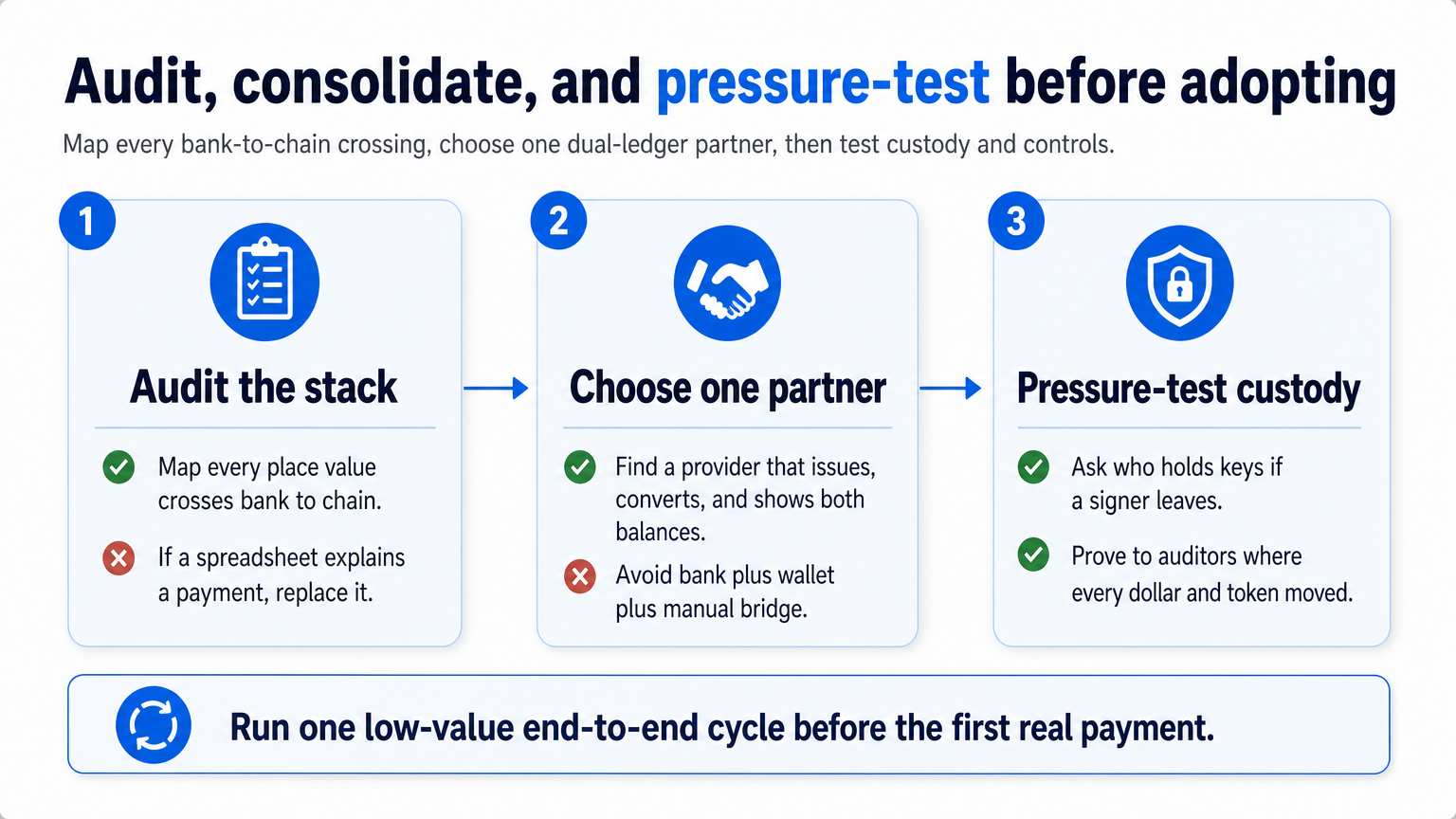
Audit your current fiat‑crypto payment stack
Map every place value crosses between a bank and a chain: who initiates it, what it costs, how long it takes, and how it hits the ledger. Then apply this rule: one reconciliation system, not two. If a payment requires a spreadsheet to explain, it belongs on the list to replace.
Evaluate a banking partner that natively speaks both ledgers
Look for one provider that issues the account, executes the conversion, and exposes both balances in a single view, rather than a bank plus a wallet plus a manual bridge. This is the design OneSafe builds for: a single platform for fiat and crypto with multi-currency accounts in USD, Euro, and CAD, free USDC deposits and withdrawals, ACH and wire rails, and worldwide FX — with banking services delivered through partner banks rather than as a licensed bank itself.
Pressure‑test security and custody for business‑grade stablecoin flows
Consumer apps optimize for a tap. Businesses need custody, permissions, and an audit trail. Ask three questions: who holds the keys, what happens if a signer leaves, and can you prove to an auditor where every dollar and token moved? Post-Binance-hack, the bar on custody and withdrawal controls is higher than most teams assume — our breakdown of that breach covers the control gaps worth checking. On OneSafe specifically, digital assets are held via Fireblocks custody and MFA is mandatory at signup, with customizable roles and permissions for DAOs.
Pre-adoption checklist
- Confirm which entity signs and who holds withdrawal authority
- Document conversion rates and all-in fees, including FX and wires
- Verify accounting integration and export format before the first payment
- Run one live low-value end-to-end cycle (on-ramp → payment → off-ramp)
- Confirm jurisdiction eligibility and KYB requirements up front
What to Watch Next: Open Questions
Will more fintechs follow OnePay’s consumer play?
Likely, and quickly — the feature is now a competitive expectation rather than a differentiator. The interesting question is whether followers extend it to business accounts or leave the commercial side to specialists. If you publish this beat for customers or a board, keeping a daily cadence is now part of the job; tools like Joyrise plan, write and publish illustrated SEO articles to your Webflow blog every day.
How will regulators treat stablecoin balances inside insured accounts?
This is the open seam. A dollar credited to a checking account behaves like a deposit, but the underlying mechanics differ from a conventional deposit; the Brookings comparison of payment stablecoins and tokenized bank deposits is a useful primer on why the distinction matters. Access questions are still being litigated, as the Custodia Supreme Court case illustrates.
When will business checking accounts get the same instant USDC rails?
No announced date. The consumer version is live; the business version is the one that matters for treasury, and nothing in the November 3 report commits to it.
Quick Answers for Finance Teams
What is a crypto bank?
An institution or platform that combines account and payment services with crypto custody, conversion, or trading. The label is increasingly applied to fintechs that partner with banks rather than hold a bank charter themselves.
What is a stablecoin bank?
A provider that treats stablecoin balances as a first-class part of the account — accepting stablecoin deposits, holding them or converting to fiat, and letting customers spend from a single balance. OnePay's new flow is a consumer example.
Why crypto bank?
Because the alternative is operating two systems — a bank for fiat, a wallet or exchange for on-chain value — and paying the reconciliation tax on every transfer between them.
Are cryptocurrencies regulated?
Yes, but by activity rather than by asset: banking, money transmission, and securities rules can each apply, and the perimeter differs by jurisdiction. The FDIC's 2025 letter and the OCC's stablecoin rule are two of the pieces relevant to account providers.
What does OnePay’s move mean for crypto banking?
It moves stablecoin-to-fiat conversion from a trading action into a deposit action for mainstream U.S. consumers. For businesses, it sets an expectation of instant, fee-light settlement that crypto-friendly banking providers will be measured against.
How can stablecoins improve business banking?
Faster cross-border settlement, fewer intermediary hops, programmable payouts to global contributors, and 24/7 availability instead of banking-hours cut-offs — provided the on- and off-ramps are handled by a provider you trust.
What should a business consider when adopting stablecoin deposits?
Custody and signer controls, all-in conversion costs, accounting treatment and export, jurisdiction eligibility, KYB documentation, and a tested fallback if a conversion is delayed.
Key Takeaways
- OnePay began letting select U.S. customers deposit USDC into checking as dollars from October 30, 2026, reported by PYMNTS on November 3, 2026, with no conversion fees at launch.
- OnePay cited roughly $1.79 trillion in adjusted stablecoin transaction volume in June, up 125% year over year — volume that increasingly reflects settlement, not trading.
- For finance teams, the relevant shift is that stablecoin-to-fiat conversion is becoming a deposit rather than a trade, which removes the lag that made crypto treasury management expensive.
- Before adopting stablecoin deposits, confirm custody, signer permissions, all-in fees, and accounting export — and run one live low-value cycle end to end.
- No business-account equivalent has been announced; treat consumer milestones as a signal of direction, not as available infrastructure.
If your business needs fiat and on-chain money in one account, you can open a OneSafe account and start the fully digital onboarding process.
Get started with Crypto in minutes!
Get started with Crypto effortlessly. OneSafe brings together your crypto and banking needs in one simple, powerful platform.