OpenAI’s launch of ChatGPT payments on November 13, 2026, marks a genuine milestone for autonomous commerce. The company introduced a wallet that lets its AI agent complete purchases through Visa, Mastercard, and American Express, turning a conversational assistant into a spending machine (Cointelegraph via TradingView, November 13, 2026). But for finance leads at global startups, Web3 businesses, and DAOs, the card-rail reveal is only half the story. The more consequential shift will be the inevitable move to stablecoin payments—a rail purpose-built for the speed, programmability, and cross-border cost structure that agentic commerce demands.
Table of Contents
- What Just Happened: AI Agents Get a Card Wallet
- Why Stablecoin Payments Are the Native Rail for Agentic Commerce
- Actions for Finance Leads This Quarter
- What to Watch Next: The Agent‑Payment Protocol Stack
- Key Takeaways
- Sources
What Just Happened: AI Agents Get a Card Wallet
OpenAI’s ChatGPT wallet lets its AI agent make purchases directly in chat, partnering with American Express, Mastercard, and Visa. Users authorize transactions via facial recognition or fingerprint; for each approved payment, the networks generate tokenized card credentials so neither the merchant nor the agent sees the actual card number. The service is initially available to ChatGPT Pro subscribers in the US with eligible US-issued cards.
The launch places OpenAI alongside Google’s Agent Payments Protocol (AP2), introduced in 2025, and separate card-network initiatives for AI-initiated transactions. OpenAI says it plans to allow purchases within preset limits without per‑transaction approvals and is working to integrate with existing checkout systems.
How will AI agents pay? Today, ChatGPT relies on tokenized card credentials on legacy card rails. Google’s AP2 aims for a dedicated protocol that can route value across multiple rails, including stablecoins. Both signal that agent-to-merchant and agent-to-agent payments will be multi‑rail and multi‑protocol.
Why Stablecoin Payments Are the Native Rail for Agentic Commerce
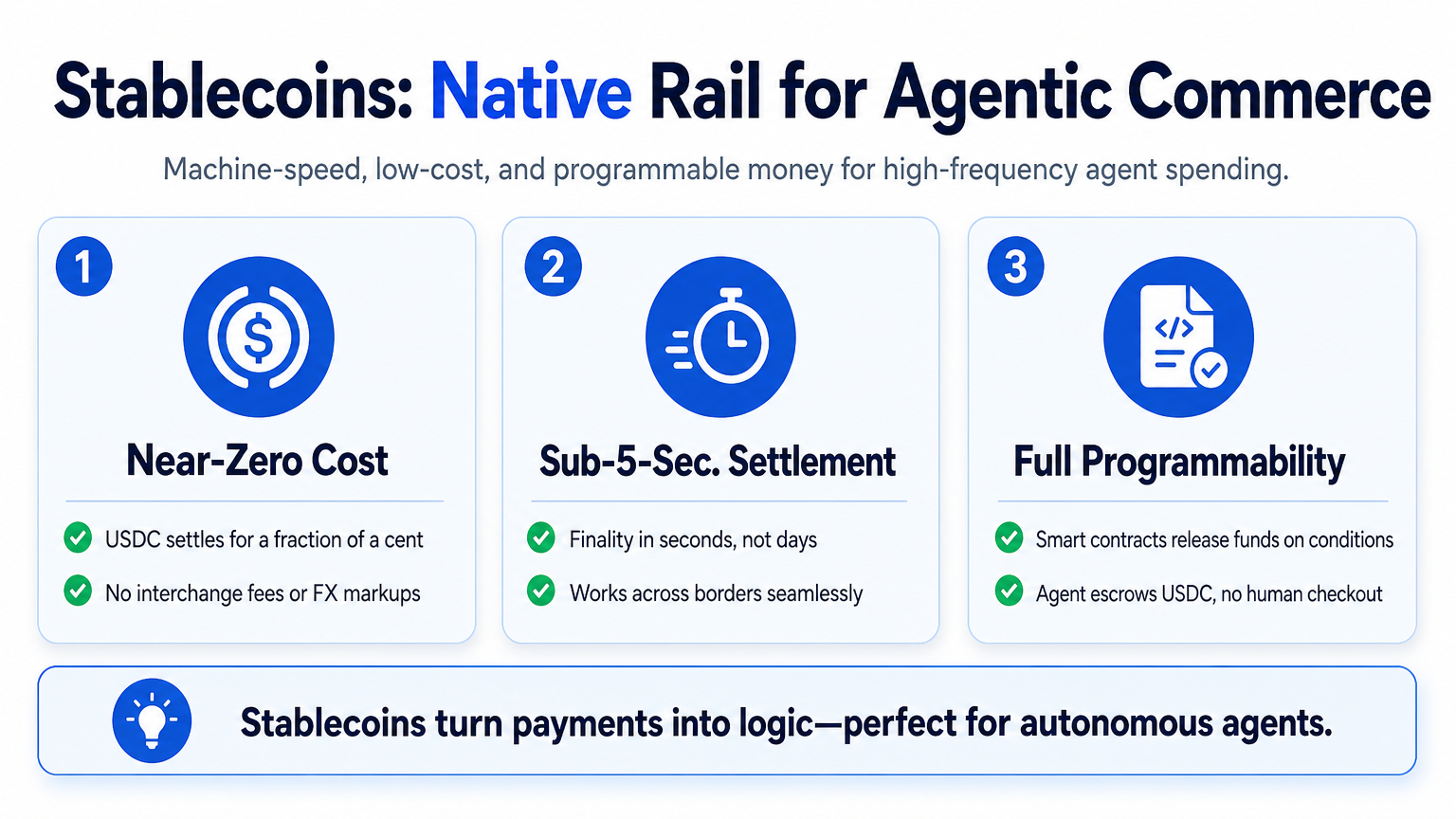
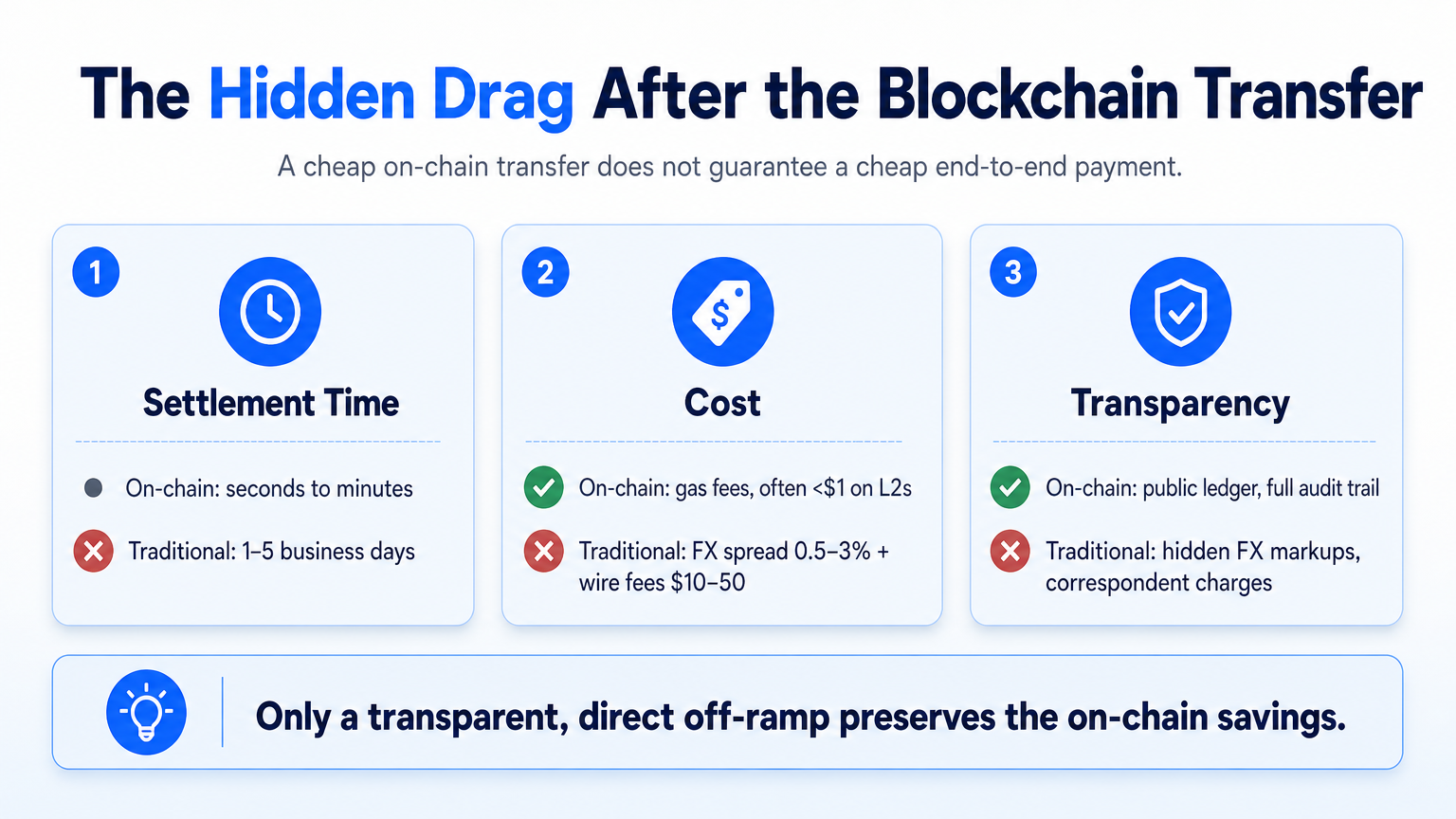
When an AI can autonomously execute purchases, the unit economics of a payment shift. An agent might make dozens of tiny, high-frequency transactions—subscriptions, API credits, micro‑data purchases—where round‑trip cost and settlement time become critical. Card networks carry structural overhead: interchange fees, cross‑border FX markups, and multi‑day settlement. That makes them poorly suited to machine‑speed, low‑margin spending. For cross-border stablecoin payments, the cost difference is stark: USDC settles in seconds for a fraction of a cent, regardless of borders.
In late 2026, solid infrastructure is in place. Stablecoin transaction volumes have surged, accounting for more than 18% of total blockchain payment volume by some measures. Major processors—Stripe, Circle, Visa, Paxos—have built stablecoin payment APIs, on‑ramps, and off‑ramps. Regulatory clarity is progressing: the GENIUS Act and equivalent frameworks define payment stablecoins, and Circle frames USDC as a consumer utility. Traditional banks are moving, too: in October 2026, PNC launched a USDC payment settlement pilot for corporate treasury, proving stablecoin rails for business‑critical flows (OneSafe).
Programmable payments meet programmable agents. A credit card is a payment instrument; a stablecoin on a smart‑contract chain is programmable money. Programmable payments let an AI agent escrow USDC into a smart contract that releases funds only when a condition is met—say, on‑chain data delivery—without a human touching a checkout page. This is the essence of stablecoin payment orchestration: value moves automatically based on logic, not batch files.
DAO treasury management already leads here. Crypto‑native organizations have run programmable treasuries for years, paying contributors in USDC, settling operational expenses through multi‑sig wallets, and using platforms that offer secure custody via Fireblocks custody and automated workflows. For them, AI agents that can autonomously spend on‑chain are a natural extension—provided their financial stack can handle agent‑initiated streams without manual approval bottlenecks.
Actions for Finance Leads This Quarter

The OpenAI ChatGPT payments wallet is a working consumer implementation. It will accelerate pressure on B2B payment infrastructure. Start with a payment rail audit that doesn’t assume future spending will look like today’s.
Are stablecoin payments safe enough for business‑critical, autonomous spending? Safety depends on the asset, custody, and operational controls. USDC is a regulated, fully reserved stablecoin. Custody is the critical variable: for autonomous spending, agents must never hold private keys directly. Instead, they should interface with a platform that uses institutional‑grade custody—Fireblocks custody or equivalent—and enforces multi‑factor authentication and spending limits. On the operational side, agent spending policies must be embedded in smart‑contract rules that cap amounts, restrict counterparty addresses, and require multi‑signature approval above a threshold. Built this way, a stablecoin‑based agent payment flow can be more auditable and controllable than a shared credit card with a monthly limit.
Audit your payment rails for agent compatibility. For each payment type, ask whether an agent could execute it with the same cost and latency if it needed to do it ten times a day. Card payments fail on FX and settlement; wire transfers fail on speed and cost. Only a well‑integrated stablecoin rail passes consistently, with a crypto - fiat on‑ramp that lets agents convert and settle in the payee’s preferred currency.
Understand the security and compliance stakes when machines spend. Compromised agents could trigger thousands of micro‑transactions before human review. Apply zero‑trust principles to agent spending: least privilege, time‑ and amount‑gated tokens, real‑time anomaly detection. Compliance demands that every on‑chain agent payment be attributable to a known, KYC’d entity, which requires a platform that securely links a business’s identity to its on‑chain settlement accounts.
Build on infrastructure that handles both worlds. No business will go entirely card or entirely on‑chain overnight. The ideal is a financial operating system that combines fiat accounts, corporate cards with spend limits, ACH and wire capabilities, and direct‑to‑chain stablecoin settlement with institutional custody—all with programmable access an agent could eventually tap. Platforms like OneSafe, which provide multi‑currency fiat accounts, corporate cards, and USDC settlement with Fireblocks custody for crypto assets, demonstrate an agent‑ready treasury architecture. The goal: a single dashboard where a finance lead sees both a card payment authorized by an AI agent and a USDC settlement the same agent triggered on‑chain, with consistent reporting.
What to Watch Next: The Agent‑Payment Protocol Stack
OpenAI’s card‑based wallet is a necessary first step. Google’s AP2 shows where the industry is heading: a dedicated protocol stack that abstracts away the settlement rail, letting agents negotiate and pay via what makes the most economic sense—often a stablecoin. Expect custody providers to ship agent‑optimized APIs where a digital wallet can execute a USDC transfer on‑chain, sign a message, and report the result without a human in the loop, all inside a permissioned environment. Regulators, too, will move from “what is a stablecoin?” to “what rules apply when a machine spends one?” Finance leads who treat the OpenAI news as a one‑off feature will miss the infrastructure shift already underway.
Key Takeaways
- OpenAI’s November 13, 2026 launch of AI agent payments on card networks makes autonomous spending tangible, but card‑rail overhead is poorly suited to machine‑speed, cross‑border commerce.
- Stablecoin payments offer near‑zero cost, sub‑five‑second settlement, and full programmability—making them the natural rail for high‑frequency, low‑value agent‑initiated transactions.
- Finance leads should run a cost‑and‑latency audit of their payment stack, trial a USDC payment settlement for a single recurring payment, and draft an agent spending policy this quarter.
- Security for autonomous spending demands institutional‑grade custody (Fireblocks custody or equivalent) and strictly gated, tokenized authorization per transaction—not a credit card with a high limit.
- The evolution from card networks to agent‑to‑agent stablecoin protocols is visible in Google’s AP2 and in DAO treasury management operations that already use USDC; platforms that bridge fiat and crypto seamlessly will be the command centers for this shift.
For teams looking to educate their audience on these shifts automatically, Joyrise: grow organic traffic while you sleep: Joyrise analyzes your site, then writes and publishes SEO articles to Webflow, WordPress or Shopify every day. Your first article is written before you pay.
Start building the treasury infrastructure that can accept, settle, and report on machine‑driven payments today—open an account with OneSafe to manage both fiat and crypto from a single platform.
Sources
- AI Agent Payments Infrastructure Wallets, Cards & Payouts ...
- AI Agent Payments Explained
- Payments AI Agent
Get started with Web3 transactions in minutes!
Get started with Web3 transactions effortlessly. OneSafe brings together your crypto and banking needs in one simple, powerful platform.