The Financial Services Commission announced a government bill for the Digital Asset Industry Act that permits won-denominated stablecoin issuance starting from bank-led consortiums and limits the major shareholder stake in virtual asset exchanges to 20% in principle, with a maximum of 34%. The bill also allows domestic digital asset issuance and sale (ICO), provided sufficient information disclosure is made. Key issues, such as whether shareholding regulations apply to parent companies, have been passed on to National Assembly deliberations and enforcement decrees.
On the 24th, the Financial Services Commission held a virtual asset committee meeting chaired by Chairman Lee Eui-won and released the government bill for the "Act on Innovation of the Digital Asset Industry and Protection of Users (Digital Asset Industry Act)," which is the second-stage legislation for virtual assets. The industry law covers everything from the definition of digital assets to stablecoin issuance requirements and ownership diversification regulations for virtual asset exchanges, including user protection and business conduct regulations.
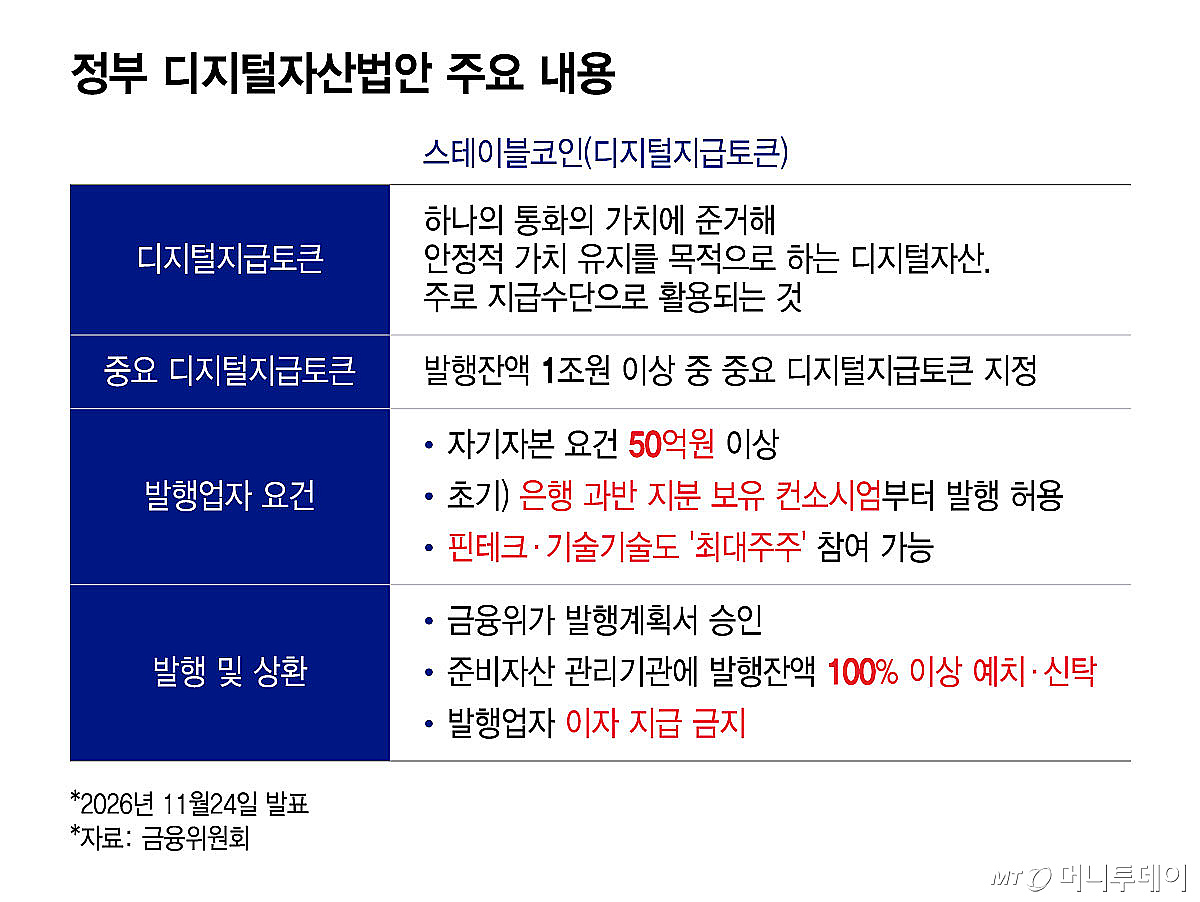
Most importantly, a legal framework has been established for issuing won-denominated stablecoins. The government bill defines stablecoins as "digital assets that aim to maintain stable value by pegging to a single currency value and are primarily used as a means of payment," and designates the legal term as "digital payment token." Stablecoin issuance will be permitted starting from consortiums in which banks hold a majority stake and possess own capital of 5 billion won or more. Fintech and technology companies can also participate in the consortium as major shareholders.
The Financial Services Commission decided to delegate specific shareholder composition requirements to an enforcement decree so that non-bank consortiums can also issue stablecoins once the system is established. Foreign issuers under the supervision of their home country's regulatory authority can issue and redeem stablecoins domestically after establishing a domestic branch and registering with the Financial Services Commission. For example, U.S.-based Circle would be able to establish a Seoul branch and issue USDC after going through registration and notification with the Financial Services Commission.
The procedures for stablecoin issuance and standards for managing reserve assets have also been disclosed. Issuers must obtain approval from the Financial Services Commission for an issuance plan that includes details such as issuance volume and limits, and must deposit or entrust 100% or more of the outstanding balance in highly liquid assets such as deposits and government bonds with a management institution like a bank. The Financial Services Commission can designate "important digital payment tokens" among stablecoins with an outstanding balance of 1 trillion won or more, taking into account their impact on financial stability and monetary policy.
Virtual asset exchanges such as Upbit and Bithumb are expected to be subject to a maximum shareholding limit of 34% per shareholder as digital asset platform operators going forward. The government bill sets the legal cap on stock ownership at 20%, in line with regulations for alternative trading systems (ATS) in the capital market, but an enforcement decree will allow an exception permitting ownership up to 34% with Financial Services Commission approval.
Yoo Young-jun, Director of Digital Finance Policy at the Financial Services Commission, said in a briefing on the day, "What the Financial Services Commission is looking at is the major shareholder of the exchange." He added, "We will review up to major shareholders and parties with special relationships, and (in cases where a company becomes a wholly-owned subsidiary through mergers and acquisitions) we will look at the owning shareholders of the exchange." He further explained, "If ownership diversification regulations are violated, the Financial Services Commission can issue corrective orders, etc., and violations must be resolved to obtain other licenses or permits." The policy is to determine whether regulations apply to friendly shares and parties with special relationships, such as co-founders, through an enforcement decree.
The practice of circumventing issuance through overseas foundations will also be improved by institutionalizing domestic digital asset issuance. Issuers who create digital assets must prepare a digital asset whitepaper and report the ICO to the Financial Services Commission. Similar to filing a securities registration statement for an initial public offering (IPO) in the capital market, details such as the issuer, total issuance volume, and risks must be included.
Under the Digital Asset Industry Act, digital asset businesses are divided into five categories by function: △trading △brokerage △custody △platform operator (exchange) △and operation. Trading, brokerage, and custody operators are subject to a licensing system, operation operators to a registration system, and platform operators to a designation system for entry regulations. Existing businesses such as Dunamu and Bithumb must also go through procedures, including submitting documents to the Financial Services Commission, in accordance with the new entry regulations.
User protection and business conduct regulations will also be strengthened. Digital asset businesses will be subject to obligations under the Financial Consumer Protection Act, such as duty of explanation and prohibition of undue solicitation, and will have obligations to protect user property, including prohibitions on offsetting or seizing user assets. In the event of hacking or computer system failure accidents, operators will bear no-fault liability for damages to users, and if an accident occurs due to a violation of computer safety obligations, punitive surcharges of up to 10% of sales revenue will be imposed. Regulations on unfair trading, such as use of undisclosed material information and market manipulation, have also been supplemented.
Although the government bill has been released, National Assembly passage and the enactment of subordinate regulations remain before institutionalization. Director Yoo said, "We have consulted with the National Assembly through various channels and will actively support legislative deliberations in the National Assembly."