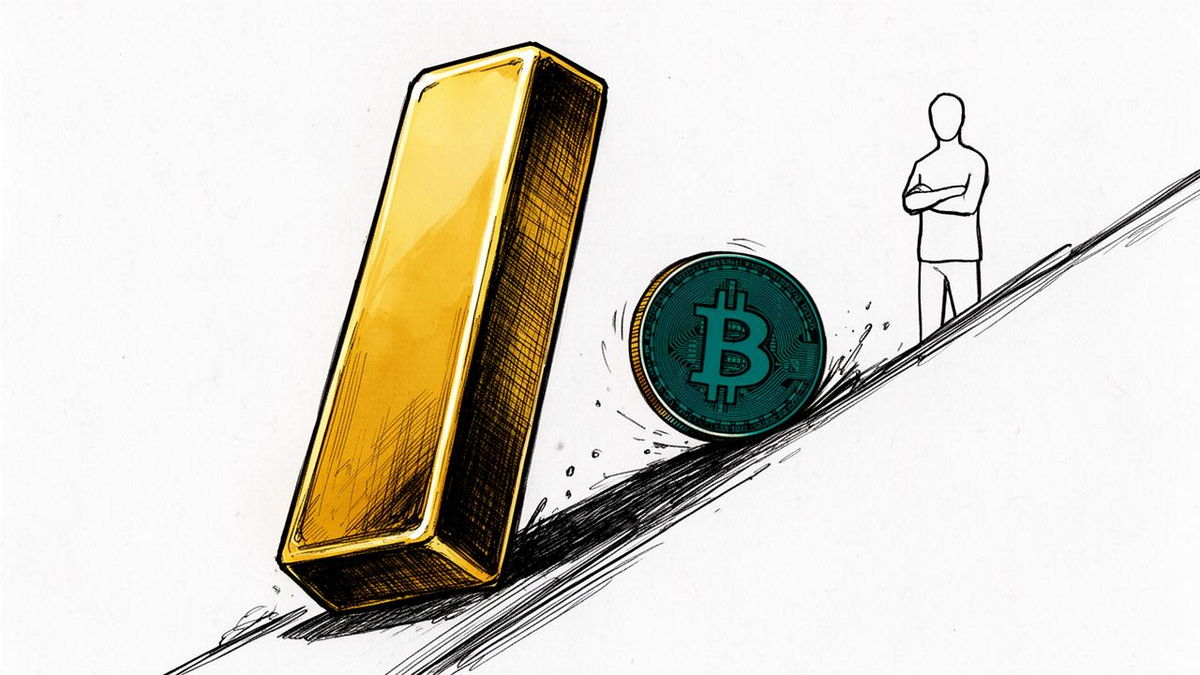
Peter Schiff, chief economist at Euro Pacific Asset Management and one of the most persistent critics of digital assets, renewed his call for Bitcoin holders to exit on Tuesday, arguing that the token's failure to hold the $75,000 level while other risk assets rallied points to further losses.
Bitcoin traded as low as $73,664 during the session before recovering to close around $75,223, a gain of 0.86% on the day, according to market data. The modest advance masked a wider divergence: the S&P 500 climbed 2.3%, the Nasdaq Composite added 2.7%, the Dow Jones Industrial Average rose 2.2%, and spot gold pushed past $4,100 an ounce.
"In case Bitcoiners haven't noticed, the stock market is up big today, including tech and precious metals mining stocks, plus gold and silver. Yet Bitcoin is down again, trading below key support at $75K. Make sure to sell before it closes," Schiff wrote in a post on X. He added that there is "a short window before the crash."
Schiff has made the same argument repeatedly over the past year. In July he said he regretted not buying Bitcoin early but predicted more investors would regret failing to sell above $60,000, when the token was near $62,852. In August he declared that the "Bitcoin party is over," then dismissed a climb above $72,000 as a "fakeout, not a breakout" and urged holders to rotate into gold. Days before his latest post, he labeled Bitcoin a bubble and advised selling "before the air comes gushing out" as AI-linked equities slid and the midterm elections reshaped Washington.
Those earlier calls have not been borne out. Bitcoin has traded well above the $60,000 threshold he flagged in July, and whether the current warning proves prescient hinges on whether the token can reclaim $75,000.
Schiff also pointed to performance since the midterm elections. U.S. stocks are roughly flat over that stretch, he said, while Bitcoin has lost more than 4%. Gold is up more than 5% and silver nearly 7% in the same period, with gold mining stocks ahead by more than 18%. He described the gap as "a sign of things to come" and told investors to position accordingly.
In a separate post, Schiff turned to inflation, saying the consumer price index rose 0.4% in October and has climbed 4.15% in 2026 with two months remaining. That puts the year on pace for 5% inflation, he argued, and he contended that price pressures have worsened under President Donald Trump. The figures are Schiff's own claims drawn from his posts.
He further noted that Bitcoin has never posted declines in two consecutive calendar years across its 18-year history. The token fell 6.34% last year and is already down 16.5% in 2026, he said, warning that back-to-back annual losses would break sharply from the historical pattern and that a lower finish in 2027 would mark three straight down years.
Note: Figures are as described by Schiff in his posts on X.
The divergence matters for investors because it challenges the long-running thesis that Bitcoin behaves as a hedge or a high-beta play on liquidity. When equities, precious metals and miners all advance while the largest cryptocurrency stalls below a widely watched support level, momentum and trend-following funds have a reason to trim exposure. A sustained break under $75,000 could accelerate outflows into gold and gold miners, which have already absorbed capital during the latest rally.
Schiff's record cuts both ways. His repeated sell calls through 2026 have so far preceded higher prices, which limits how much weight traders may give the latest warning. Still, the relative weakness he highlights is measurable, and the token's inability to participate in a broad risk-on session is the kind of data point that can shift positioning even among investors who dismiss his broader case against Bitcoin.